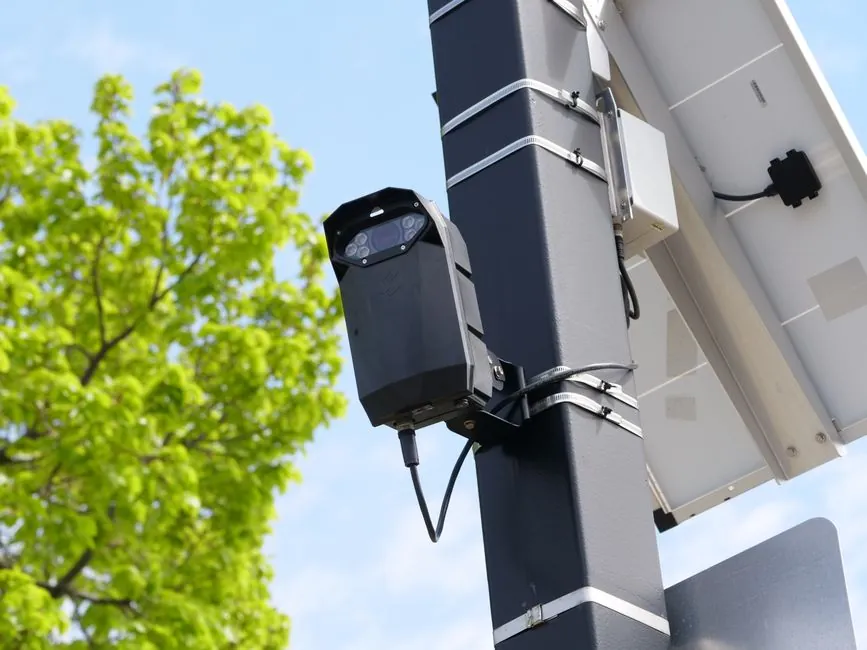
A fully programmable industrial camera is distinguished by editable imaging logic, application tools, and I/O behavior, while a fixed-function smart camera operates within a narrower, predefined performance envelope [S1][S4].
The distinction concerns application control rather than camera count alone: both architectures can use a single imager, processors, communication electronics, and industrial I/O, but their software boundaries differ substantially [S2][S3].
Architecture Defines the Degree of Control
A smart camera normally combines at least 3 core elements: an image sensor, a processing chip such as a CPU, DSP, or FPGA, and some form of I/O [S3]. Integrated smart-camera products can also combine lighting, optics, image capture, processing, and communication in one housing [S2].
The output boundary provides a sharper technical distinction than the presence of a processor alone. A conventional camera primarily delivers images, whereas a smart camera primarily produces a decision or information after performing its configured vision algorithm on the device [S3]. That decision may be a pass/fail report sent to a database, a digital signal that triggers sorting equipment, or a serial command sent to a PLC [S3].
The fixed-function variant is often called a vision sensor. Its performance envelope is limited and fixed, while a smart camera offers tools and sufficient flexibility to be programmed for multiple imaging algorithms and application functions [S1]. The fully programmable industrial camera is therefore not simply a smart camera with a faster processor. Its defining feature is the depth of user access to algorithms, tools, triggers, I/O, and runtime behavior.
Programmability Changes the Inspection Workflow
A fixed-function smart camera is suited to a narrowly defined task such as barcode verification, presence detection, or a standardized inspection, with configuration focused on selecting among supplied capabilities [S1][S3]. A fully programmable camera can support barcode reading, geometric pattern matching, color analysis, line detection, and particle analysis within one inline inspection application [S3].
A smart camera typically includes an image sensor, a processor, and some type of I/O, with optional features such as direct-drive lighting control, industrial I/O, and a display port [S3]. Those figures demonstrate workflow density rather than a universal throughput specification. Actual cycle time still depends on image resolution, algorithm mix, field of view, lighting, trigger frequency, and the processor selected for the camera.
Smart-camera software can expose tools through a user-friendly interface without requiring extensive machine-vision programming experience [S2][S7]. That lower barrier is not equivalent to full programmability. It means an operator can configure supplied tools and parameters; it does not establish that the user can add a custom algorithm, modify the execution environment, or create new application logic. The distinction should be verified in the product documentation, SDK, or development environment rather than inferred from a “smart” label [S4].
Decision Criteria Across the Main Camera Types
Fixed-function smart cameras, fully programmable smart cameras, and PC-based industrial vision should be compared on 4 criteria: application logic, I/O control, deployment complexity, and expansion capacity. The industrial camera category offers greater programmability and flexibility for complex tasks than more restricted smart-camera configurations [S4].
PC-based systems normally offer the widest application range, while smart cameras can be deployed as a single unit [S1]. An embedded vision computer provides a middle arrangement: it has frame storage and processing intelligence, but remains tethered to the camera and often contains fixed, application-specific routines [S1].
Best-Fit Applications and User Profiles
A fixed-function smart camera fits operators and maintenance teams that need repeatable barcode reading, presence checks, or predefined quality inspection without maintaining custom application code [S1][S2]. A fully programmable industrial camera fits vision engineers and controls integrators who need to adapt inspection logic, coordinate triggers and lighting, and connect decision outputs to machinery or plant data systems [S3].
The all-in-one camera is also a practical choice where space is constrained, wiring must remain simple, or low-latency local decision-making matters [S2]. On-device analysis can reduce image-data transfer and provide immediate feedback, while PC-based systems introduce a transfer step between acquisition and processing [S2].
A fully programmable camera is not the automatic choice for every single-station task. If the requirement can be met through a limited set of supplied tools, a fixed-function unit may reduce deployment effort and avoid unnecessary software complexity [S7]. Conversely, a PC-based architecture is usually preferable when multiple synchronized cameras, extensive custom processing, or continuously changing algorithms justify the greater infrastructure [S1][S4].
Constraints, Failure Modes, and Commissioning Traps
A smart camera is a self-contained unit, whereas a traditional PC-based machine vision approach may use cameras connected directly to a PC or a frame grabber or other intelligent image-processing board or vision engine that plugs into the PC [S1].
Customization also carries limits. More programmable does not mean unlimited throughput. A camera executing barcode reading, pattern matching, color analysis, line detection, particle analysis, triggering, lighting control, and communications may reduce processing headroom compared with a narrowly configured unit [S3]. Procurement should therefore request measured cycle time under the intended algorithm mix rather than relying on camera bandwidth alone.
PC-based designs introduce different failure paths: image transport can create bandwidth bottlenecks, particularly for high-resolution or high-frame-rate video, while separate components require more space, connectivity, and maintenance [S2]. A smart camera specification sheet should be checked for supported protocols, trigger modes, lighting outputs, result types, and SDK access, while an industrial camera specification should be reviewed for the actual programmable tools and I/O behavior.
Sourcing Criteria for a Definitive Comparison
Specify “fully programmable” as an engineering requirement, not a marketing term. Require the supplier to identify the processor architecture, supported development language or environment, editable algorithm library, trigger modes, I/O map, supported communication protocols, and restrictions on user-created functions [S1][S3][S4]. A camera with a CPU, DSP, or FPGA and built-in I/O meets the baseline smart-camera definition, but the SDK and application toolset establish its actual programmability [S3].
Use 4 acceptance tests during selection: modify a parameter outside the factory task, execute a custom inspection routine, trigger an external device from the camera’s decision output, and document the processing time at the specified resolution and frame rate. The first 3 tests separate configurable products from programmable ones, while the fourth exposes the performance cost of a more complete algorithm set [S3].
For multi-camera work, confirm whether each camera must operate independently or whether synchronization and shared processing are required. Independent smart cameras can provide distributed decisions, while PC-based systems generally provide the stronger route for multiple camera inputs and centralized workflows [S1]. Environmental and mechanical requirements should be checked separately, including operating temperature, enclosure protection, illumination, and mechanical shock limits.
The next verifiable node is a vendor demonstration using 1 representative production image set, the intended trigger rate, and the required pass/fail or sorting output; record algorithm configuration time, inspection cycle time, I/O latency, and recovery behavior after a communications interruption.