
Choosing a gas chromatograph and its column is a four-axis decision: stationary-phase polarity, column length, internal diameter (ID), and film thickness, with the detector class and carrier-gas choice locked in afterward [S3][S4]. Capillary columns in fused silica dominate modern GC; packed columns (stainless or glass, 2-4 mm ID, 0.5-5 m long) survive only in official methods, large sample loops, and fixed-gas analysis where their higher sample capacity and contamination tolerance outweigh resolution losses [S3].
Resolution scales with the square root of plate count N, so doubling column length buys only a factor of ~1.41 in resolution while roughly doubling head pressure, run time, and column cost [S4]. That trade-off, not raw plate count, is what should drive a sizing decision in any QC, environmental, or research lab.
Column Length: 10-15 m vs 30 m vs 50-60 m
Three column lengths cover ~90% of bench-GC work: 10-15 m for fast screening and high-MW analytes, 30 m as the default, and 50-60 m for complex multi-component matrices [S4]. Doubling length raises N in proportion, but head pressure and purchase price also scale nearly linearly, so length is the right dial to turn only when stationary phase, ID, and film thickness have already been optimised [S4].
For method development on an unknown sample, start at 25-30 m to balance speed and resolution, then escalate to 50-60 m only if shorter tactics fail [S4]. Specialised assays such as fatty-acid methyl esters (FAME) by China GB 5009.168-2016 and GB 5009.257-2016 push to 100 m highly polar columns because cis/trans isomers and chain-length homologues cannot be resolved in shorter formats [S4].
Internal Diameter: 0.1 mm, 0.25 mm, 0.32 mm, 0.53 mm
Capillary IDs span 0.1-0.53 mm, with 0.25 mm as the workhorse for most general methods and 0.53 mm (wide-bore) reserved for dirty matrices, large on-column injection volumes, and direct replacement of packed-column methods [S3]. Efficiency per metre (N/m) rises as ID shrinks, so a 0.1 mm micro-bore column can deliver the same plate count in a fraction of the length, at the cost of much higher head pressure, lower sample capacity, and tighter injection-volume tolerances [S4].
A 0.32 mm ID column is a common compromise in environmental and food labs that need a 1-2 µL splitless injection without the back-pressure penalty of 0.1-0.18 mm formats. Rule of thumb from the column-selection literature: narrower ID increases resolution and lowers detection limits, but reduces loading capacity and tightens the carrier-gas flow window [S3][S4].
Film Thickness: 0.1 µm to 5 µm and the 5/95 Rule

Film thickness is the dominant dial for retention and sample capacity. Standard films (0.25-0.5 µm) handle the broad mid-range of volatile and semi-volatile methods [S4]. Thick films (1-5 µm) are specified for volatile solvents, gases, and very small early-eluting molecules, where thicker stationary phase increases interaction time and prevents analytes from co-eluting with the solvent front [S4].
A useful numeric anchor: at a given temperature, retention grows roughly proportionally to film thickness, while sample capacity scales even faster.
Stationary Phase Polarity: 5% Phenyl, Mid-Polar, and PLOT
Stationary-phase chemistry is decided by analyte polarity, not by column dimensions. Non-polar 100% dimethyl polysiloxane (e.g. 100%-methyl) columns separate by boiling point only, ideal for hydrocarbon and simulated-distillation work [S3][S5]. Low/mid-polarity 5%-phenyl-arylene-95%-dimethyl polysiloxane phases (the "5" column) handle semi-volatiles, drugs, pesticides, and the bulk of USP <621> methods [S3]. Mid/high-polar phases such as 50%-phenyl-50%-cyanopropyl, polyethylene glycol (PEG), or cyanopropylphenyl cover alcohols, fatty acids, amines, and FAME cis/trans isomers [S3][S4].
For permanent gases and highly volatile light hydrocarbons, use a Porous Layer Open Tubular (PLOT) column (alumina, porous polymer, molecular sieve) rather than a wall-coated column, because gases do not partition meaningfully into a liquid film [S3]. A practical shortlist: 5-type for ~70% of GC methods, 50-type or PEG for polar small molecules, PLOT for fixed gases, and dedicated chiral or ionic-liquid phases for stereochemistry [S3][S4].
Detector Class: FID, TCD, MS, and ECD
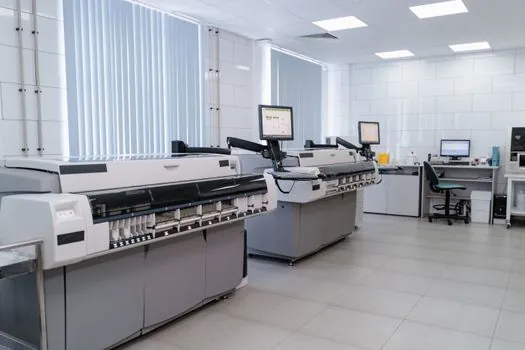
Detector choice is set by analyte class and required sensitivity: Flame Ionisation Detector (FID) for organics at sub-ppb to ppm levels; Thermal Conductivity Detector (TCD) for permanent gases and universal response; Electron Capture Detector (ECD) for halogenated pesticides, PCBs, and PCBs at sub-ppt levels; Mass Spectrometric Detector (MSD) for confirmation and full-spectrum identification [S6]. A typical QC lab pairs one FID with one TCD on the same gas chromatograph oven; an environmental lab running EPA 8081/8082 organochlorines is non-negotiable on an ECD or MSD/QQQ [S6].
Detector flow geometry also constrains column choice. MS detectors typically require 0.1-0.25 mm ID columns at 1-2 mL/min He to stay inside the high-vacuum pump capacity; TCD cells need higher reference flow and tolerate 0.32-0.53 mm columns at 5-30 mL/min. The detector is therefore a downstream hard constraint, not a free variable [S6].
Carrier Gas: He, H2, N2, and the Van Deemter Knee
Helium is the default for capillary GC because it sits near the optimum of the van Deemter curve at typical linear velocities (20-30 cm/s for 0.25 mm ID) and is compatible with all major detectors. Hydrogen gives 2-3x faster analysis at the same resolution, important for high-throughput labs, but requires safe-gas handling and reduced-thermal-conductivity detectors in some setups [S6]. Nitrogen is restricted to packed columns and TCD use; its high optimum linear velocity and low diffusivity make it inefficient on narrow-bore capillaries [S6].
Speed gains from H2 are real but bounded: above ~40 cm/s the H2 curve flattens and resolution loss is modest, while He peaks sharply and penalises over-speed. The throughput case for H2 in a 0.18 mm ID column running a 5-minute method is far stronger than for He in a 0.53 mm column running a 20-minute method [S6].
Selection Criteria: A Side-by-Side Comparison
Four candidate configurations for a new bench-GC installation, evaluated on the criteria that actually drive spec sheets:
Config A (General QC, 5% phenyl, FID): 30 m × 0.25 mm × 0.25 µm, He carrier, FID. Resolution medium-high, sample capacity medium, analysis time medium, He cost medium. Fits USP <621> assays, residual solvents, and most QC methods. Not for gases, not for low-ppb halogenated pesticides without ECD.
Config B (Environmental trace organics, mid-polar, ECD/MS): 30-60 m × 0.25 mm × 0.25 µm, H2 carrier, ECD or MSD. Resolution high, sample capacity medium, analysis time medium, H2 cost low. Required for EPA 8081/8082 PCBs/OCPs, and for any sub-ppb halogenated work.
Config C (Fixed gas / light hydrocarbon, PLOT, TCD): 30 m × 0.53 mm Al2O3 PLOT or molecular sieve, He, TCD. Resolution low-medium for liquids but excellent for C1-C5 hydrocarbons, H2, O2, N2, CO, CO2. Not for organics above C12, not for trace moisture.
Resolution high per metre, sample capacity low, analysis time short, instrument back-pressure high. Use for very high-MW or rapid-screening methods; not for dirty matrices or large-volume injection.
Who Should NOT Pick the Default 30 m × 0.25 mm × 0.25 µm 5%-Phenyl
The default 5-type 30 m × 0.25 mm × 0.25 µm He/FID configuration is wrong for: fixed-gas analysis (use PLOT + TCD); sub-ppb halogenated pesticides (use ECD or MSD on a 5-type or 1701 column); FAME cis/trans isomers (use a 100 m highly polar or 50%-cyanopropyl column); chiral APIs (use a chiral stationary phase, not a 5-type); trace water in solvents (use a PLOT or dedicated water column, not a wall-coated liquid film) [S3][S4][S6]. Picking the default for these duties is the single most common GC failure mode in newly commissioned labs.
Standards, Sourcing, and Method Validation
For pharmaceutical, environmental, and food methods, column choice is not free: USP General Chapter <621>, Ph.Eur. 2.2.28, ASTM E594, EPA 8000-series, and GB 5009-series in China each prescribe phase chemistry, dimensions, and validation criteria [S4]. Confirming that a candidate column is named in the official method, or running a method-equivalence study, is mandatory before the column is qualified in a regulated workflow [S4][S5].
Method development typically proceeds in the order stationary phase → film thickness → ID → length, with carrier-gas velocity and oven program tuned last, because phase chemistry dominates selectivity while length, ID, and film only shift efficiency and retention [S4][S5]. When a method is transferable across labs, the column (phase + dimensions + part number) is specified explicitly, not generically, to control selectivity drift between instruments [S5].
Sample Prep, Lab Integration, and Final Sizing
Sample preparation, not the column, is the limiting step in most GC workflows: headspace, solid-phase microextraction (SPME), or liquid injection each set the injection volume, split ratio, and therefore the ID and film thickness that will work [S6]. A lab running headspace for residual solvents per USP <467> should not be specified around a 0.10 mm ID column, because headspace injection volumes routinely exceed 0.1-1 mL, demanding 0.32-0.53 mm ID columns with 1-3 µm film [S4][S6].
Integration also drives sizing: the same gas chromatograph housing will often be referenced against fire-alarm control panels and other lab safety systems when a new building is commissioned, so column-changer autosamplers, detector counts, and oven ramp rates are part of the broader facility spec rather than a standalone instrument decision. For wider industrial context, the same spec-discipline logic used in strapping band selection for food and beverage lines and fire alarm control panel selection for laboratories applies: lock the duty case, then map it to a single numeric spec. Trackable signals for the next buying cycle: PLOT column demand for hydrogen-energy and biogas testing, and the migration from 0.25 mm to 0.18 mm ID micro-bore formats in high-throughput contract labs.
Spec-level background on the components involved: linear guide, and crossed roller guide.