
Polypropylene (PP) strapping accounts for roughly 65% of light-to-medium bundling applications in European food and beverage facilities, while PET strap handles the heavier outdoor pallet loads in both hot and cold climates [S1][S3].
Food and beverage packagers unitize glass bottles, cans, snack boxes, and corrugated cases with strap that must feed reliably at 40 to 60 cycles per minute, weld predictably, and tolerate wash-down environments [S3][S5].
PP Strap Spec Range and Why Virgin Grade Matters
PP strap for European food lines ships in 14 standard variants spanning 5 mm to 18 mm width, 0.47 mm to 0.80 mm thickness, and 38 Kgf to 188 Kgf break strength, with elongation at break between 10% and 25% [S3]. Core inner diameters of 152 mm, 203 mm, 280 mm, and 405 mm cover hand tools, semi-automatic, and high-speed automatic strapping machine platforms, and width tolerance is held to ±0.06 mm for consistent friction-weld feeding [S3].
Virgin-grade PP is the default for food-contact-adjacent lines because recycled resin introduces mixed molecular weight and contaminants that produce inconsistent friction welds, the dominant failure mode on automated bundlers running near 60 straps per minute [S3]. KIC markets virgin-resin strap with reduced particle shedding specifically to keep wash-down strappers cleaner, and notes RoHS certification plus ISO 9001 quality management as part of the food-grade value proposition [S5].
PET Strap for Outdoor, Cold-Chain, and Heavy Pallets
PET (polyester) strap is the standard upgrade when food and beverage loads exceed roughly 200 Kgf, when pallets sit in outdoor storage, or when the chain crosses refrigerated or deep-freeze zones down to fishing-boat and cold-store applications [S1][S3][S5]. PET maintains tension across temperature swings where PP would creep, and a 12 mm to 19 mm PET band with a 0.6 mm to 1.0 mm gauge typically replaces light steel for palletized canned goods and beverage multipacks [S1].
GlobalSpec's banding and strapping selection guide lists PET as suitable for outdoor food and beverage storage in both hot and cold climates, while still noting that PP is the lighter-cost default for indoor case sealing [S1]. The Pacific 200 to 1,400 Kgf PET operating envelope covers the upper end of beverage pallet loads, withstanding conveyor impact forces that would fracture a PP weld [S3].
Material Comparison on Four Decision Criteria
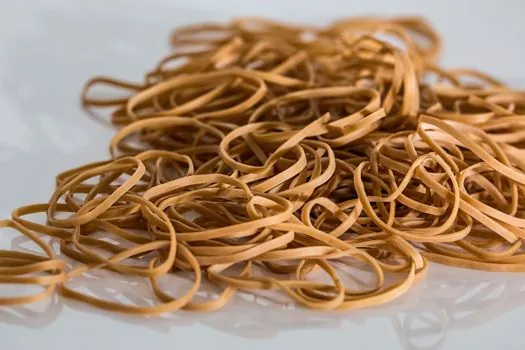
The four material families line up against food and beverage decision criteria as follows: PP scores low on tensile load ceiling (typically capped below 200 Kgf) but wins on cost per metre, indoor hygiene, and weld speed on friction-weld strapping band heads; PET scores high on tensile strength (200 to 1,400 Kgf), UV and cold tolerance, and recyclability under PPWR; steel scores high on break strength and on railroad-class securement but loses on cost, weight, and corrosion risk in wash-down zones; woven composite scores high on elongation recovery and on securing fragile high-value goods, but at a per-metre premium that is hard to justify for commodity beverage pallets [S1][S3][S4].
For most food and beverage unitizing, the practical decision tree is: PP for cases, cartons, and snack boxes under 200 Kgf in a dry or wash-down indoor line; PET for outdoor pallets, cold store, and any load above 200 Kgf; steel reserved for rail and heavy export where regulations or carrier rules still mandate metal strap [S1][S3][S4].
Equipment and Hygiene Interactions
Strapping machines in food and beverage plants must be quickly and easily cleaned along the entire process chain, which means low-particle, low-residue strap is a hygiene requirement, not a marketing line [S5]. KIC positions its virgin-resin strap specifically for cool-store packaging houses and deep-ocean fisheries, where weld residue and strap dust would otherwise contaminate the conveyor and the product zone [S5].
On the line side, strap width tolerance and core inner diameter have to match the machine; a 405 mm core on a machine specified for 203 mm will not feed, regardless of material quality [S3]. Choosing a strapping machine with documented strap cross-sections, or restricting the strap SKU list to a small number of variants, eliminates the most common cause of chronic jamming on 40 to 60 strap-per-minute FMCG bundlers [S3].
Regulatory and Standards Touchpoints
Food-contact packaging is not a single regulated strap property; the dominant food-and-beverage strap standards touchpoints are FMCSA cargo securement rules, which require that the aggregate working load limit of all securement devices be at least one-half the weight of the article being secured, and PPWR-driven recyclability expectations that both PP and PET strapping can meet when supplied as mono-material [S3][S4]. For facilities that also bundle printed point-of-sale units, RoHS certification on the strap and ISO 9001 on the supplier are the two most commonly cited quality system references [S5].
For wider facility PPE and hygiene spec context, see Food Processing Safety Shoes: Spec-First Selection Across Slip, Hygiene, and Impact, which sits on the same wash-down, hygiene-first selection logic that drives food-grade strap specification.
Who PP and PET Strap Are, and Are Not, For
PP strap is the right call for indoor case sealers, snack-box bundlers, and can multipackers running below 200 Kgf, especially where wash-down hygiene and 60-straps-per-minute friction welding dominate the operating envelope [S1][S3]. It is the wrong call for outdoor pallet storage, refrigerated deep-freeze holding, or any load above 200 Kgf where PP creep will release tension before delivery [S1][S3].
PET strap is the right call for outdoor beverage pallets, cold store, and any heavy multipack above 200 Kgf that still needs to be recyclable under PPWR [S1][S3][S5]. It is the wrong call where a friction-weld head is locked to a PP-only cycle time, or where the lowest-cost per metre is the deciding factor on a dry indoor case line [S3]. Steel and woven composite are reserved for specific transport modes or fragile cargo, not for routine food and beverage unitizing [S1][S4].
Track next: any 2026 PPWR implementing acts that tighten mono-material requirements on food-contact-adjacent strapping, and any FMCSA amendment shifting the half-weight aggregate working load limit for beverage and canned-goods pallets. Watch supplier disclosures for virgin-grade resin traceability and core-inner-diameter SKUs that match the installed strapper fleet.
For component-level specifications, see construction machinery and equipment.