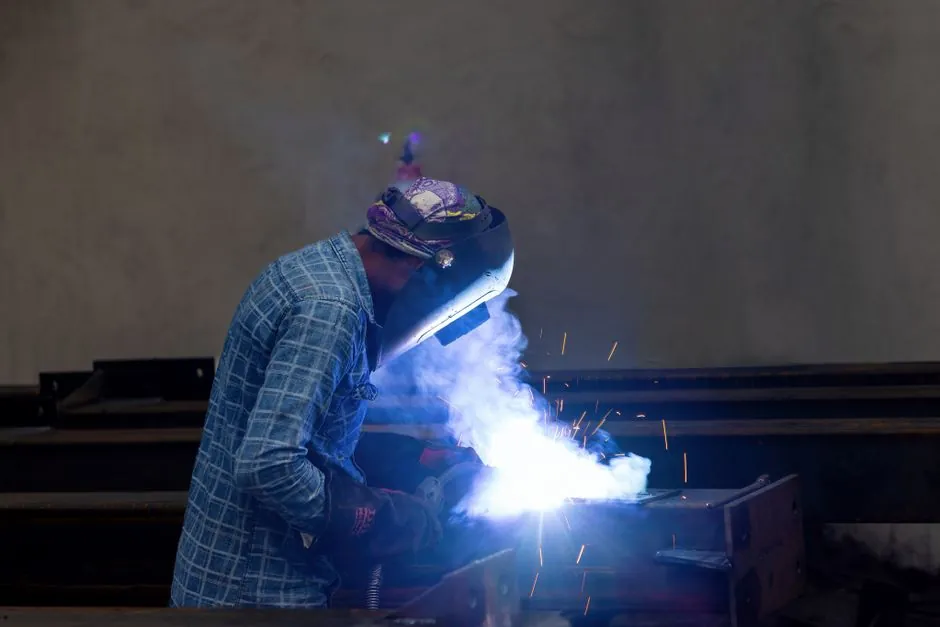
Welding and cutting cells generate the most fire-prone hot workstream in any plant: sparks and molten slag routinely travel 35 feet from the arc, per OSHA 29 CFR 1910.252 hazard guidance, and showers of incandescent particles are punctuated by miniature explosions as acetylene pre-ignites or dissimilar metals react [S3]. That travel distance is the single most important number a spec writer should anchor a gas suppression layout to, because it sets the protected radius of any fixed nozzle, the placement of any fire watch, and the spacing between the welding booth and the nearest combustible stock [S5].
The selection question is not whether to suppress, but which agent chemistry and which delivery mode (fixed total-flooding, local application, or portable/handheld) fits the fire class profile a welding cell actually presents. Class A (ordinary combustibles in surrounding racks), Class B (flammable solvents, paint thinners, fuel-gas leaks), and Class C (energized MIG/TIG power sources) can all coexist inside one fabrication bay, and each maps to a different suppression family [S1][S4].
Welding Fire Risk Profile and Governing Standards
NFPA 51B is the foundational welding-fire standard, and OSHA 29 CFR 1910.252(a) implements its four-part precaution logic (move the work, move the fuel, shield in place, or stop work) on every U.S. job site [S3]. NFPA 2001 governs clean agent total-flooding systems, while NFPA 17 and NFPA 17A cover dry and wet chemical systems respectively; these are the three codes a welding-bay suppression package will be evaluated against during FM or AHJ inspection [S4]. For fixed gas systems protecting occupied enclosures, NFPA 2001 mandates concentration limits tied to NOAEL/AEL data so the agent suppresses fire without creating a respiratory hazard for the welder inside the booth [S4].
OSHA 1910.252 also requires the Permit Authorizing Individual (PAI) to designate a trained Fire Watch whenever combustibles cannot be moved, and the watch must be equipped with appropriate extinguishers or suppression equipment (typically a water hose or a Class ABC extinguisher within reach) [S5]. This is the layer that catches the small slag-fire a fixed system would over-react to, so the suppression spec should always be written as a stack: fixed system for the bay, portable extinguishers for the cell, fire watch for the operator.
Gas Agent Options Compared: CO2, Dry Chemical, Clean Agent
CO2 systems discharge at roughly 34 bar (500 psi) stored pressure, work by oxygen displacement, and are reserved for unoccupied enclosures because the design concentration that extinguishes a Class B fire also exceeds the 7.5% physiological threshold for human exposure [S1]. They are common in welding-generator rooms and unattended switchgear rooms, but they should not be specified as total-flooding agents inside an occupied welding bay [S1].
Dry chemical ABC powder systems operate across a -20 to 120 degrees Fahrenheit ambient band, making them the most thermally tolerant factory-floor option and the dominant choice for paint booths, dip tanks, coating operations, and welding cells with solvent exposure [S2]. ABC powder is non-toxic, non-conductive, and non-corrosive, and is removed by vacuum after discharge, which matters when the protected enclosure holds live electrical gear [S2]. The tradeoff is post-discharge cleanup and visibility loss inside the cell for 30 to 60 minutes.
Clean agents (FM-200 / HFC-227ea, Novec 1230 / FK-5-1-12, and inert blends such as IG-541 / Inergen) extinguish by heat absorption or chain-breaking chemistry and leave zero residue, which is why they dominate data halls, museums, and any enclosure with sensitive electronics adjacent to the welding cell [S1][S4]. FM-200 is the most widely deployed Halon 1301 replacement, has an ODP of 0 and a GWP around 3,500, and reaches design concentration in roughly 10 seconds for Class A hazards [S2][S4]. Novec 1230 has a GWP below 1 and is increasingly specified where end-users have corporate net-zero scopes, though per-pound agent cost runs 2 to 3 times FM-200 at typical 200 to 400 cubic meter room sizes [S4].
Dual-Agent and Local-Application Systems for Welding Cells
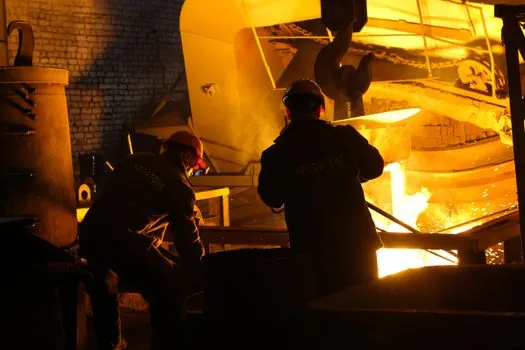
Dual-agent units combine a clean gas (typically HFC-227ea / FE-227) with ABC powder in a single heat-activated self-contained bottle, eliminating external piping and wiring while still delivering the rapid knockdown of a clean gas plus the burn-back resistance of dry chemical [S2]. This topology is common in mobile welding rigs, construction-site hot work carts, and remote pipeline tie-ins where a fixed engineered system is impractical. The CFF-800 class of unit is FM Approved and UL Listed for these duty cycles, and is representative of the dual-agent category used in field welding applications [S2].
Local-application (non-total-flooding) systems are the more disciplined choice for an open welding bay: nozzles are aimed at the workpiece and the immediate spark/slag catchment rather than trying to fill the whole room to a design concentration. NFPA 17 governs this topology, and the design rate is calculated per square foot of protected surface rather than per cubic foot of room volume. For a typical robotic MIG cell with a 6 by 6 foot weld envelope, a local-application dry chemical system at 0.5 to 1.0 lb per square foot will knock down a slag fire without forcing the rest of the bay to evacuate [S4].
Selection Criteria: Matching Agent to Welding Process
Selection should start with three binary filters. First, is the protected space normally occupied? If yes, eliminate CO2 total-flooding and stay with clean agent or ABC powder local-application. Second, is energized equipment within the hazard zone? If yes, specify non-conductive agents (clean gas, ABC powder); never specify water mist or foam on a live MIG power source. Third, what is the dominant fuel: paint solvent, hydraulic oil, magnesium alloy, or ordinary cardboard packaging? Magnesium fires cannot be suppressed by CO2 or standard ABC powder and require Met-L-X or comparable Class D agents, which are outside the gas-suppression scope entirely [S1][S2].
Once those filters pass, weight the secondary criteria. Residue tolerance: clean agent if a discharged system must not contaminate the workpiece or downstream paint line. Temperature envelope: ABC powder for unheated bays in northern climates, since dry chemical discharge tests are validated down to -20 degrees Fahrenheit [S2]. Re-ignition risk: wet chemical or ABC powder over clean gas where the fuel is a Class B flammable liquid with sustained vapor release. Discharge time: clean gas at 10 seconds for electronics, ABC at 15 to 20 seconds for fabrication cells where the slower knockdown is acceptable [S2][S4].
Integration with the Fire Watch and Portable Extinguisher Layer
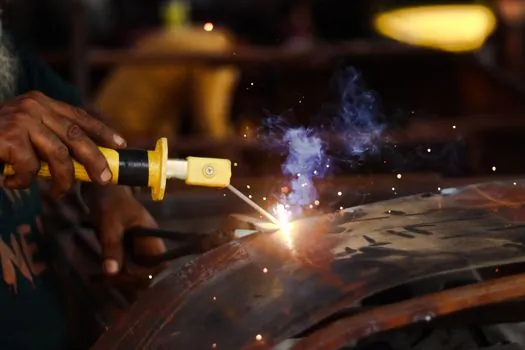
No fixed gas system replaces the fire watch. OSHA 29 CFR 1910.252 and NFPA 51B both require a designated Fire Watch whenever welding is performed within 35 feet of combustibles that cannot be moved or shielded, and the watch must be equipped with a Class ABC extinguisher of adequate rating (typically 2-A:10-B:C minimum for hot work areas) plus, where fixed systems are absent, a water hose or pressurized water supply [S3][S5]. The suppression spec should therefore always include a portable layer sized to the worst-credible incipient fire, sized so the operator can reach any point of the cell within 10 seconds walking distance [S5].
Welding operations also produce toxic combustion products, and selection of a respiratory layer falls outside the suppression decision but interacts with it: in a confined-space weld, a discharged CO2 or FM-200 system will drive an immediate evacuation, so the gas suppression spec must be coordinated with the supplied-air/SCBA provisions in the firefighter respirator selection playbook. The gas fire suppression reference page consolidates the agent chemistry, nozzle spacing, and cylinder-storage rules for each option. Handheld portable extinguishers complete the layered system; spec guidance for Class A/B/C ratings, hose length, and mounting height is captured in the fire extinguisher encyclopedia entry.
Maintenance, Inspection, and Failure Modes
Dry chemical systems need the same annual inspection but additionally require shake-testing of powder stores to prevent packing, which would prevent proper discharge after years of vibration in a fabrication shop. CO2 systems are sensitive to temperature: a cold bay sitting below 0 degrees Fahrenheit will drop cylinder pressure below the regulator setpoint and may fail to discharge, which is why CO2 is rarely specified for outdoor or unheated welding cells [S1][S2].
The dominant failure mode in welding cells is not agent leakage but detection latency. Optical flame detectors specified for welding must discriminate the 2,800 to 3,200 K arc signature from a true flame signature, and UV/IR dual-sensor units are the minimum for false-alarm rejection; a poorly specified IR-only detector will discharge the entire suppression system on every arc strike and render the bay unusable within a week. Pairing the suppression release with a fire safety audit cadence and a clear hot-work permit (per [S5]) prevents both the chronic false-discharge failure and the rarer missed-event failure that the OSHA 29 CFR 1910.252 framework is designed to catch [S3][S5].
Trackable signals to monitor over the next quarter: (1) Novec 1230 bulk-price trend, since the 3M phase-out announcements continue to tighten supply of PFAS-based agents and may push more welding-bay specs toward FK-5-1-12 alternatives or back to FM-200; (2) any NFPA 17/17A revision activity that tightens local-application rules for robotic welding cells, since several FM Global field advisories in 2024 to 2025 flagged local-application dry chemical systems as a leading cause of suppressed-but-not-extinguished welding fires; and (3) UL listing updates for self-contained dual-agent units, which are the fastest-growing segment of the welding suppression market and increasingly the default for field hot work.