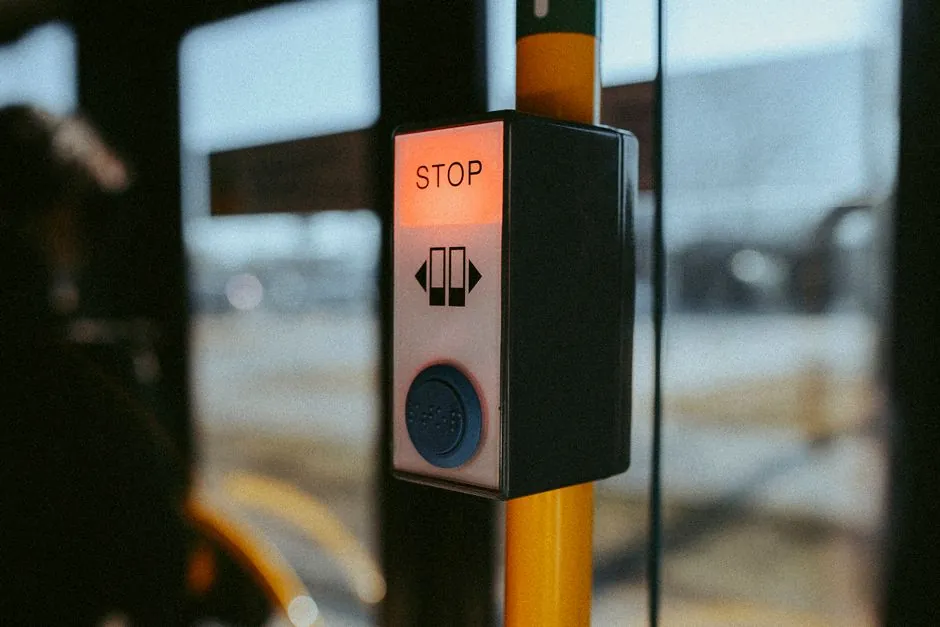
An emergency stop on a food processing line is not just a red button: it is a complementary protective measure under ISO 13850 that must survive daily washdown, sanitizer exposure, and glove operation while reliably halting mixers, slicers, fillers, conveyors, and packaging machines [S5].
Food and beverage equipment such as mixers, slicers, fillers, conveyors, and packaging machines should incorporate emergency stop devices per ISO 13850, with selection driven by the line's risk assessment, stop category, ingress protection, and actuator ergonomics rather than by brand familiarity alone [S5][S4].
ISO 13850 Scope and the Core Principle Behind the Button
ISO 13850, titled "Safety of Machinery, Emergency Stop Function, Principles for Design," is a type-B2 international safety standard that sets out requirements for emergency stop mechanisms and is read alongside ISO 12100 for risk assessment and risk reduction [S5]. The standard states plainly in Clause 4.1.1.1 that the purpose of the emergency stop function is "to avert actual or impending emergency situations arising from the behaviour of persons or from an unexpected hazardous event" [S5].
The standard frames the E-stop as a complementary, human-initiated protective measure intended to rapidly place machinery into a safer state during an emergency, without requiring analysis, deliberation, or complex action by the operator [S5]. That framing is the reason ISO 13850 mandates features such as single human action, always-available and operational status, positive opening contacts, manual reset, and prevention of unexpected restart, all of which are non-negotiable on a wet, glove-lined food line [S1][S5]. Industrial guidance reinforces the same principle, adding that an emergency stop is an additional layer of protection within a complete machine safety system and should never replace normal machine controls [S3].
Stop Category 0 vs Category 1: Picking the Right Halt Behaviour
Stop categories define how machines halt during an emergency, with Category 0 providing immediate power removal and Category 1 allowing controlled deceleration before power disconnection; the choice depends on machine characteristics and the hazard analysis, not on operator preference [S4].
Category 0 is specified when uncontrolled stop is acceptable and where the hazard to personnel or product is severe enough that any continued motion is worse than the coast-down; it is implemented as a hard cut through positive-opening contacts on the E-stop device [S4]. Category 1 is used where a controlled stop is needed to prevent secondary hazards, for example a high-inertia filler bowl that could slosh hot product or a vertical form-fill-seal machine whose sealer must clear before power drops, and it is implemented through a safety timer or safety PLC that commands the drive to a controlled stop before removing power [S4]. Food processing risk assessments commonly combine both: Category 0 on conveyors and slicers where any motion is the hazard, and Category 1 on mixers, augers, and packaging heads where a controlled stop protects product and tooling [S4][S5].
Ingress Protection, Sanitizer Chemistry, and the Washdown Reality

Food processing areas are routinely hosed down with hot water, caustic, acidic, and chlorinated sanitizers, so the E-stop device must be specified for both IP rating and chemical compatibility rather than just for the electrical function [S3][S4].
Typical minimum specification for an E-stop head installed in a washdown zone is IP65 from the front of the panel, with IP67 or IP69K on equipment that sees direct high-pressure spray or steam cleaning, and a housing material of stainless steel AISI 304 or 316 for chemical and corrosion resistance rather than painted zinc alloy [S3][S8]. E-stop push button covers selected for food processing equipment typically emphasize corrosion-resistant materials because of the caustic cleaners used; the same source notes that outdoor machinery needs waterproof protection and that heavy industrial settings call for impact-resistant shrouds, so the same part number cannot be carried across zones without a review [S3]. Wiring practices also matter: conduit entries should be sealed with food-grade cable glands, and any boot or shroud should be silicone or EPDM rated for the cleaning chemistry, not generic nitrile that swells in hot caustic [S3][S4].
Actuator Type, Reset Behaviour, and Operator Ergonomics on a Glove
The mushroom head E-stop is the most common food-line actuator because it offers a large operating surface, fast activation, and easy visual identification on a red-on-yellow background, all of which are usable with wet, gloved hands during a stressful stop event [S3]. The same article distinguishes the emergency stop button from a normal stop button by purpose (emergency shutdown vs routine stopping), safety function (yes vs no), activation speed (immediate vs standard), and reset method (manual reset vs usually automatic) [S3].
Twist release and key-release E-stops are preferred in food lines over pull or automatic-reset styles because they force a deliberate, intentional reset action that prevents accidental restart, with twist release the typical default and key release used where only authorised personnel may bring the line back up [S3]. A practical selection rule used on processing floors: if the operator can reach the device with a single hand and actuate it without looking, the spacing and height are right; if they have to search or use two hands, the layout will fail a real incident even though it passes a paper review [S3][S5]. For palletiser and case-packer zones where line-of-sight is poor, run-cable or rope-pull E-stops wired into the same safety circuit are commonly added so the operator can trip the line from anywhere along the hazard length [S3][S8].
Wiring Architecture: Positive Opening, Dual Channel, and Safety Relay
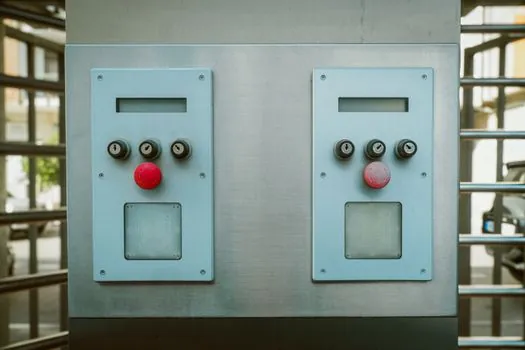
ISO 13850 and IEC 60204-1 require the E-stop to use direct mechanical action with positive opening contacts and to be wired so that a single component failure cannot prevent the stop command from being delivered [S4]. In practice this means a mechanically linked contact block (typically 1 NC + 1 NO or 2 NC) rather than spring-only logic, and a dual-channel path into a safety relay or safety PLC that monitors both channels and detects cross-faults [S4].
For Category 1 stops, the safety timer or safety controller commands the drive to a controlled stop within the risk-assessment-defined stop time, then drops the contactors; this requires the E-stop to be wired through a safety output, not a general-purpose I/O point, so the stop command survives a processor fault [S4]. The fail-safe requirement also means that loss of power, broken wire, or welded contact must default to a safe state, which is why the NC contact of an E-stop is treated as the safety contact and the NO contact is only used for status or non-safety signalling [S4]. Reference material on emergency rescue planning stresses that the wiring architecture has to be tested at the documented interval, not just installed and forgotten, because a food plant's E-stop is exercised daily and a sticky contact will not be noticed until the day it fails to open.
Food-Line Specific Selection Criteria: A Side-by-Side Comparison
The four E-stop families commonly bid on a food processing line are panel-mount mushroom, rope-pull / cable-pull, foot-operated, and stand-alone post-mounted; the right choice depends on hazard length, operator reach, and washdown zone rather than on a single preferred supplier [S3][S8].
Across all four, the constant requirements are ISO 13850 design, red mushroom on yellow, positive-opening NC contacts, manual reset, and a tested dual-channel safety circuit, so the selection problem is really about matching actuator geometry and IP rating to the station, not about choosing whether to follow the standard [S3][S4][S5]. Emergency light stacks on the same post or panel are often specified alongside the E-stop so a tripped station is visible to the line supervisor from across the room, which speeds reset and avoids the wrong machine being investigated.
Compliance Stack: ISO 13850, NFPA 79, IEC 60204-1, and Food-Specific Standards

Industrial E-stop circuits typically cite ISO 13850 for the function, IEC 60204-1 for electrical equipment of machines, and NFPA 79 for U.S. industrial machinery electrical requirements, with OSHA 1910.217 adding mechanical power press rules in the U.S. [S4]. For food plants in particular, the equipment also has to satisfy the food-safety regime in force, which in the U.S. is the FSMA / FDA 21 CFR framework on hygienic design, in the EU is the food-contact and machinery regimes, and in the dairy and meat segments is supplemented by sector-specific cleaning rules that drive the IP and material choices described above [S5]. The E-stop switch family itself is built around IEC 60947-5-5, which works hand-in-hand with ISO 13850 to define the actuator, electrical, and mechanical requirements of the device [S7].
For engineering teams, the practical takeaway is that ISO 13850 is non-negotiable and the supporting standards (IEC 60204-1, NFPA 79, IEC 60947-5-5) tighten the implementation, while the food-safety regime governs the materials, seals, and cleanability that determine whether the device survives the washdown [S4][S5][S7]. When audits fail, the recurring findings are missing positive-opening contacts, single-channel wiring, automatic reset where manual reset is required, and IP ratings below the actual cleaning method, all of which are addressable at the spec stage rather than in the field [S4].
Common Failure Modes and Trackable Signals
Three failure modes account for most food-line E-stop problems: ingress of water or cleaning chemistry past an underspecified seal, contact welding from inductive DC loads that the device was not rated to break, and accidental or automatic reset because a twist- or key-release head was not specified in the first place [S3][S4]. Each one is detectable: monthly push-button functional tests logged against the safety controller's diagnostic counters will show increasing reset attempts on a sticky contact; a drop in the safety circuit's loop resistance or an unexplained safety relay trip will show a degraded seal; and a post-incident review will show whether a manual reset actually happened or whether someone bypassed the head to keep the line running [S3][S4].
Two trackable signals for the next review cycle are the IEC 60947-5-5 / ISO 13850 alignment of any new mushroom head being qualified, and the IP rating move from IP65 toward IP67 or IP69K on any new station sitting inside a high-pressure washdown zone, both of which are called out in current selection guidance rather than in any future regulatory change [S3][S7]. A construction site emergency stop certification checklist provides a useful template for the test-and-audit side of that signal, even outside construction, and food-plant safety engineers often borrow its structure because the standards chain (ISO 13850, IEC 60204-1, NFPA 79) overlaps heavily with processing-line work.