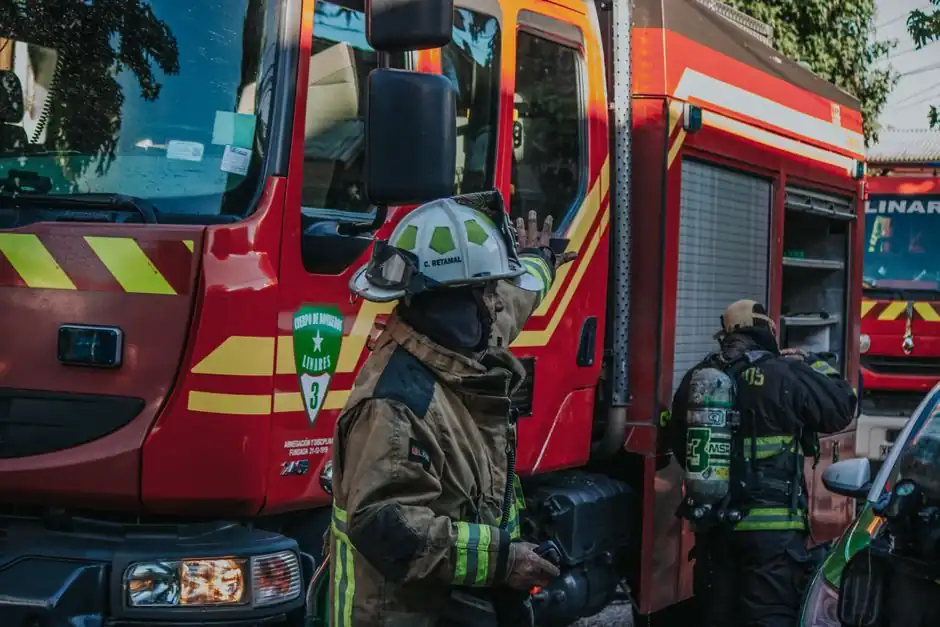
For fire attack inside a structure, OSHA 29 CFR 1910.134 and NIOSH guidance position the open-circuit self-contained breathing apparatus (SCBA) as the only respirator that simultaneously addresses oxygen deficiency, particulates, and toxic gases [S1][S4].
During overhaul, investigation, and post-fire cleanup, departments that cannot equip every member with SCBA may use NIOSH-approved air-purifying respirators (APRs) and powered air-purifying respirators (PAPRs), but only outside the IDLH and only when a multi-gas monitor confirms the atmosphere is safe to breathe [S5].
Respirator Categories and Assigned Protection Factors
NIOSH groups all certified respirators into air-purifying respirators (APRs) and atmosphere-supplying respirators (ASRs), with SCBAs falling under the open-circuit ASR class commonly issued to fire departments [S1].
Each category carries an Assigned Protection Factor (APF) defined in Table 1 of OSHA 29 CFR 1910.134; for structural firefighting the open-circuit SCBA is the reference device, while half-mask APRs sit at APF 10 and full-face APRs at APF 50, which is why neither is acceptable inside an IDLH [S1][S4].
Powered air-purifying respirators (PAPRs) raise the wearer's effective protection by maintaining positive pressure inside the facepiece, but a PAPR is still an air-purifying device and cannot be used in oxygen-deficient atmospheres [S1][S5].
Filter Classes: N95, P100, and What the Letters Mean
NIOSH filter designations are a two-part code: the letter indicates oil resistance (N = not oil-resistant, R = somewhat oil-resistant, P = oil-proof) and the number indicates the minimum filtration efficiency (95 = 95%, 100 = 99.97%) [S2].
For fire-ground particulates, P100 filters are the conservative choice because smoke is oily and can degrade an N-series filter prematurely; the Dräger X-plore 3500 half-face mask with a P100 filter, for example, is rated to remove 99.97% of particulates when properly fit-tested [S5].
Disposable N95 masks such as the Dräger X-plore 1300 and X-plore 1700 still filter 95% of particulates and are used at the cold-zone perimeter or for on-scene support personnel, but they offer no gas or vapor protection [S5].
Cartridge Color Codes and Multi-Gas Choices
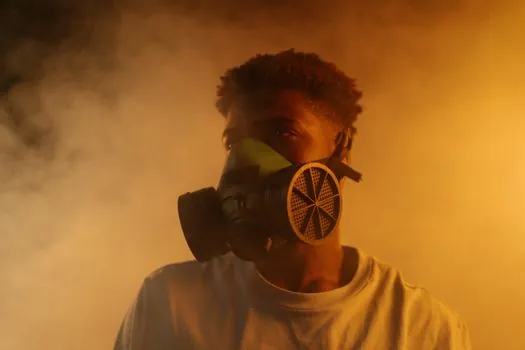
The NIOSH color convention lets users identify cartridge chemistry at a glance: magenta = P100 particulate, black = organic vapor, white = acid gas, yellow = organic vapor + acid gas, and olive = multi-gas [S2].
The American Industrial Hygiene Association recommends a half-face respirator with particulate filters plus organic-vapor cartridges as the minimum for environments with strong smoke odors or VOC exposure, which is the typical condition inside a structure after suppression [S2].
For urban-wildfire and structure-cleanup work where chlorine, hydrogen chloride, sulfur dioxide, and other acid gases can be released from burning plastics and synthetics, the olive multi-gas cartridge adds sorbents for those acid gases and inorganic vapors on top of the organic-vapor protection [S2].
Cartridges adsorb gas continuously and saturate, so they must be replaced on the manufacturer's change-out schedule rather than by smell alone; a saturated cartridge gives the wearer a false sense of protection while passing contaminants through [S2].
Zone-Based Selection: Attack, Overhaul, Investigation, and Cold Zone
Selection is driven by zone: IDLH (attack and interior overhaul) requires open-circuit SCBA rated to 4500 psi with a 30-, 45-, or 60-minute cylinder; the warm zone during exterior overhaul and overhaul without active burning is the boundary case where SCBA remains the default and APRs only appear when a four-gas monitor reads oxygen ≥19.5%, LEL <10%, and CO below the department's action level [S1][S5].
The cold zone around fire-investigation sifting and post-fire cleanup is where PAPRs and APRs deliver the most practical value: a PAPR like the Dräger X-plore 8500 delivers 99.97% filtered air through a belt-mounted blower, extending wear time during the hours-long search for cause and origin [S5].
For full-face coverage on the fire ground the Dräger X-plore 5500 with P100 filters protects both the airway and the eyes, and the X-plore 1700 N95 disposable is recommended as a baseline for personnel stationed outside the warm zone [S5].
Any APR or PAPR substitution on the fire ground must be paired with continuous multi-gas monitoring; an alarm on the detector means the atmosphere is no longer suitable for air-purifying protection and the crew must withdraw or upgrade to SCBA [S5].
Fit Testing, Medical Clearance, and Program Discipline
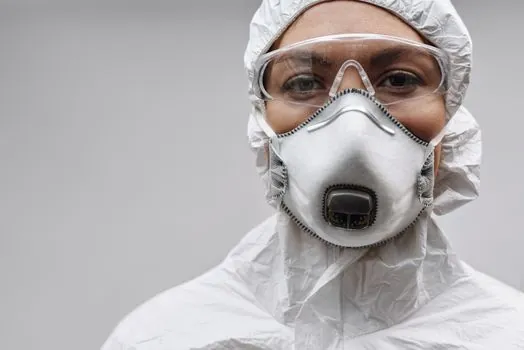
OSHA 29 CFR 1910.134 requires qualitative or quantitative fit testing before any tight-fitting respirator is used, with annual re-testing and re-testing whenever a different model or facepiece size is issued [S1][S4].
Each wearer must also have a current medical evaluation by a physician or other licensed healthcare professional confirming they can tolerate the breathing resistance and dead-space load of the device; SCBA wear in particular pushes heart rate and core temperature, so the medical clearance is not optional paperwork [S1][S4].
A compliant Respiratory Protection Program assigns a program administrator, trains users on the specific make and model they wear, documents cartridge change-out schedules, and tracks when cylinders were last hydrostatically tested (typically every 3 years for composite SCBA cylinders) [S1][S4].
SCBA vs APR vs PAPR: A Decision Comparison
SCBA (open-circuit) provides the highest protection, supplies clean air independent of the atmosphere, and is the only legal option inside an IDLH, but it is heavy (typically 25-35 lb with a 4500 psi 60-minute cylinder) and time-limited [S1].
Full-face APR with P100 plus multi-gas cartridge costs less, weighs about 1-2 lb, and can be worn for hours, but cannot be used in oxygen-deficient atmospheres and does not protect against all fireground gases on its own [S2][S5].
PAPR adds a battery-powered blower that keeps the facepiece under positive pressure, raising comfort and usable wear time during long investigation shifts, but it shares the same oxygen and IDLH restrictions as any air-purifying device [S1][S5].
Disposable N95 filtering facepiece respirators are the lowest-cost, lowest-weight option for cold-zone support personnel, but filter only particulates, fit only by negative pressure, and provide no eye or gas protection [S5].
Limits, Failure Modes, and Common Mis-specifications
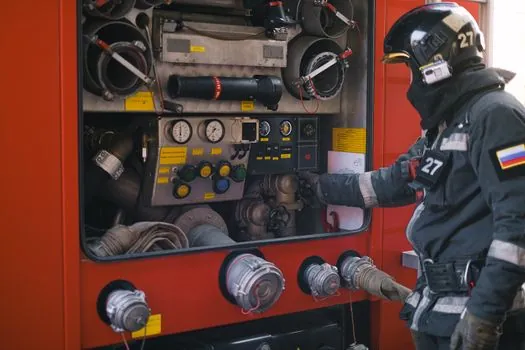
Air-purifying respirators do not generate oxygen and must never be used where oxygen may be below 19.5%, which is the default OSHA threshold for safe breathable air [S1][S4].
Wearing an N95 or P100 filtering facepiece without a fit test can drop effective protection by a factor of 5 to 20 versus the lab-rated filtration, and facial hair under the sealing surface degrades protection even further [S1][S4].
Cartridge sorbents have a finite life and are consumed by exposure even when the respirator is off the wearer's face, so storing a half-mask in a contaminated compartment without a sealed bag effectively pre-loads the cartridge with contaminants before the next use [S2].
Wildfire smoke can contain both particulates and gases, and a particulate-only mask such as an N95 leaves the wearer exposed to VOCs like benzene and formaldehyde, which is why pairing the particulate filter with an organic-vapor or multi-gas cartridge is the conservative choice for post-fire cleanup [S2].
Sourcing, Standards, and Verification
All respirators used in U.S. workplaces must be NIOSH-approved and used inside a written Respiratory Protection Program that meets OSHA 29 CFR 1910.134, with fit testing, medical evaluation, training, and cartridge change-out schedules documented for every user [S1][S4].
For structural firefighting the relevant NFPA consensus standards cover SCBA performance (NFPA 1981) and the broader respiratory protection program for emergency services (NFPA 1500 series); departments should confirm the specific edition cited by their Authority Having Jurisdiction before purchasing [S1].
Before deploying any APR or PAPR on the fire ground, run a multi-gas meter (O2, LEL, CO, H2S as a minimum) and re-check it at every transition between zones; an alarm on any channel pulls the crew back to SCBA immediately, regardless of cartridge chemistry on the facepiece [S5].
Track two signals going into the next budget cycle: any NFPA 1981 or NFPA 1500 revision that tightens SCBA cylinder-duration or alarm thresholds, and the cost delta between a 60-minute composite SCBA cylinder and a P100/multi-gas APR kit, since that gap drives whether the second-out engine carries SCBA or APR for overhaul [S1][S5].
Detailed specification references: respirator, pressure transmitter, and flow meter.
Related analysis: Safety glasses types, ANSI Z87 ratings, and hazard-class selection.