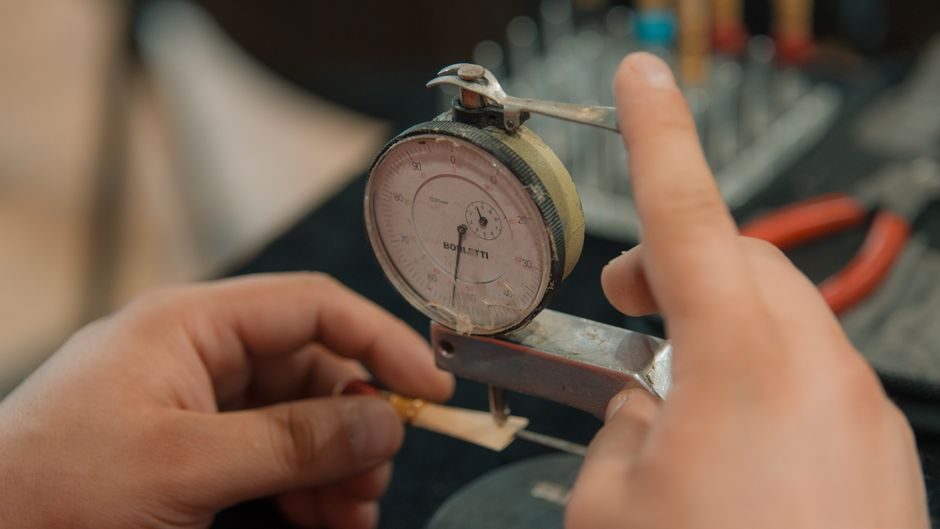
A gauge block is a rectangular block of steel, ceramic or tungsten carbide with two opposite faces lapped flat and parallel to micrometre-level accuracy, wrung together to build an exact length [S2][S4]. Blocks are graded for flatness, parallelism and length tolerance, and they remain the working length standard in machine shops and calibration labs because no other hand-held artefact reaches sub-micrometre stability at comparable cost [S4].
Selection in 2026 is driven by four gates: the metrology grade you actually need (K/00/0/1/2 or ISO equivalent), the block material matched to your environment, the number of pieces in the set, and the recertification interval your quality system can absorb. Skip any one of those and the blocks either fail the audit or cost more than they should.
Grades: Where the Real Cost Difference Lives
Gauge block grades define the maximum permissible deviation in length, flatness and parallelism at the point of manufacture and at the calibration interval, and a single step up the grade ladder typically multiplies price several times [S4]. Calibration-grade and reference-grade blocks (the two highest classes) are intended for lab use where they verify the working sets on the shop floor, and they are usually over-spec for daily micrometer checking.
For most production-line use, grade 1 or grade 2 (or the ISO equivalent) gives the right balance between cost and uncertainty; pushing higher only makes sense if the downstream instrument is itself a class better than the blocks used to check it [S4]. Grade K (or "00") is the keeper-grade for a calibration laboratory that issues traceability to working sets across the plant.
Material: Steel, Ceramic or Tungsten Carbide
Steel gauge blocks remain the default because of cost, thermal conductivity close to many workpiece steels, and well-understood wringing behaviour, and they are the material most calibration labs still hold as the primary reference [S1][S4]. Surface finish on commercial sets is typically specified at the sub-microinch range (Fowler lists 0.4 microinches on its general-purpose set) and the blocks are coated at final inspection to resist corrosion and handling marks [S1].
Ceramic (zirconia-based) blocks are specified where thermal expansion has to be minimised, where magnetic effects on delicate parts matter, or where the shop environment is humid or chemically aggressive; tungsten carbide is harder and more wear-resistant but is heavier and tends to be reserved for heavy shop use. The trade-off is straightforward: steel is cheapest and most familiar, ceramic is dimensionally the most stable in a warm shop, carbide is the most wear-tolerant.
Set Size and Long Series: Match the Wringing Stack, Not the Catalogue

Long series (typically 81, 88 or 112-block sets) cover most micrometer, height-gauge and sine-bar builds with a single wrung stack; short series (e.g. 32 or 47 blocks) are cheaper and lighter but force more wrung combinations, which adds uncertainty per build [S4]. For a metrology cell that runs fixed routines, count the actual unique lengths you build in a month before you pay for a 112-block long series you will only ever use 60 pieces of.
Block-pair strategy also matters: sets built on a 0.001 mm or 0.0001 in geometric step (e.g. the Mitutoyo-style 0.001 step series) reduce wring count to one or two blocks per build and minimise stack error; arithmetic-step sets are cheaper but cost accuracy as stack height grows. When height gauges and height gauges are the dominant downstream instrument, an 81 or 88-block geometric-step set is the default that gives the best cost-per-uncertainty ratio.
Accessories: Wringing Tools, Optical Parallels and Calibration Bezel
Wringing film, optical parallels, and a calibrated thermal source (typically a 20 °C ± 0.1 °C bath) are not optional extras — they determine whether a grade 1 set stays grade 1 between recertifications [S4]. A broken or dirty wrung face is the single most common reason a working set drifts out of tolerance, and replacing one block mid-set is more expensive than the full accessory kit.
Optical parallels (a matched pair of rectangular blocks, one of which carries a reference optical flat) are needed only if you check flatness with an autocollimator; for routine micrometer and dial indicator work they are usually dead weight. A traceability certificate from an ISO/IEC 17025 lab (NPL, NIST, A2LA-accredited national institutes) is the third must-have: without it, the grade on the box is just a label.
Procurement Gates: Lead Time, Recertification and Storage
Lead time on a full long series from a recognised OEM is typically weeks, not days, and recertification of an in-service set at an ISO/IEC 17025 lab is on a similar clock — plan your purchase around your metrology system's annual budget, not on the day a block is dropped [S4]. Storage at 20 °C ± 1 °C in a desiccated case is the bare minimum; thermal gradients across the set during measurement are the dominant source of unaccounted error in field use.
Recertification interval is the line item procurement forgets: a working grade 1 steel set is commonly on a 12-month cycle in a regulated plant, which means one full lab cost per set per year on top of the purchase price [S4]. Build that into the total-cost-of-ownership calculation before you compare two quotes.
Limits: When a Gauge Block Is the Wrong Tool
A gauge block set cannot replace a coordinate measuring machine for free-form geometry, a laser interferometer for sub-micrometre linearity, or a thread or ring gauge for internal diameters; specifying a block where a purpose-built artefact is the proper tool burns hours and adds uncertainty [S4]. For shop-floor length transfer between fixed nominal values, however, a graded steel set is still the cheapest, fastest and most portable reference a metrology cell can own.
Track the next two signals before you reorder: (1) the published interval between your last and next 17025-accredited recertification, and (2) any change in your shop's controlled-temperature specification — both of these determine whether the set you buy in 2026 will still be the right set in 2029.
Related: gauge block, aac block.