
Gear couplings, clutches, and brakes share a common job — moving rotational energy between shafts — but only the coupling is a permanent connection. A gear coupling links driver and driven shafts full-time, transmitting high torque through meshing external teeth on the hub and internal teeth on the sleeve, and is rated for substantial parallel and angular misalignment; a clutch actively engages and disengages the same power path; a brake stops rotation rather than transmitting it across a continuous load path [S1][S5].
For the maintenance-access question, the relevant differences are not torque density (gear couplings win that comparison by a wide margin [S2]) but three practical points: whether the joint is solid or split, whether the housing has to come off for inspection, and whether the equipment is sized to absorb dynamic stopping energy. On a paper machine winder, crane hoist, or any line where a servo motor and PLC coordinate indexing, these three points often decide the whole driveline package.
Functional Role of Couplings, Clutches, and Brakes in the Same Driveline
A clutch is a transmission and control device that transfers energy from a driver shaft to a driven shaft on command, while a brake is a mechanism that dissipates that energy to stop motion — the two are functionally distinct even when they share a common housing [S5]. Couplings, by contrast, hold the driver and driven shafts in fixed mechanical relationship whenever both shafts exist. A single driveline routinely uses all three: a coupling between motor and gearbox, a clutch between gearbox and load, and a brake on the high-inertia side to hold position when the clutch is open. Specifying them independently — rather than treating "coupler" as a generic term — is the first step in any maintenance-access analysis, and the F16D cooperative patent classification (CPC scheme F16D, "Couplings for Transmitting Rotation; Clutches; Brakes") tracks exactly that functional split.
Why Gear Couplings Demand Axial Access for Routine Service
Gear couplings are engineered for high torque transmission in a compact installation space, and that compactness is also their main maintenance liability [S2]. The sleeve that carries the internal gear teeth is retained by end covers and fitted bolts, and "some axial allowance is required for maintenance, as the cover needs to be removed for inspection" — meaning the shafts must be able to move axially by at least the cover thickness, or the coupling must be specified as a drop-out (spacer) assembly. Where shaft axial movement is not available, the only options are to pull a shaft, cut the spacer, or accept blind inspection. Designers who skip this allowance at the layout stage are the ones who later quote the longest Mean Time To Repair numbers on the line.
SKF Sizing Rule: Braking Duty Needs 200% of Running Torque
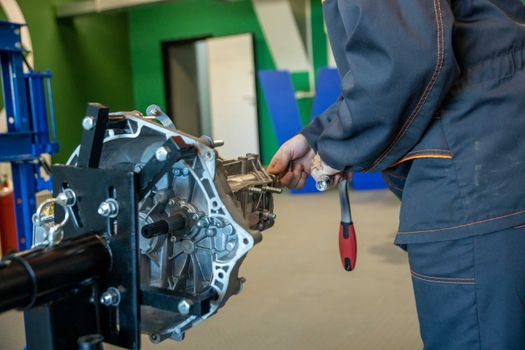
When a gear coupling is mounted on the braked (driven) side of a driveline, it sees energy it never sees as a pure coupling: dynamic braking torque. The SKF couplings catalogue states that "the coupling selection for dynamic braking should be no less than 200% of the running (installation) torque" and that the only deviation from standard gear-coupling components is the extended length of the fitted bolts that retain the sleeve. Engineers who reuse a standard gear-coupling part number on a brake shaft without applying that 200% multiplier are the engineers who later find the internal teeth polished smooth after a single emergency stop, because the running-torque rating is a continuous-duty thermal/mechanical number, not a one-shot energy absorption number. [S1]
Split Clamp Couplings as a Maintenance-First Alternative
Where access is the binding constraint and torque is moderate, two-piece split clamp couplings are the cleaner answer. They "split into two halves" so they "can be mounted or removed without sliding over the ends of the shafts, which can be a significant benefit during maintenance or retrofits," and are explicitly aimed at "machinery with limited access or assemblies requiring frequent adjustments" [S6]. The trade-off is torque density: split clamp couplings do not match gear couplings for continuous high-torque service, and any axial-misalignment allowance is smaller, so the choice is squarely between access and capacity. For pump and compressor skids tied to pressure transmitters and industrial valves on the process side, the maintenance frequency of the instrumentation often dictates the coupling side of the same skid — when the instrument has to come out every quarter, the coupling has to come out faster than the bolt count suggests.
Engagement Method: C-Face vs Shrink-Fit 360° Contact
Clutch and brake modules attach to the host machine through standard C-face connections, but the C-face "loose fit can cause torque to transfer through the key and keyway, which hastens failure" [S4]. The alternative is shrink-fit or clamping-hub mountings that give a true 360° frictional connection and unload the keyway; in stop-and-index duty these typically last several times longer before key fretting shows up. Dynamic-torque sizing for a clutch or brake is based on "time to stop the load or bring it to speed," which is independent of the actuation time of the coil or air supply [S4] — and that distinction matters when the same brake is being evaluated for normal-stop versus emergency-stop ratings, because emergency-stop energy can be 5–10× the normal-stop energy on a high-inertia load.
Failure Mode: Locked Sleeves Hidden Under Bolt-On Covers
The most expensive gear-coupling failures are the ones where the sleeve stops transmitting torque while the hub keeps rotating inside it, and "the metal covers over the shafts and couplings were difficult to remove" during the post-failure inspection [S3]. Field reports show this pattern repeating: the internal gear teeth lose their mesh, the sleeve sits visually intact, and the covers that would have shown early grease leakage or tooth polish are the very components that block hands-on inspection. The WJE case study records that "neither rotational movement nor torque were transferred from the coupling hub to the coupling sleeve" and that the disassembly was the time-consuming step, not the replacement [S3]. Couplings with sight glasses, removable end covers without shaft pull, and grease sampling ports are the mechanical answer to a problem that is really an inspection-access problem, and the cost of those features is trivial compared to one unplanned eight-hour teardown.
Decision Table: Which Device Wins on Access, Torque, and Stopping Duty
Continuous torque is the dimension on which gear couplings win by a wide margin, with no practical upper limit at the sizes used in steel and mining service, while engagement/disengagement while running is a clutch (or clutch-brake unit) function, since neither gear couplings nor brakes change state without stopping the line. Holding a load stationary with no rotation is a brake, sized for the dynamic stopping torque and not the running torque. Maintenance access on a fixed-installation driveline is split clamp coupling first, with a drop-out (spacer) gear coupling a close second where torque is non-negotiable. Choosing a gear coupling where a clutch is needed gives a permanent, very strong, very hard-to-service shaft link; choosing a clutch where a coupling is needed gives a wear part on a duty cycle that was never designed for it. The fourth decision dimension, dynamic braking energy, belongs only on the brake or clutch-brake side and forces a 200% torque re-rate per the SKF rule. [S2]
Trackable signals for the next design review: confirm whether the gearbox-to-motor and gearbox-to-load couplings on each driveline have documented axial allowance for cover removal; verify that any coupling on the braked shaft is rated to at least 200% of running torque per the SKF couplings sizing rule; and flag any clutch or brake mounted with a standard C-face and keyed shaft for conversion to a shrink-fit or clamped hub if duty cycle exceeds one engage-disengage per minute. The next real node is the next planned outage — that is when either the access cost gets paid in labour hours or the engineering change gets justified on the bill of materials.