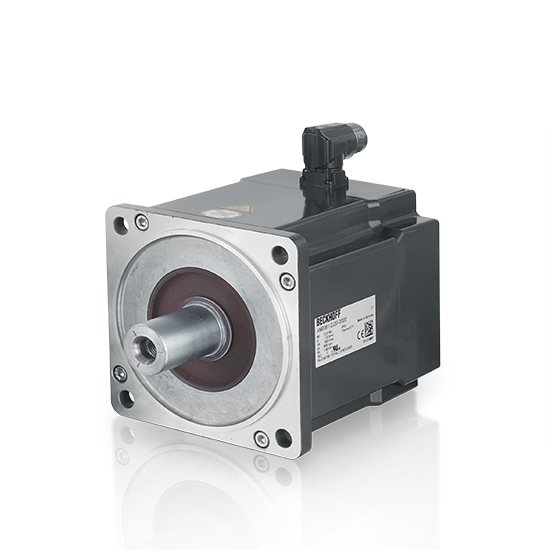
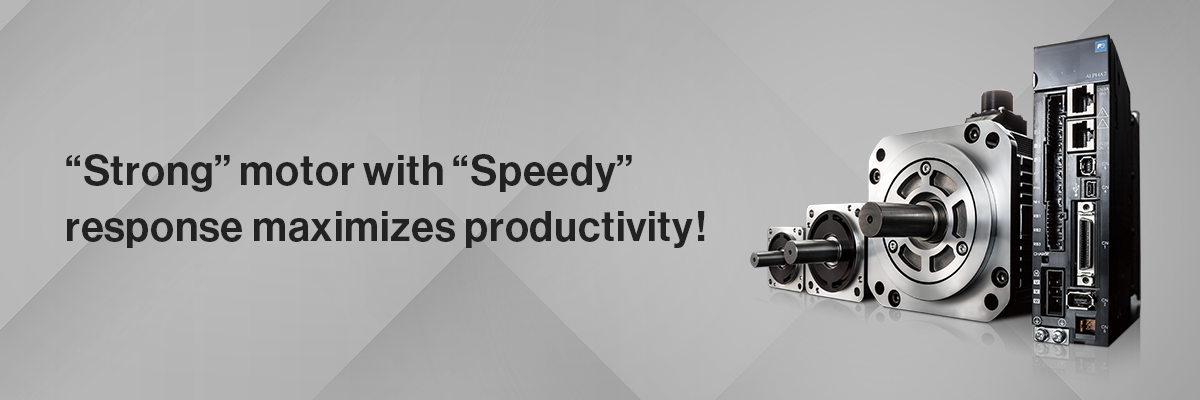
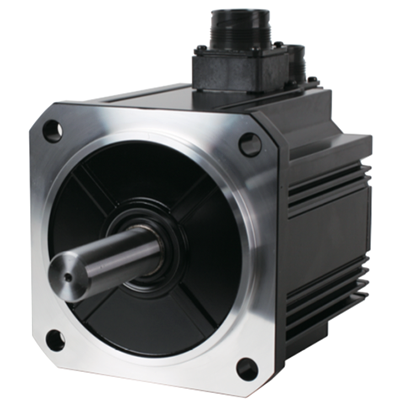
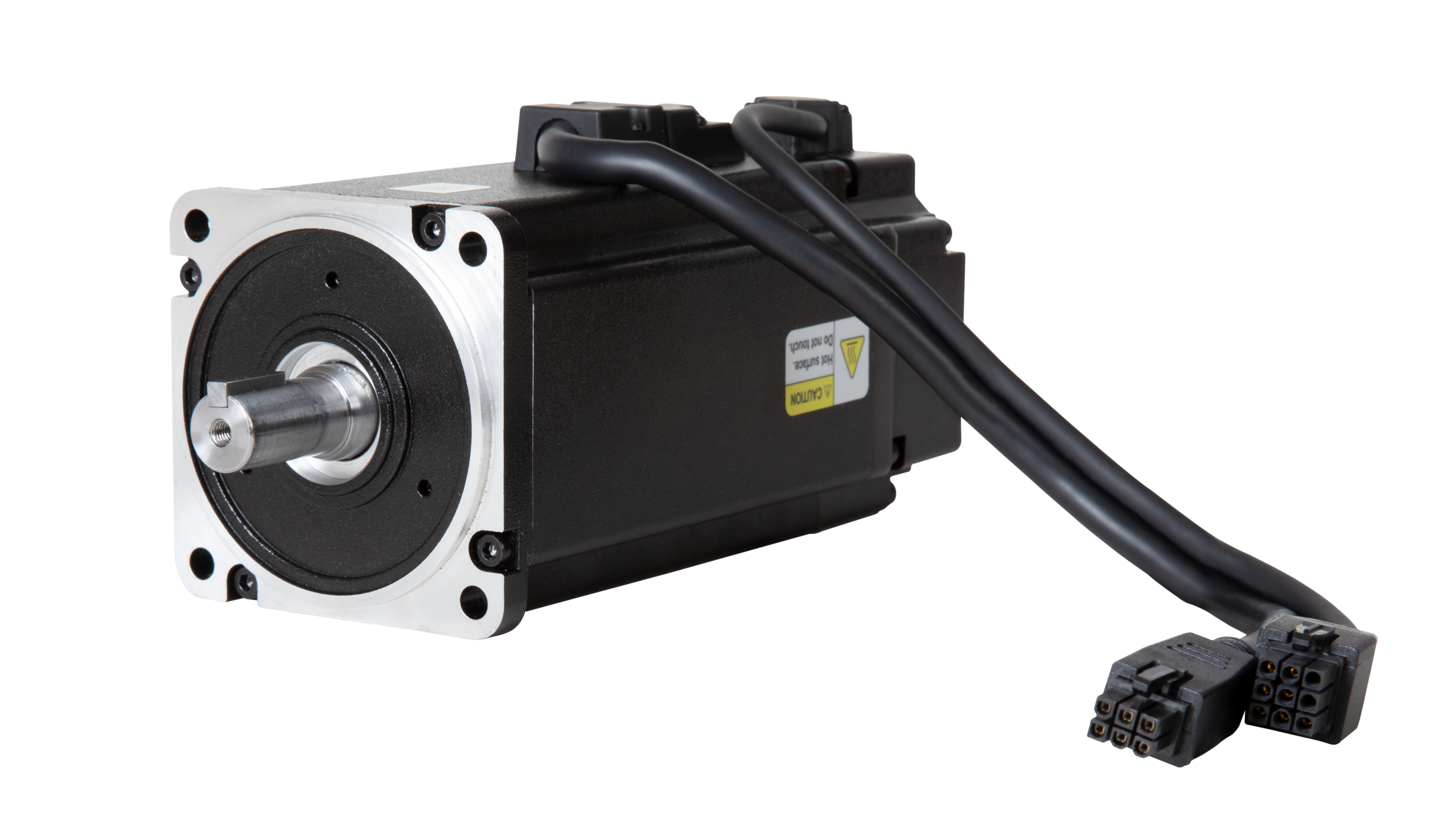
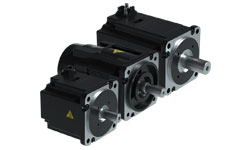
A servo motor is an electric motor operated inside a closed-loop control system together with a matched servo drive (amplifier) and a position or velocity feedback device (encoder or resolver). "Servo" denotes the feedback-controlled behavior, not a specific motor construction. Because the motor and drive are almost always selected and tuned as a pair (inertia matching, bus protocol, encoder protocol), this guide covers the complete servo system across Yaskawa Sigma-7, Panasonic MINAS, FANUC alphai, Siemens SIMOTICS, and other flagship platforms.
This guide is aimed at industrial purchasing engineers and design engineers. It covers 6 chapters from construction types, nested-loop control technology, encoder feedback, materials and media, spec-sheet decoding, to selection decisions, with 7 selection FAQs and manufacturer comparisons, helping you size a servo motor and drive as a tuned pair. All parameters reference IEC 60034, IEC 61800, IEC 60529, and ISO 13849-1 public standards, and manufacturer-published data from Yaskawa, Panasonic, FANUC, Siemens, Mitsubishi, Delta, and Inovance.
Chapter 1 / 06
What is a Servo Motor and Servo Drive
A servo motor is an electric motor operated inside a closed-loop control system together with a matched servo drive, also called an amplifier, and a position or velocity feedback device such as an encoder or resolver. The word "servo" denotes the feedback-controlled behavior of the system, not a specific motor construction. The same machine run open-loop, without feedback and error correction, would not be a servo. This is the single most important conceptual distinction in the field: it is the closed loop, not the iron and copper, that makes a motor a servo.
The drive continuously compares the commanded value against the actual measured value of position, speed, and torque, and corrects the error in real time. This continuous error correction gives the system its defining qualities: high precision, high dynamic response, fast settling after a move, and stable holding torque at zero speed. A servo can sit at a commanded position and resist a disturbing load without drifting, because the drive keeps injecting current to hold the error near zero. An ordinary variable-frequency-driven (VFD) induction motor without feedback cannot do this and is not a true servo.
Motor and drive are almost always selected and tuned as a pair. Three compatibility axes bind them together: inertia matching between the rotor and the reflected load, the communication (fieldbus) protocol that links the drive to the controller, and the encoder protocol that the drive must decode. A mismatch on any of these axes breaks the system, which is why this page treats the servo motor and servo drive as one product type rather than two separate components. On most factory purchase orders the two are quoted together as a "servo axis" or "servo package."
Structurally, the system has three functional blocks. First, the servo motor itself, which on high-performance machines is a three-phase permanent-magnet synchronous motor (PMSM) with a sinusoidally wound stator. Second, the feedback device mounted on the motor shaft, an encoder or resolver, which reports actual position and speed. Third, the servo drive, a power electronics unit that performs field-oriented (vector) control, generates the commutation waveform through space-vector PWM, closes the three nested control loops, and exchanges commands and status with the upper controller over a fieldbus.
Typical applications span the high-dynamic, high-precision end of industry: CNC machine tools, semiconductor and flat-panel manufacturing, robotics and cobots, printing and converting, packaging, injection molding, electronics assembly (SMT and pick-and-place), labeling, textile, food processing, and new-energy equipment for battery, PV, and EV manufacturing. In each of these, the servo is chosen not for raw power but for the precision and responsiveness that only a closed loop can deliver.
Chapter 2 / 06
Servo Types and Variants
Servo motors are classified along three independent axes: electrical construction, motion form, and inertia class. The first determines commutation behavior and torque quality, the second determines whether motion is converted mechanically, and the third is a primary selection axis that must be matched to the load. The table below summarizes the electrical-construction families.
Construction
Commutation
Torque Quality
Typical Use
AC synchronous PMSM (BLAC / PMAC)
Continuous sinusoidal
Low torque ripple, high density
High-performance industrial servo
Brushless DC (BLDC)
6-step, every 60°
More ripple, more noise
Cost-sensitive servo and motion
AC asynchronous / induction
Sinusoidal with slip
Lower torque density
High-speed / large-power spindle servo
Brushed DC
Mechanical brushes
Brush wear limits life
Legacy, largely displaced
AC synchronous PMSM (also called BLAC, PMAC, or brushless AC) is the dominant high-performance industrial servo motor. It is three-phase, with a permanent-magnet rotor and a sinusoidally wound stator driven by continuous sinusoidal commutation. The rotor locks to the stator field with no slip, giving low torque ripple, high torque density, and high efficiency. When the industry says "AC servo motor" today, it almost always means a PMSM: the Yaskawa Sigma-7, Panasonic MINAS, Siemens SIMOTICS S, Mitsubishi MELSERVO, Delta ASDA, Inovance MS1, and FANUC alphai/betai families are all PMSM machines.
Brushless DC (BLDC) uses a trapezoidally wound stator with trapezoidal back-EMF and 6-step commutation that switches every 60 electrical degrees. This produces more torque ripple and more audible noise than a PMSM, so BLDC is used for simpler and cost-sensitive servo and motion tasks rather than top-tier precision work. AC asynchronous (induction) servos let the rotor turn slower than the stator field (slip), and are used for high-speed and large-power spindle-type servos and where field weakening to very high speed is needed; they have lower torque density than PMSM and generally need more cooling. A plain VFD-driven induction motor without feedback is not a true servo. Brushed DC servos are legacy: the brushes wear and limit life and maintenance, and they have been largely displaced by brushless types in modern industrial use.
By motion form, the rotary servo motor is the default. A linear servo motor produces direct linear thrust with no mechanical conversion, eliminating backlash and giving very high accuracy; it is used in semiconductor, flat-panel, and precision stage applications. A direct-drive (DD) torque motor is a large-diameter, low-speed, very high-torque rotary motor coupled directly to the load with no gearbox, again eliminating backlash and the transmission error that a reducer would introduce.
By inertia class, the third axis and one of the most consequential for selection, motors split into two camps. Low-inertia motors give fast acceleration and response, suited to light, fast, frequently start-stopping loads such as printing, packaging, and pick-and-place. Medium and high-inertia (high-rigidity) motors give better stability and stiffness for large or fluctuating loads such as heavy cutting, large-mass conveyors, and injection molding. Choosing the wrong inertia class is a classic mistake: a low-inertia motor on a heavy, variable load oscillates and is hard to tune, while a high-inertia motor on a light fast load wastes available bandwidth.
Chapter 3 / 06
Control Technology and Feedback
A servo system runs three nested (cascaded) closed loops, with the fastest loop innermost. Each outer loop issues a command to the loop inside it, and no loop can run faster than the loop it depends on. The table below lists the three loops and their typical update rates.
Loop
Position
Typical Rate
Feedback Source
Current (torque) loop
Innermost, fastest
~10 kHz
Motor phase current (≈ torque)
Velocity (speed) loop
Middle
Between current and position
Encoder-derived speed
Position loop
Outermost
~1 kHz
Encoder position vs. command
The current (torque) loop is innermost and fastest, typically running at about 10 kHz, and regulates motor phase current, which is approximately proportional to torque. Its bandwidth caps overall system performance: the outer loops cannot be made faster than the current loop supports. The velocity (speed) loop uses encoder-derived speed feedback to track a commanded speed. The position loop is outermost, typically about 1 kHz, and drives the load to the commanded position. The loops are tuned with PID and feed-forward control, and modern PMSM drives close them using field-oriented (vector) control with space-vector PWM. Feedback resolution and loop bandwidth together determine accuracy, stiffness, and settling time. High-end drives reach control and velocity-loop responsiveness around 3.0 to 3.2 kHz; the Panasonic MINAS A6 quotes roughly 3.2 kHz frequency response and the Delta ASDA-A3 roughly 3.1 kHz bandwidth.
The feedback device is the heart of servo precision. Resolution is usually quoted in bits, where counts per revolution equal 2 raised to the number of bits, or sometimes in PPR. A resolver is a rugged, analog device tolerant of heat and vibration but lower in resolution, common in harsh and legacy systems. Optical and magnetic incremental and absolute encoders are the modern standard: an absolute encoder reports the exact shaft position at power-up with no homing required, and a multi-turn absolute encoder also tracks revolutions. Battery-less absolute encoders, which are self-powered through a mechanical multi-turn mechanism, are increasingly standard and remove battery maintenance, as on the Mitsubishi MELSERVO and Panasonic A6.
The table below lists verified encoder resolutions from manufacturer documentation, the single most-compared feedback specification.
Platform
Resolution
Counts / Rev
Type
Mitsubishi MELSERVO MR-J5
26-bit
67,108,864
Battery-less absolute
Yaskawa Sigma-7
24-bit
16,777,216
Absolute
Delta ASDA-A3
24-bit
16,777,216
Absolute
Panasonic MINAS A6
23-bit
8,388,608
Absolute
Inovance MS1 / IS620 / SV660
23-bit
8,388,608
Single / multi-turn absolute
FANUC alphai pulsecoder
—
1,000,000 or 16,000,000
Pulsecoder (betai betaA32B/betaI32B = 32,768)
Siemens SIMOTICS S-1FK2 HD
22-bit
—
Absolute single-turn (option)
A general industrial rule of thumb is that 17-bit (131,072 PPR) handles most tasks, while 23-bit and above (8.39 million counts per revolution and up) is used for nanometer-class, ultra-precision positioning. A crucial engineering caveat: encoder bit-count is meaningless without matched mechanical stiffness. Backlash and compliance anywhere in the transmission — coupling, gearbox, lead screw — cap the real achievable accuracy regardless of how fine the encoder reads. Specifying a 26-bit encoder behind a sloppy reducer buys precision the machine can never realize.
Chapter 4 / 06
Materials, Media, and Environment
A servo motor does not have a "wetted material" in the way a pressure sensor does, but the operating environment imposes a parallel set of material, sealing, and thermal constraints that determine which motor variant survives the application. The four dominant environmental selection parameters are ingress protection, insulation class, ambient temperature and altitude derating, and cooling method.
Ingress protection (IP rating) follows IEC 60529, with IEC 60034-5 defining the IP degrees specifically for rotating machines. An IP65 motor is protected against water jets and tolerates occasional splash, but it is NOT washdown-rated and must not be treated as if it were. An IP67 motor withstands immersion to 1 m for 30 minutes. The single most common field mistake here is specifying IP65 for a food or hygienic line: high-pressure washdown will defeat an IP65 seal, so food and hygienic environments require a higher IP rating or a sealed, stainless variant designed for the duty.
Insulation class sets the thermal ceiling of the winding insulation system. Servo motors are typically Class B (130 degrees C) or Class F (155 degrees C). The class must be read together with the ambient temperature and the duty cycle: a Class F motor in a 50 degrees C cabinet near continuous peak torque has far less thermal headroom than the class number alone suggests, which is why thermal sizing is done on RMS torque rather than peak (see Chapter 5).
The table below maps common environments to the recommended protective and thermal specifications. It is a starting point for selection; always confirm against the manufacturer derating curves for the specific ambient temperature, altitude, and duty.
Two further hardware options belong in this material-and-environment discussion. An optional holding brake is built into the motor to hold a vertical or gravity-loaded axis when power is removed; it is a holding brake, not a dynamic stopping brake. Shaft options such as keyway or oil seal, and cooling method — natural convection, fan-forced, or water cooling — round out the mechanical specification. A subtle but important standards note: the IEC efficiency IE classes (IE3, IE4, IE5) that buyers know from induction motors do NOT apply to servos. IEC TS 60034-30-2, which covers variable-speed AC motors from 0.12 kW to 1000 kW, explicitly excludes servo motors used for dynamic motion control, so an "IE class" is not a valid servo specification.
Chapter 5 / 06
Key Specification Parameters
Reading a servo spec sheet is a fundamental skill for purchasing engineers. A servo motor and drive together may list dozens of parameters, but a core set drives every selection: rated and peak torque, rated and maximum speed, rated power, rotor inertia and the load-to-motor inertia ratio, the torque and back-EMF constants, encoder resolution, control-loop bandwidth, supply voltage class, bus protocol, protection and insulation, and functional safety. Each is explained below.
Rated (continuous) torque, in N·m, is the torque the motor delivers continuously without overheating. The sizing guideline is to keep continuous demand at or below about 80 percent of rated torque. Peak (maximum) torque, also in N·m, is a short-term overload, typically 2 to 3 times rated torque, with some high-end drives reaching about 300 to 350 percent peak (the Delta ASDA-A3 offers about 350 percent). Peak torque is sustained for seconds depending on the duty cycle, and it is needed for acceleration and for overcoming static friction at breakaway.
Rated speed, in rpm, is commonly 1500, 2000, or 3000 rpm, with high-speed models reaching 5000 to 6000 rpm (the Delta ASDA-A3 reaches 6000 rpm). Choose a rated speed with roughly 20 to 30 percent margin over the true maximum process speed. Maximum speed is a higher ceiling reached only at reduced torque, so always check the torque available at the operating speed on the torque-speed (T-N) curve. Rated power or output, in W or kW, follows P = T·ω; the servo range runs roughly from 50 W to tens of kW, with the common factory-automation range around 100 W to 7.5 kW.
The table below compares the flagship platforms named in this guide on the parameters engineers weigh first. Values are from manufacturer documentation.
Platform / Series
Construction
Encoder
Representative Spec
Yaskawa Sigma-7 (SGM7)
PMSM
24-bit
SGM7J to ~2.39 N·m @ 3000 rpm; SGM7G to ~95.2 N·m @ 1500 rpm
Rotor (motor) moment of inertia, in kg·cm² or ×10−⁴ kg·m², is critical for matching to the load. The load-to-motor inertia ratio is dimensionless: target 1:1 to 10:1 for good response and stability. A lower ratio gives higher achievable bandwidth and stability; a high ratio degrades bandwidth and increases settling time. A stiff direct coupling can be tuned to a much higher ratio, but at the cost of dynamics. The torque constant Kt (N·m/A) and back-EMF constant Ke (V/krpm) describe how current becomes torque and how speed becomes voltage, and they let you predict drive current and voltage headroom.
The remaining decision parameters are interface and protection grade. Encoder resolution in bits or counts per revolution is covered in Chapter 3. Control / velocity-loop bandwidth (frequency response) is quoted in Hz or kHz, with high-end drives around 3.0 to 3.2 kHz. Supply voltage class is typically a 200 V class (single or three-phase 200 to 240 V) or a 400 V class (three-phase 380 to 480 V). The bus / communication protocol options include EtherCAT, MECHATROLINK, CANopen (CoE), PROFINET, SERCOS III, and EtherNet/IP, plus pulse-train and analog modes. Protection (IP) rating is IP65 (water jets, occasional splash, not washdown) or IP67 (1 m immersion, 30 min) per IEC 60529, and insulation class is typically Class B (130 degrees C) or Class F (155 degrees C). Functional safety is specified as STO (Safe Torque Off) plus higher functions such as SS1, SS2, and SLS, with a SIL level (for example SIL 2 or SIL 3) and a Performance Level (PL) rating. Remember to size by RMS torque over the whole cycle, not by peak: running near peak continuously overheats the motor.
Chapter 6 / 06
Selection Decision Factors
To turn the preceding five chapters into a specific model choice, follow the decision sequence below. Most selection mistakes come not from a single wrong number but from deciding in the wrong order — for example, picking an encoder before computing the inertia ratio, or picking a bus before confirming the controller. These ten steps form a fixed RFQ template.
Define the motion profile: required travel, maximum speed, acceleration, cycle time, and the target positioning accuracy and repeatability. Everything downstream derives from this.
Compute load torque: sum friction, gravity, and acceleration (inertial) torque. Verify that RMS (continuous) torque is at or below about 80 percent of rated torque, and that peak demand is at or below the motor peak torque.
Compute reflected load inertia and match: keep the load-to-motor inertia ratio in the 1:1 to 10:1 band. Use a low-inertia motor for fast light loads and a high-inertia / high-rigidity motor for heavy or variable loads.
Select speed: rated speed should be at or above the process maximum speed with 20 to 30 percent margin, and you must check the torque available at that speed on the T-N curve.
Choose feedback: encoder resolution to meet the positioning accuracy, absolute versus incremental, and battery-less if maintenance-free homing is needed.
Choose bus and controller compatibility: EtherCAT, MECHATROLINK, PROFINET, or CANopen to match the PLC or motion controller, axis count, and synchronization needs.
Environment: IP rating, insulation class, ambient temperature and altitude derating, vibration, and cooling method.
Functional safety: STO, SS1, and SLS as required, and the SIL and PL the machine safety assessment demands.
Voltage class and power: 200 V versus 400 V, and size the drive amplifier to the motor current.
Gearbox or mechanism: a reducer ratio changes reflected inertia, multiplies torque, and adds backlash; alternatively use a direct-drive or linear motor to eliminate transmission error.
Three engineering gotchas deserve a final word because they cause the most field failures. First, the servo motor and drive are a tuned pair: a mismatch in inertia, voltage class, or encoder protocol breaks the system, so never mix components across incompatible platforms. Second, RMS torque over the cycle, not just peak, determines thermal sizing; a motor that survives its peak torque can still cook itself if it spends too much of each cycle near that peak. Third, encoder bit-count is meaningless without matched mechanical stiffness, so invest in the coupling, gearbox, and mounting before chasing more encoder bits.
One last commonly overlooked dimension is platform ecosystem and serviceability: controller integration, fieldbus profile support (CiA 402 over the chosen bus), spare-part availability, and tuning-tool maturity. FANUC servos, for example, are tightly integrated with FANUC CNC and are usually chosen as a system rather than a discrete axis, while open EtherCAT platforms from Yaskawa, Panasonic, Delta, Inovance, Beckhoff, and others give more freedom to mix controller and drive. Match the platform to how the rest of the machine is built, not just to the cheapest axis price.
FAQ
What is the difference between a servo motor and a stepper or plain VFD-driven induction motor?
A servo motor is defined by closed-loop control, not by its construction. It runs inside a control system with a matched servo drive and a position or velocity feedback device (encoder or resolver). The drive continuously compares commanded versus actual position, speed, and torque and corrects the error, giving high precision, fast dynamic response, fast settling, and stable holding torque at zero speed. The same machine run open-loop is not a servo. A plain VFD-driven induction motor without feedback is therefore not a true servo, and a stepper runs open-loop by counting pulses with no error correction. Because the drive and motor are tuned as a pair (inertia matching, bus protocol, encoder protocol), they are almost always selected together.
How do the three nested control loops work, and why does the current loop matter most?
A servo system uses three cascaded closed loops with the fastest one innermost. The current (torque) loop is innermost and fastest, typically about 10 kHz, regulating motor phase current, which is roughly proportional to torque. The velocity (speed) loop sits in the middle and uses encoder-derived speed feedback. The position loop is outermost, typically about 1 kHz, and drives the load to the commanded position. The current-loop bandwidth caps overall performance because the outer loops cannot run faster than the current loop supports. Loops are tuned with PID plus feed-forward control, and modern PMSM drives use field-oriented (vector) control with space-vector PWM. High-end drives reach velocity-loop frequency response around 3.0 to 3.2 kHz, for example the Panasonic MINAS A6 at about 3.2 kHz and the Delta ASDA-A3 at about 3.1 kHz.
What encoder resolution do I actually need, and what do the bit numbers mean?
Encoder resolution is quoted in bits, where counts per revolution equal 2 to the power of bits. A general industrial rule of thumb is that 17-bit (131,072 PPR) handles most tasks, while 23-bit and above (8.39 million counts per revolution and up) is reserved for nanometer-class ultra-precision positioning. Verified flagship resolutions: Mitsubishi MELSERVO MR-J5 is 26-bit, 67,108,864 counts per revolution, battery-less absolute; Yaskawa Sigma-7 is 24-bit, 16,777,216 counts per revolution; Delta ASDA-A3 is 24-bit absolute, 16,777,216 counts per revolution; Panasonic MINAS A6 is 23-bit absolute, 8,388,608 counts per revolution; the Inovance MS1 family is 23-bit single or multi-turn absolute, 8,388,608 counts per revolution; FANUC alphai pulsecoders are 1,000,000 or 16,000,000 pulses per revolution; and Siemens SIMOTICS S-1FK2 HD offers a 22-bit absolute single-turn option. Note that encoder bit-count is meaningless without matched mechanical stiffness, because backlash or compliance in the transmission caps the real achievable accuracy.
How do I size rated torque, peak torque, and speed correctly?
Size by the RMS (continuous) torque over the whole motion cycle, not by peak alone, because running near peak continuously overheats the motor. Keep continuous torque demand at or below about 80 percent of rated torque. Peak (maximum) torque is a short-term overload, typically 2 to 3 times rated and sustained for seconds depending on duty cycle, with some high-end drives offering about 300 to 350 percent peak (for example the Delta ASDA-A3 at about 350 percent); reserve enough peak for acceleration and overcoming static friction. For speed, choose a rated speed with roughly 20 to 30 percent margin over the true maximum process speed, and verify the torque available at that speed on the torque-speed (T-N) curve, since the maximum-speed ceiling is reached only at reduced torque. Common rated speeds are 1500, 2000, and 3000 rpm, with high-speed models reaching 5000 to 6000 rpm (the Delta ASDA-A3 reaches 6000 rpm).
What is inertia matching and why does the load-to-motor inertia ratio matter?
The load-to-motor inertia ratio is the reflected load inertia divided by the rotor inertia, and it is one of the most important selection axes. Target a ratio between 1:1 and 10:1 for good response and stability: a lower ratio allows higher achievable bandwidth and better stability, while a high ratio degrades bandwidth and increases settling time. A stiff direct coupling can be tuned to a much higher ratio, but at the cost of dynamics. Match the inertia class to the load: low-inertia motors give fast acceleration and response for light, fast, frequent start-stop loads such as printing, packaging, and pick-and-place, while medium and high-inertia (high-rigidity) motors give better stability and stiffness for large or fluctuating loads such as heavy cutting, large-mass conveyors, and injection molding. A gearbox reduction ratio changes reflected inertia, multiplies torque, and adds backlash, so the reducer is part of the inertia-matching calculation.
Which fieldbus should I choose, and what standards govern it?
Match the bus to your PLC or motion controller, axis count, and synchronization needs. EtherCAT is an Ethernet-based real-time fieldbus standardized in IEC 61158 (and IEC 61784); it is deterministic, gives excellent multi-axis synchronization through Distributed Clocks, and is the de facto high-performance servo bus. CANopen and CoE (CANopen over EtherCAT) carry the CiA 402 drive profile over CAN or EtherCAT. SERCOS III and other drive profiles are standardized under IEC 61800-7 (generic interface and use of profiles for power drive systems). MECHATROLINK (Yaskawa-led), PROFINET/PROFIdrive (Siemens), and EtherNet/IP (CIP Motion) are other common real-time servo networks. For simple or legacy control, pulse plus direction (line-driver) and analog plus-or-minus 10 V torque or velocity commands are still used.
Should I spec an IE efficiency class and an IP rating for a servo motor?
Do not spec an IE efficiency class for a servo motor. IEC efficiency IE classes (IE3, IE4, IE5) apply to line-operated and VFD-driven induction motors under IEC 60034-30-1, while IEC TS 60034-30-2 (which covers variable-speed AC motors from 0.12 kW to 1000 kW) explicitly excludes servo motors used for dynamic motion control. For ingress protection, IP65 is protected against water jets and suits occasional splash but is NOT washdown-rated, while IP67 withstands 1 m immersion for 30 minutes, both per IEC 60529 (with IEC 60034-5 defining IP degrees specifically for rotating machines). For food or hygienic washdown environments, choose a higher IP rating or a sealed/stainless variant. Specify insulation class as well, typically Class B (130 degrees C) or Class F (155 degrees C), and where machine safety is required, define functional safety functions such as STO and SS1/SS2/SLS with the needed SIL level under IEC 61800-5-2 and Performance Level (PL) under ISO 13849-1.
Servo Motor Manufacturers
Source-backed product routes. Open a company dossier for procurement scope and cited evidence.
On the SpecForge servo motor and servo drive channel, browse specification sheets for complete servo systems in which the motor and drive are selected and tuned as a pair, covering AC synchronous PMSM, brushless DC, induction, rotary, linear, and direct-drive variants across low-inertia and high-rigidity classes. This channel compiles servo databases from Yaskawa Sigma-7, Panasonic MINAS A6, FANUC alphai, Siemens SIMOTICS S, Mitsubishi MELSERVO MR-J5, Delta ASDA-A3, and Inovance SV660, with multi-dimensional filtering by rated and peak torque, rated speed, encoder resolution (17-bit to 26-bit), load-to-motor inertia ratio, control-loop bandwidth, voltage class (200 V / 400 V), and bus protocol (EtherCAT / MECHATROLINK / PROFINET / CANopen). Coverage spans CNC machine tools, semiconductors, robotics, printing, packaging, injection molding, electronics assembly, and new-energy equipment, with selection comparison tables, low-inertia versus high-rigidity guidance, and functional-safety (STO / SIL / PL) reference to help buyers and design engineers complete a servo-axis selection in 30 minutes.