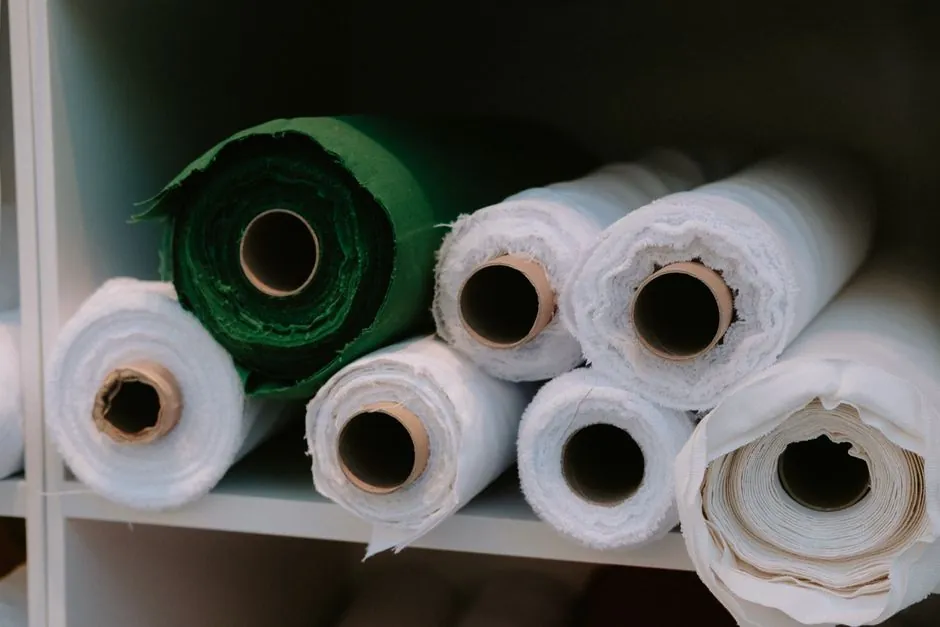
E-glass accounts for over 90% of reinforcement usage in composite fabrication worldwide, and for general-purpose layups it remains the default grade at 3,100-3,800 MPa tensile strength, 72-85 GPa elastic modulus, and 2.54-2.62 g/cm³ density, per Advanses Laboratory verification using ASTM D3039 protocols [S3].
General fabrication covers hand layup, vacuum infusion, pultrusion, and filament winding of tanks, pipes, boat hulls, enclosures, and architectural panels. The selection decision is governed by four variables: required tensile and flexural strength, chemical exposure, operating temperature, and total part cost per kg of laminate.
Glass chemistry families: E, S, C, E-CR, A, D, R
E-glass is an alumino-borosilicate with less than 1% w/w alkali oxides, the workhorse grade for glass-reinforced plastics (GRP) and electrical insulation [S2]. S-glass is an alumino-silicate without CaO/MgO, delivering 4,400-4,900 MPa tensile and 85-90 GPa modulus, roughly 41.3% higher strength than E-glass at 3-4x the unit cost [S3].
C-glass carries high boron oxide and is specified for chemical-tank linings and acid-resistant veils where E-glass would degrade. E-CR-glass (electrical/chemical resistance alumino-lime silicate) targets the same corrosion niches with a different alkali profile below 1% w/w. D-glass (low dielectric constant borosilicate) is reserved for radomes and PCB substrates, not structural layups. R-glass and A-glass fill the alkali-lime and high-modulus niches respectively, with R-glass used where S-glass cost is unjustified but E-glass modulus is insufficient [S2].
For readers comparing reinforcement families, the broader material landscape is covered in the carbon fiber encyclopedia entry, which pairs with E-glass in hybrid layups to tune stiffness without the full cost jump to S-glass.
Comparison of the four fabrication-relevant grades
For general fabrication the realistic shortlist is E, S, C, and E-CR, and the decision reduces to four criteria: tensile strength, cost per kg, chemical resistance, and continuous-service temperature. S-glass wins on strength and temperature (15-20% higher heat deflection than E-glass) but loses on cost at 3-4x E-glass pricing [S3]. C-glass and E-CR-glass win on acid and alkali resistance but sit below E-glass on raw tensile properties. E-glass is the lowest-cost baseline at 35-45% below specialty fibers, with 3-5% batch-to-batch property variation per Advanses test data [S3].
The practical rule is to default to E-glass unless the laminate is exposed to sustained acid/alkali, requires greater than 3,800 MPa fiber strength, or operates above the E-glass heat-deflection ceiling. Switching to S-glass is justified only when the laminate design calculations actually require the extra 1,000+ MPa of fiber strength; otherwise the cost premium is paid for unused margin.
Manufacturing route and what it does to fiber properties
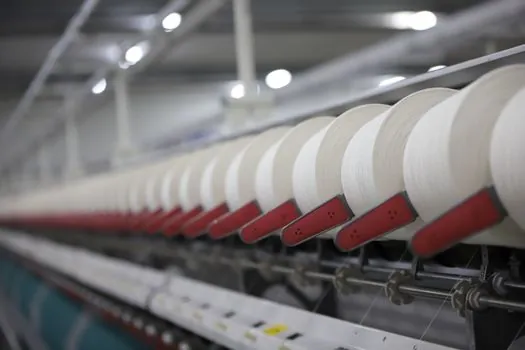
Continuous filament glass fiber is produced in five steps: batching, melting, fiberization, coating (sizing), and drying/packaging [S6]. The critical step for fabricators is fiberization, where the molten glass is drawn through bushings into filaments typically 5-24 micrometers in diameter, followed immediately by the aqueous sizing application that defines the fiber-matrix interphase.
The 2026 Materials Today Communications review emphasizes that final composite performance is governed not only by intrinsic fiber properties but by melt-processing stability, fiber diameter, flaw distribution, sizing durability, matrix compatibility, processing route, and long-term environmental exposure, not by glass chemistry alone [S1]. In practice this means two E-glass rolls from different suppliers, both meeting ASTM D3039 nominal values, can still deliver different laminate fatigue lives because the silane sizing package and filament diameter distribution differ. Fabricators running qualification on a new supplier should pull both roving samples and run short-beam shear (ASTM D2344) and interlaminar shear retention after 1,000-hour humidity aging before releasing the part.
Fabric form factors: roving, mat, woven, and chopped
General fabrication draws on four physical forms, each tied to a process. Direct roving and woven roving feed pultrusion, filament winding, and hand layup of large panels. Chopped strand mat (CSM) is the lowest-cost reinforcement for hand layup of boat hulls and tank shells, but it carries the lowest fiber-volume fraction and the lowest mechanical efficiency. Continuous filament mat (CFM) bridges the gap between CSM and woven, giving better wet-out and higher fiber content for closed-mold processes. [S2]
Surface chemistry interacts with these forms: the same E-glass roving used in a polyester hand layup will fail to wet out in an epoxy infusion unless the sizing is epoxy-compatible. For structural layups where fabric form matters, the glass fiber encyclopedia page documents the standard weight ranges (typically 300-800 g/m² for woven roving) and resin-consumption rules of thumb that procurement and process engineering both need.
Selection criteria mapped to application

For boat hulls, ATV bodies, and architectural panels in benign environments, E-glass CSM or woven roving in polyester or vinylester is the economic choice and accounts for the bulk of the marine and corrosion-equipment market [S2]. For chemical process tanks, pipes, and scrubbers in acid or chloride service, the inner corrosion liner should be specified as a C-glass or E-CR-glass veil backed by E-glass structural layers, a hybrid that cuts cost versus an all-C-glass build while meeting the chemical resistance requirement.
For aerospace secondary structures, high-performance sporting goods, and defense applications where the laminate is weight- or stiffness-critical, S-glass or R-glass is the correct baseline. S-glass is also preferred where elevated temperature service or fatigue performance dominates, since its higher heat-deflection temperature and higher tensile strength give longer service life under cyclic loading.
For a deeper look at how layup choices compare to other composite processes, the carbon fiber encyclopedia page gives the cost-versus-stiffness reference points that help justify hybrid E-glass/carbon stacks when a part sits between boat-hull and aerospace requirements.
Standards, testing, and verification
Tensile testing of glass-fiber-reinforced composites is typically run to ASTM D3039 for coupon tensile, ASTM D2344 for short-beam shear, and ASTM D3171 for constituent content (fiber volume fraction). The Advanses data set was collected on these protocols, and the reported ±2% measurement accuracy applies to ASTM D3039-modulus measurement specifically [S3].
For dielectric and electrical-insulation applications, the relevant property window is volume resistivity of 10¹²-10¹⁴ ohm-cm, which the Advanses test program reports for E-glass and which is the typical acceptance band for GRP used in switchgear and transformer housings [S3]. Fabricators chasing a specific dielectric-loss target should not assume S-glass substitutes cleanly: its higher alkali content in some formulations shifts the dissipation factor, so D-glass or a custom E-glass formulation is more often the right answer for radome and PCB work.
Limits, failure modes, and what to watch for in 2026
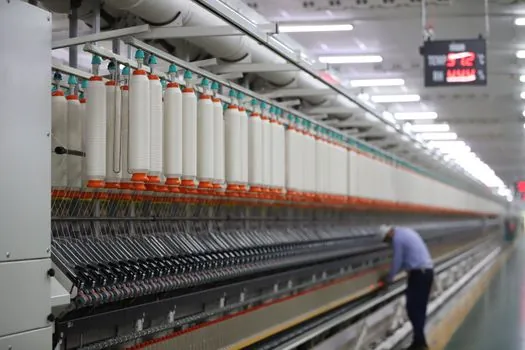
The dominant failure mode in service is not fiber breakage but interfacial degradation: moisture ingress attacks the silane sizing, the fiber-matrix interphase loses shear transfer, and laminate strength drops before any visible fiber damage. The 2026 review highlights that long-term environmental exposure and sizing durability are now treated as first-order design variables, not afterthoughts [S1].
Recycling and remelting of E-glass cullet is the other 2026 development vector, with re-sizing and re-spinning routes under evaluation to close the loop on production scrap and end-of-life composite parts [S1]. For a fabricator specifying glass today this is not yet a procurement constraint, but procurement teams are increasingly asking suppliers for recycled-content data on E-glass roving, and the answers are now starting to be available rather than deflected.
The other trackable signal is nanoparticle-based interphase coatings, which the same review flags as an emerging route to push the upper service-temperature ceiling of E-glass laminates without paying the S-glass cost premium. If a 2026-2027 datasheet release from a major roving supplier lists a nano-coated E-glass with verified interlaminar shear retention past 1,000 hours of humidity aging, that is the next buying decision worth tracking.
Detailed specification references: glass quartz.
See also our earlier report, Sand Casting Mold Selection: A Spec-First Buyer's Map.