
E-glass, S-glass, AR-glass, and C-glass are the four grades that dominate construction-grade glass fiber specification, with selection driven by required service conditions rather than chemistry alone [S1]. The dominant construction form is Glass Fiber Reinforced Polymer (GFRP), produced by embedding continuous or chopped glass fibers into polyester, vinyl ester, or epoxy resin systems [S4].
For a process engineer sizing a non-corrosive structural skin, the real decision tree is alkali exposure, tensile demand, fire/smoke rating, and panel translucency, with fiber diameter, sizing chemistry, and matrix compatibility acting as the sub-filters that decide final cost [S1]. The 2026 review by Hussain et al. in <em>Materials Today Communications</em> Vol. 54 makes the point explicitly: final composite performance is governed by melt-processing stability, fiber diameter, flaw distribution, sizing durability, matrix compatibility, and long-term environmental exposure, not just the nominal glass type [S1].
E-Glass: The Default Grade for GFRP Rebar, Panels, and Profiles
E-glass is the workhorse of construction GFRP because of its high electrical insulation properties, balanced mechanical performance, and the lowest cost per kg among structural grades [S5]. It is the default specification for fiberglass rebar, pultruded profiles, sandwich panels, and most chopped-strand mat laminates used in building skins and claddings [S4].
The trade-off engineers accept is alkali vulnerability: in direct contact with wet concrete, untreated E-glass loses tensile capacity over time, which is why GFRP rebar is normally specified with resin-rich surfaces and concrete-cover rules rather than bare fiber contact [S1]. For non-embedded uses (cladding panels, purlins, girts, cable tray, cooling-tower fills, FRP doors, translucent roofing), E-glass remains the cost-default choice, with sizing selection (silane, film former, lubricant package) doing the heavy lifting on interphase durability [S1][S3].
S-Glass and S-2 Glass: When Tensile Strength and Modulus Drive the Section
S-glass is specified for high-tension zones where E-glass's specific strength runs out, including bridge tendons, seismic retrofit wraps, high-pressure FRP pipe, and aerospace-grade structural laminates [S5]. S-glass is valued for its exceptional tensile strength and modulus compared with E-glass, which directly translates to thinner laminates for the same design load, a real benefit when dead-weight is a constraint [S5].
The cost premium versus E-glass is significant and usually reserved for the load path, not the entire laminate; common practice is a hybrid lay-up with S-glass in the principal stress direction and E-glass elsewhere [S1]. For construction buyers, the spec-relevant parameters are tensile strength (typically quoted in the 4.0-4.8 GPa range for S-glass versus 2.4-3.1 GPa for E-glass rovings, per the comparative review), tensile modulus, and the sizing family matched to the chosen resin [S5].
AR-Glass: The Required Grade for Concrete, Mortar, and Cementitious Matrices
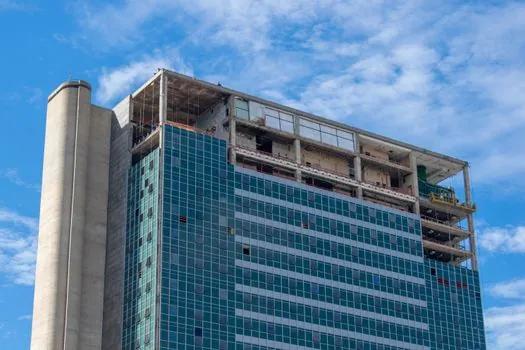
AR-glass (alkali-resistant glass) is engineered specifically for cementitious matrices, where ordinary E-glass would suffer from Portlandite-driven corrosion of the silica network [S7]. AR-glass typically contains 16-20% zirconia (ZrO2) in the glass formulation, which gives the fibers long-term stability in the high-pH pore solution of concrete, typically pH 12.5-13.5 [S1].
In construction, AR-glass is the standard fiber for GFRC (Glass Fiber Reinforced Concrete) architectural panels, thin-shell elements, and sprayed-concrete façade work, where the fiber must survive decades of moisture cycling and alkali exposure without losing flexural performance [S7]. For structural concrete reinforcement (rebar, mesh), AR-glass is the technically correct grade, though E-glass-based GFRP rebar is still common when a resin-rich barrier is engineered to keep the fiber out of direct alkali contact [S1][S4].
C-Glass and Surface Veils: Chemical Resistance and Surface Finish
C-glass is the grade to specify when the service environment is chemical attack (acids, chlorides) rather than just moisture; it carries a higher calcium borosilicate content and is valued in chemical-tank liners, pipe internals, and surface veils where the outer ply of a laminate sees the corrosive medium first [S5]. C-glass veils are commonly used as the outer 0.2-0.5 mm ply of FRP tanks, ducting, and swimming-pool shells, with structural E-glass or S-glass rovings carrying the mechanical load beneath [S1][S5].
From a procurement standpoint, C-glass is rarely ordered as the full laminate; it almost always appears as a thin veil or surface tissue, priced per m2 of areal weight rather than per kg of roving [S3]. This is also the grade to consider when surface finish and gel-coat protection matter, because its chemistry bonds well with the vinyl ester and polyester gel-coats used in sanitary and pool construction [S5].
Polypropylene Fiber vs Glass Fiber: Cost, Flexibility, Thermal Resistance

Polypropylene (PP) fiber and glass fiber (GF) are both used as concrete and mortar reinforcement, but they solve different problems, with PP fiber being the cost-effective choice for plastic-shrinkage crack control and GF being the choice where structural tensile capacity or thermal stability is required [S6]. PP fiber is more cost-effective and flexible, while glass fiber offers superior strength and thermal resistance, a useful one-line selection rule for non-structural slab and screed work [S6].
The two are not strict substitutes: PP fiber is typically dosed at 0.6-1.2 kg/m3 as discrete short fibers to suppress plastic-shrinkage cracking in slabs and screeds, whereas glass fiber in concrete applications is dosed at 2-5% by mass as chopped strands or filaments to carry post-crack tensile load [S1][S6]. For fire-rated construction, PP fiber has a low melting point (~160-170 °C) and will burn out, leaving void channels for explosive spalling mitigation in tunnel and high-rise concrete; glass fiber survives much higher temperatures but loses strength above ~400-500 °C depending on the grade [S1].
Construction Forms: Rebar, Profiles, Panels, Sandwich, and Translucent Skins
Beyond chemistry, the construction form drives the spec: GFRP rebar (AR or E-glass with resin-rich coat), pultruded profiles (mostly E-glass), GFRC panels (AR-glass), FRP sandwich panels (E-glass skins with foam or honeycomb core, like Mitsubishi Chemical's MultiQ range as a plywood substitute with stable flexural strength under humidity), filament-wound pipe (E- or S-glass), and translucent roofing sheets (typically E-glass with polyester or acrylic film) [S3][S4].
The 1987 Transportation Research Record case study of the all-composite radio-frequency test building (the first structure of its kind, with rigid frames, columns, purlins, girts, bolts, nuts, and cladding all made of glass-fiber-reinforced composites) is still cited as the proof-of-concept that GFRP can carry primary structural loads when designed on the merits of the composite, not as a steel substitute [S2]. The key design point from that case is the use of captive elements to resist buckling, because the low Young's modulus of the composite relative to steel means free-edge beam design that is acceptable in steel shapes is not acceptable in FRP [S2].
Selection Criteria: Strength, Alkalinity, Fire, Translucency, and Lifetime Cost
The four main glass fiber options line up against the five decision criteria that matter in construction: E-glass leads on cost and electrical insulation, S-glass leads on tensile strength and modulus, AR-glass leads on alkali resistance, and C-glass leads on chemical resistance, with no single grade winning across all five [S1][S5]. A practical decision table looks like: cost sensitivity (E > C > AR > S), tensile demand (S > E > AR > C), alkali exposure (AR > E > C), chemical exposure (C > E > AR > S), electrical insulation (E > S > AR > C) [S1][S5].
Lifetime cost (not per-kg price) is the metric that usually picks the grade: GFRP rebar and GFRC panels have higher unit cost than carbon steel and unreinforced concrete, but their corrosion resistance and lower maintenance deliver favorable life-cycle cost in coastal, industrial, and de-icing-salt environments [S2][S4]. For applications where steel fails to function effectively (electromagnetic transparency, chemical plants, coastal structures), composites are specified not as a cheaper alternative but as the only material that meets the service requirement [S2]. For related background on the glass fiber material family, the broader construction materials category, and the tools used to install FRP systems, see the linked encyclopedia entries.
Sourcing, Standards, and Common Failure Modes
The dominant construction standards to cite on drawings and data sheets are ACI 440 (GFRP reinforcement), ASTM D7957/D7958 (GFRP rebar), EN 13121 (GRP tanks and vessels), and ASTM C1666 (AR-glass fiber for GFRC); the 2026 review explicitly calls for stronger integration between composition design, scalable manufacturing, surface modification, performance-based material selection, and predictive lifetime modelling [S1]. Buyers should ask for mill certificates naming the glass type (E/S/AR/C), filament diameter (commonly 9-24 µm for rovings), tex/yield (g/km), sizing chemistry, and compatibility with the named resin system [S1].
Common failure modes that show up in the field are: alkali attack on E-glass in concrete (mitigated by resin-rich coat or moving to AR-glass), UV-driven resin degradation in translucent roofing (mitigated by UV-stabilized film and gel-coat), creep rupture in long-span pultruded profiles (mitigated by reduced sustained-stress design factors and S-glass hybridization in the load direction), and loss of flexural strength at the FRP-plywood interface when humidity cycles, a problem the MultiQ sandwich panel specifically targets by replacing plywood with all-GFRP laminates whose mechanical properties remain virtually unchanged after prolonged humidity exposure [S1][S3]. For a related perspective on procurement discipline that applies equally to GFRP sourcing, the suspended ceiling spec map for UK classrooms walks the same criteria-based, service-condition-first approach.
Trackable signals for 2026-2027: (1) wider commercial availability of nano-coated sizing systems that improve fiber-matrix interphase durability, flagged as an emerging research route in the 2026 <em>Materials Today Communications</em> review [S1]; (2) more AR-glass-based primary rebar bids on highway and marine substructure tenders as 50-100-year service-life requirements are written into specifications; (3) growing use of all-GFRP sandwich panels (MultiQ-type) as a direct plywood replacement in humid construction environments, driven by stable flexural strength under moisture cycling [S3].
Component reference pages worth checking: construction tools.