
Quartz in mold and die shops shows up in two distinct roles, and conflating them leads to bad specification: as a granular foundry sand (silica, SiO2) that fills a casting mold or sand casting mold, and as a respirable airborne hazard created when that sand is discharged, conveyed, crushed, or mixed [S5]. The first role is a process consumable; the second is an occupational-health regulation problem tied to TRGS 900, TRGS 560, and TA-Luft in EU jurisdictions [S5]. Neither role makes quartz a candidate for the steel or aluminum that actually machines the cavity.
Tooling-material selection for the cavity and core inserts still follows the established steel and aluminum decision tree documented in 2025-2026 engineering guides: P20-class pre-hardened steel at HRC 28-40 for medium runs, H13/D2/SKD11 hardened steels at HRC 45-52+ for high-volume or die-casting tools, and 7075 aluminum for prototype and short-run tooling [S2][S3]. A practical spec map for mold base and die work, including the quartz-dust compliance layer, is laid out below.
Where quartz actually sits in a mold and die workflow
Quartz sand is the traditional main aggregate for green sand and chemically bonded foundry systems, valued for refractoriness, grain availability, and low cost, and it is processed through discharge conveyors, lump crushers, magnetic separators, bucket elevators, sand coolers, and mixers [S5]. The mechanical preparation stages listed by Keller Lufttechnik are the exact nodes where SiO2 dust becomes airborne: material discharge, belt transfer, lump crushing, magnetic separation, bucket elevator lift, sand cooler, and mixer feed [S5]. Foundry engineers therefore treat quartz as a quartz material consumable with a binding spec (grain size, AFS number, SiO2 percentage, loss-on-ignition) and a parallel EHS spec (respirable crystalline silica exposure controls).
For a comparison view, glass quartz shares the same SiO2 chemistry but is a fused, amorphous derivative used in semiconductor and optics, not in green sand; mis-substituting fused silica for foundry sand has happened on poorly specified construction machinery and equipment liner pours, where the wrong thermal expansion cracks the part. Foundry quartz spec is therefore not interchangeable with optical or electronics-grade quartz spec, even though both report a SiO2 assay.
Tooling steel selection vs aluminum: 2025-2026 reference table
For the steel and aluminum that actually cut the cavity, the 2025-2026 selection data resolves into a stable four-tier ladder [S2][S3][S4]:
1) 7075 aluminum: prototype and short runs, hundreds to tens of thousands of parts, fastest cycle time thanks to high thermal conductivity, but limited life and unsuited to abrasive or high-temperature engineering plastics [S3]. 2) P20 / 718 / NAK80 pre-hardened steel at HRC 28-40: medium runs, direct machining without post-heat-treat, NAK80 preferred for optical polish [S2]. 3) H13 / D2 / SKD11 hardened steel at HRC 45-52+: mass production and die casting, with H13 specified for thermal stability and D2/SKD11 for wear [S2]. 4) Powder-metallurgy steels such as ASP23 / ASP30 plus tungsten carbide: ultra-high precision, ultra-long life stamping and forming dies [S2].
Cycle-volume alignment is sharp: aluminum covers prototype through tens of thousands of parts, pre-hardened P20 typically supports up to roughly 500,000 cycles, hardened H13/D2 extends into the high six figures and beyond, and the SPI mold-classification system maps Class 101 (1,000,000+ cycles) down to Class 105 (up to 500 cycles, prototype) directly onto the tool-life expectation of this material ladder [S3][S4]. A buyer who specifies aluminum for a Class 101 part is paying for a tool that will not survive the run.
Process selection follows the material you already chose

Material choice locks the machining strategy before the first cut, because high-speed hard milling in the 20,000-40,000 RPM band can now cut steels up to 66 HRC directly, reducing EDM dependency on complex cavities [S4]. Published Makino hard-milling data on 64 HRC steel holds ±0.0003 in tolerance with 0.0002 in repeatability, a level only stable when machine rigidity, thermal control, and toolpath strategy are aligned [S4]. Sinker EDM still owns deep ribs, sharp internal corners, and textured surfaces that no cutter can physically reach, and wire EDM handles through-cuts and small-radius features on hardened punches and die inserts [S4].
Engineers specifying 5-axis simultaneous machining should expect a ball-nose cutter to maintain a consistent contact angle across compound curves in a single setup, eliminating the repositioning errors that accumulate across stacked 3-axis setups and producing a more consistent surface finish on a Class 101 cavity [S4]. For die casting work, the cross-reference on die casting die steel and shot weight trade-offs gives a more granular view of H13 versus H21 versus H22 selection.
Quartz-dust compliance layer: TRGS 900, TRGS 560, TA-Luft, VDI 2262-3
Respirable crystalline silica from quartz handling is regulated as a carcinogenic workplace substance, and the European standards load typically cited on foundry extraction systems is TRGS 900 for occupational limit values, TRGS 560 for air recirculation after processing carcinogenic dust, TA-Luft for emission standards, VDI 2262-3 for workplace air quality and clean-air recirculation, plus DGUV Regel 109-002 (formerly BGR 121) for workplace ventilation [S5]. The compliance pattern is the same: capture at the emission source (conveyor transfer, crusher, magnetic separator, bucket elevator, sand cooler, mixer) with robust dust collectors using large, durable, flexible filter elements such as the JET-SET series, or PT filters paired with pre-separators where energy efficiency and low filter resistance dominate the spec [S5].
Air-recirculation operation under TRGS 560 is the specific clause that drives filter-grade selection, because once the cleaned air is sent back into the work hall, the residual load on each filter stage becomes a hard compliance metric rather than a maintenance preference. For a quartz material selection context that crosses into semiconductor and electronics-grade purity, the spec bands diverge sharply, and a foundry buyer should never accept an electronics-grade fused-silica data sheet as a substitute for an AFS-grain foundry sand spec.
Limits, failure modes, and what to exclude
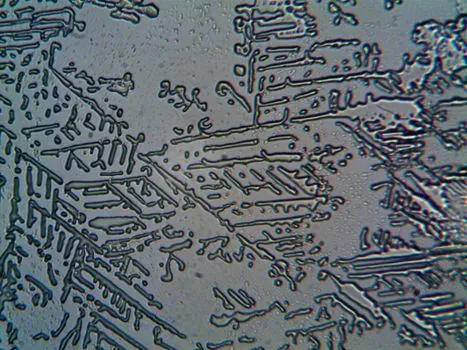
Quartz sand fails predictably in three ways: thermal expansion mismatch against metal castings if the SiO2 grade is mis-applied; mechanical degradation of the sand grain after repeated recycle loops, which forces AFS and loss-on-ignition re-checks; and respirable-dust exceedance when extraction is undersized or maintenance is deferred [S5]. For tooling steel, the documented failure modes are galling on aluminum tooling when abrasive glass-filled engineering plastics are processed, polish-pit defects on NAK80 when the steel is contaminated, and EDM recast layers on H13/D2 when sinker EDM flushing is inadequate [S2][S4].
The selection is therefore not for a single material, but for a coupled spec: a steel grade (P20 or H13, with HRC band and heat-treatment record), a machining process (5-axis hard milling or EDM with tolerance and surface-finish targets), and an extraction system (filter type, kW rating, and TRGS 560 recirculation compliance) sized to the sand-handling capacity of the foundry line [S3][S4][S5]. Buyers who treat these as separate purchase orders typically pay twice, once at the tool builder and once at the regulator.
Sourcing signals to track next
Two verifiable signals to watch over the next procurement cycle: (a) any update to TRGS 900 occupational exposure limits for respirable crystalline silica, since the limit value drives filter-stage count on every JET-SET or PT-filter installation referenced in [S5]; and (b) the BLS projection of roughly 34,200 annual job openings for tool and die makers through 2034, which directly affects lead times on the P20-to-H13 ladder documented in [S4]. A spec map for pharmaceutical equipment tooling and GxP supplier strategy is a useful cross-check when the same mold shop also serves regulated medical molding.