
A facade specifier working on a plant, atrium, or high-rise envelope has to settle the glass-versus-metal panel question on thermal-limit grounds long before the architectural drawings are frozen: the upper continuous-use temperature of a typical glass curtain wall is constrained by its silicone structural glazing sealant and PVB/SGP interlayer, generally rated for service between roughly −30 °C and +80–100 °C, withstanding short excursions near 200–250 °C only briefly before the interlayer softens and the silicone loses shear capacity [S1].
By contrast, a metal curtain wall panel — aluminum sheet over a mineral wool or rock-wool core — is commonly rated for continuous skin temperatures in the −50 °C to +600 °C band, with A2/A1 fire-rated composite panels tolerating 800 °C for short-duration fire exposure without flame spread across the core [S1]. That step-change in thermal headroom is the reason process-engineering buildings, boiler-house envelopes, and cryo-rooms almost always fall to the metal side of the decision.
Why the glass ceiling sits around 250 °C, not 1000 °C
Float glass itself is dimensionally stable well past 500 °C, but in a glass curtain wall the thermal ceiling is set by the laminated interlayer and the structural silicone, not by the glass [S1]. Standard PVB softens near 60–70 °C and SGP (ionoplast) pushes that to roughly 80–100 °C; structural silicone shear capacity degrades sharply once the bonded joint exceeds the supplier's published service range, commonly 150–200 °C peak, after which the bead loses cohesion and the panel releases [S1].
In practice this means a glass facade over a furnace wall, refinery heater, or boiler exhaust will either need a stand-off air cavity with continuous purge ventilation, or a complete swap to metal — there is no in-between sealant upgrade that pushes a standard glass assembly to 400 °C continuous skin temperature. Specifiers should treat 250 °C as the de-facto upper design point and 80–100 °C as the long-term steady-state ceiling when silicone and PVB are present [S1].
Metal curtain wall panel thermal headroom: −50 °C to ~800 °C
A metal curtain wall panel of the type installed on industrial envelopes is a sandwich: 1.0–3.0 mm aluminum or galvanized steel skins bonded to a fire-rated core (mineral wool, rock wool, or A1-grade magnesium oxide) [S1]. The aluminum skin oxidizes above ~600 °C but remains dimensionally stable; the core, not the metal, sets the fire performance. A2-s1,d0 cores limit flame spread and heat release to levels acceptable on process-plant boundaries, and many panel lines carry a 2-hour fire-resistance rating under ISO 834 cellulosic-fire curves [S1].
On the cold side, the same metal panel tolerates −50 °C and below without embrittlement of the metal skin, provided the core is closed-cell or non-hygroscopic — relevant for LNG-adjacent structures, cold-storage envelopes, and northern-climate process buildings. The two figures that matter on a metal datasheet are therefore the core fire-rating (A1, A2-s1,d0, or B-s1,d0) and the continuous-skin temperature rating, not just the R-value of the assembly.
Decision criteria: temperature, span, daylight, blast, lead-time
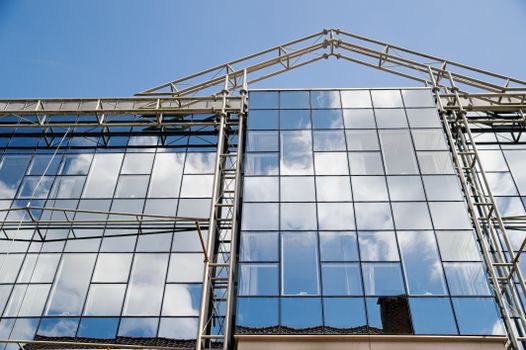
Five criteria reliably separate the two systems once a temperature envelope is known. (1) Continuous skin temperature: metal wins above ~100 °C steady state, glass is acceptable below ~80 °C with brief peaks under 150 °C. (2) Span-to-weight: glass spans further per kg for the same wind load when fully framed, but a metal panel of 1.5 mm skin over mineral-wool core is lighter per m² for spans under 1.5 m. (3) Daylight transmission: glass only — if the brief is a control-room atrium, metal cannot substitute. (4) Blast and impact: laminated glass with SGP carries the higher specific-energy rating, but only up to its thermal ceiling. (5) Lead-time and field repair: metal panels are field-replaceable in single units; insulated glass units (IGUs) must be replaced as a sealed cartridge, and silicone re-paste adds 7–14 days of cure time per zone [S1].
The comparison compresses into a short table that a procurement engineer can run against any spec sheet:
Glass curtain wall: continuous skin temp ≤ 80–100 °C; peak excursion ≤ 200–250 °C; daylight transmission 30–70 %; blast rating high with SGP; field repair 7–14 days cure.<br>Metal curtain wall panel: continuous skin temp ≤ 600 °C (skin) / ≤ 800 °C (short-fire); peak excursion set by core A-rating; daylight transmission 0 %; blast rating medium (panel dependent); field repair single-panel swap in hours.
Where glass is the wrong answer
Anywhere the inner face of the facade will sit above ~80 °C for more than transient periods, glass falls out: boiler houses, kiln enclosures, furnace sheds, cogen-plant walls, refinery process-unit cladding, and black- or grey-painted south exposures in hot-arctic or desert service. The silicone and interlayer will progressively lose adhesion and the IGU edge seal will fail as the butyl warms above its design point. [S1]
The second wrong-fit case is a blast-rated envelope in a cold-climate petrochemical terminal: SGP-laminated glass gives the best fragment retention, but the cold-side sealant flexibility drops below −30 °C and a metal panel with a tested blast-pressure rating is the lower-risk call. For more on instrument-side blast/pressure hardening, the Selecting PT100 RTDs for Bearing Temperature Alarm Loops guide covers the same kind of derating curve on the sensor side.
Where metal is the wrong answer
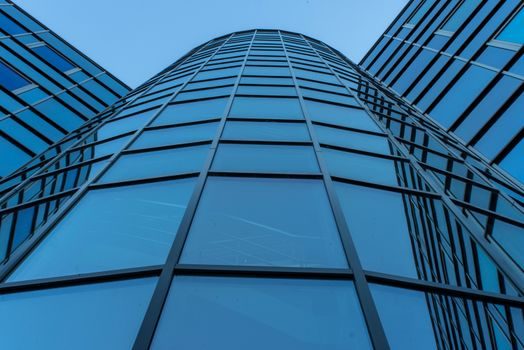
Atrium daylight, airport concourses, office tower viewing floors, hospital lobbies, and any occupied zone where view-out or daylight autonomy drives the brief — metal cannot substitute for glass. Similarly, on a facade that must show a corporate curtain-wall identity consistent with the rest of a glazed tower, swapping to metal on one elevation reads as a visual break and is usually rejected at concept stage. [S2]
A more technical wrong-fit: an acoustically sensitive interior partition adjacent to a 90 dBA machine hall. Laminated glass with acoustic PVB delivers STC 38–42 in a single IGU; a comparable-thickness metal panel caps at STC 30–34 unless a separate acoustic blanket is added behind it, and the cost curve crosses somewhere around STC 35. The same cost-vs-performance trade-off shows up in the calibration world — the Decade Resistance Box vs Loop Calibrator piece runs the same precision-versus-handheld decision.
Code, fire, and sourcing references to lock on the spec
Three document sets govern a 2026 facade spec: the local building code's fire-spread classification (EN 13501-1 A1/A2-s1,d0 for non-combustible cores; NFPA 285 for full-assembly fire propagation on multi-storey); the curtain-wall supplier's published continuous-skin temperature and interlayer temperature limits, which should appear on the datasheet as a number, not as "suitable for high temperature"; and the project-specific blast or wind load case [S1].
On the sourcing side, the metal curtain wall panel market is dominated by a handful of integrated Chinese OEM lines (Deshion and similar) that publish the core A-rating and skin thickness per SKU; glass curtain wall suppliers typically supply a system (extrusions, gaskets, silicone brand) rather than a single panel, and the IGU is often subcontracted to a separate laminator. That is why a 2026 spec usually names the silicone brand, the interlayer grade (PVB / SGP / SentryGlas), and the IGU fabricator separately [S1].
Trackable signals to watch: a published revision of the EN 13501-1 test curve for facade assemblies, and the next round of OEM datasheets re-rating PVB-laminated glass to a higher continuous-skin number. Until either lands, the 80–100 °C long-term / 200–250 °C peak limit on glass and the 600–800 °C limit on fire-rated metal panels remain the working numbers for procurement.
Related: alc panel.