
UHP graphite electrodes are manufactured from petroleum coke, needle coke and coal-tar pitch binder through calcining, kneading, forming, baking, impregnation, graphitization above 3000 °C and precision machining [S4], making the upstream raw-material mix the single biggest cost and quality lever for the entire industry.
Downstream, the same electrode grade serves EAF steelmaking, ladle furnaces (LF), silicon metal smelting, yellow phosphorus furnaces and the graphite heat-exchanger lines used in continuous chloroacetic acid production [S2][S4]; export-grade UHP material from Chinese mills was listed at US$1,300.00-1,550.00 per ton FOB in mid-2026 with a 10-ton minimum order [S6].
Upstream Raw-Material Chain: Needle Coke, Petroleum Coke, Pitch
The graphite-electrode process chain begins with two carbon precursors and a binder. Petroleum coke (regular or calcined) is the volume base, needle coke supplies the low-thermal-expansion, high-density grain structure required for UHP grades, and coal-tar pitch acts as the binder during forming and re-impregnation [S4]. The raw-material split between needle-coke-fed UHP/HP electrodes and petroleum-coke-fed RP grades is what defines the grade ladder commonly published by Chinese mills: RP Ø75-200 mm with 6-9 μΩ·m resistivity and 1-8 kA current load, HP and UHP moving to larger diameters and tighter CTE [S8].
For the same RP product line, current carrying capacity is rated 1-8 kA, while UHP/HP large-diameter electrodes (typically 400-700 mm) are engineered for arc-furnace currents that can exceed 60-80 kA per electrode in modern EAFs, which is why needle-coke availability and the calcined-petroleum-coke mesh size distribution are tracked as a supply-chain risk rather than a commodity line item. Calcined petroleum coke is also sold as a separate product category by electrode manufacturers, reflecting the dual identity of the upstream feed [S8].
Manufacturing Route and Why Upstream Quality Sets the Spec
The fixed process sequence is calcining → dosing/kneading → forming → baking → impregnation → graphitization (>3000 °C) → precision machining [S4]. Each upstream input lands at a specific step: calcined petroleum coke and calcined needle coke come out of rotary or shaft calciners above ~1200 °C; coal-tar pitch is melted and mixed in at the kneader; the green formed block is baked to roughly 800-1000 °C; pitch re-impregnation fills residual porosity before the final graphitization pass, which is the step that actually converts the carbon lattice to graphitic structure.
That is why needle-coke sulphur content, CTE anisotropy, and pitch β-resin fraction are upstream variables that propagate directly into the electrode's apparent density, resistivity (μΩ·m) and flexural strength. RP-grade published resistivity sits at 6-9 μΩ·m on Ø75-200 mm stock [S8]; UHP grades from the same producer family run tighter, in the 4.5-6 μΩ·m range, with lower thermal expansion to survive the thermal-shock cycles of a 150-ton EAF tap. Lead times on graphitization furnaces (the bottleneck step) and on needle-coke import licences are the two real schedule risks a procurement engineer has to plan around.
Downstream End-Uses: EAF/LF Steel, Silicon Metal, Yellow Phosphorus
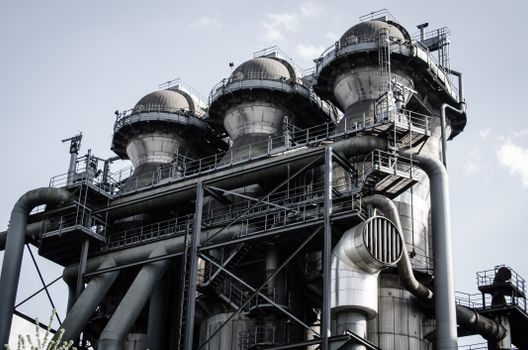
Steelmaking via electric arc furnace is the largest downstream outlet, where the graphite electrode acts as a conductive body that releases heat in the form of an arc to melt scrap [S4]. UHP electrodes in 400-700 mm diameters are the workhorse for this duty, and "UHP 500 mm for EAF and LF" is explicitly marketed as a standard product line by Chinese manufacturers [S6]. Ladle-furnace (LF) refining draws from the same UHP inventory, but at lower secondary currents, so mills often split their electrode stock between EAF and LF by diameter and nipple grade.
Beyond steel, graphite electrodes and shaped graphite parts feed silicon-metal submerged-arc furnaces, ferroalloy furnaces, yellow phosphorus (P4) electric furnaces, and the graphite heat-exchanger blocks used in continuous chloroacetic acid (MCA) lines, where the Association reporting in 2023 confirms graphite heat exchangers as a continuous-process enabling technology for MCA production [S2]. A 99.9995 % (metals basis) high-purity graphite electrode variant, 3.06 mm diameter × 38.10 mm long with a counter-pointed tip, is also listed as an analytical/laboratory-grade article for trace-metal and electrochemistry work [S5] — a low-volume but spec-demanding niche downstream of the same carbon material family.
Price, Capacity and the Upstream-Downstream Spread
Published Chinese export offers in July 2026 put FOB Dalian/graphite-electrode pricing at US$1,300.00-1,550.00 per ton for UHP material in standard diameters, with a 10-ton minimum order and wooden-case packaging [S6], while a separate 2020 listing from a Dalian trading company reported a 30,000 t/yr production capacity and HP/UHP product range with FOB tiers at US$1,500/t (10-19 t) and US$3,000/t (20+ t) — historical bands that show how UHP electrode quotes tightened and spread out as needle-coke supply moved in and out of surplus [S7].
For a procurement engineer, the upstream-downstream margin map therefore compresses or expands with needle-coke index pricing rather than with EAF steel demand alone: when needle-coke tightens, UHP electrode offers move up faster than EAF steel selling prices, squeezing mini-mill cost stacks; when needle-coke loosens, the same offer can drop back toward the US$1,300/t floor [S6]. The trade press framed this dual sensitivity — overcapacity coexisting with sub-scale margins — as the defining 2022 condition of China's graphite-electrode industry, alongside consolidation pressure and the need to climb the value chain rather than compete on tonnage [S9].
Comparison: Upstream Feeds vs Downstream Duties
For spec selection, the upstream raw-material choice can be lined up against the downstream duty on four criteria: cost per ton, maximum operating current, thermal-shock resistance, and purity requirement. Needle-coke-based UHP feeds the high-current, high-shock EAF/LF duty at the top cost; standard petroleum-coke-based UHP serves medium-tonnage EAF and silicon-metal furnaces; RP-grade (petroleum-coke + pitch) covers LF trimming, small foundries, yellow-phosphorus and MCA heat-exchanger blocks at the lowest cost and lowest current (1-8 kA per the published RP data sheet) [S8]; high-purity 99.9995 % graphite is its own line, sized for laboratory and analytical use rather than tonnage production [S5].
On the same four criteria the 2026 FOB bands in the export offers land where the duty meets the upstream mix: US$1,300-1,550/t for UHP steelmaking grades in standard diameters [S6], the 30,000 t/yr HP/UHP capacity ceiling from a single Dalian trading desk [S7], and the 6-9 μΩ·m / 1-8 kA / Ø75-200 mm envelope defining where RP electrodes stop being a sensible pick [S8]. The procurement decision is therefore not "which electrode is best" but "which upstream feed matches which downstream duty at the lowest landed cost per kA delivered to the furnace."
Industrial-Map Context: Upstream-Downstream Linkage Data
For buyers who need a wider industry-chain view, the Wind Product Chain Database (PDB) covers 5,154 industries and over 160,000 upstream and downstream relationships across A-share, H-share and major US-listed companies, with a dual-chain map that runs from primary raw materials through processing equipment to end products and services [S3]. That kind of supply-chain map is how a mill buyer or an electrode producer overlays needle-coke suppliers, pitch suppliers, graphitization capacity, EAF steel demand, and silicon-metal / yellow-phosphorus off-take on a single screen, and it is also the kind of data the China Chlor-Alkali Industry Association used to convene chloroacetic-acid producers with more than 30 upstream-and-downstream related industries at the Guiyang forum [S2][S3].
Two practical signals to watch on the 2026 horizon are the needle-coke import-licence flow (the binding upstream constraint for UHP output) and the EAF-steel capacity-utilization rate in China (the binding downstream demand signal). When the two move in opposite directions, the US$1,300-1,550/t FOB band [S6] typically widens and the squeeze moves to whichever side of the chain holds less inventory — the same dual-sensitivity that has defined this market since the 2022 overcapacity diagnosis [S9]. Readers comparing this supply chain to other carbon-based industrial-feed chains can also reference our polysilicon supply-chain map for 2026, which applies a similar upstream-feed-vs-downstream-grade framing to a different but structurally comparable market.
Spec-level background on the components involved: pressure transmitter, flow meter, and industrial valve.