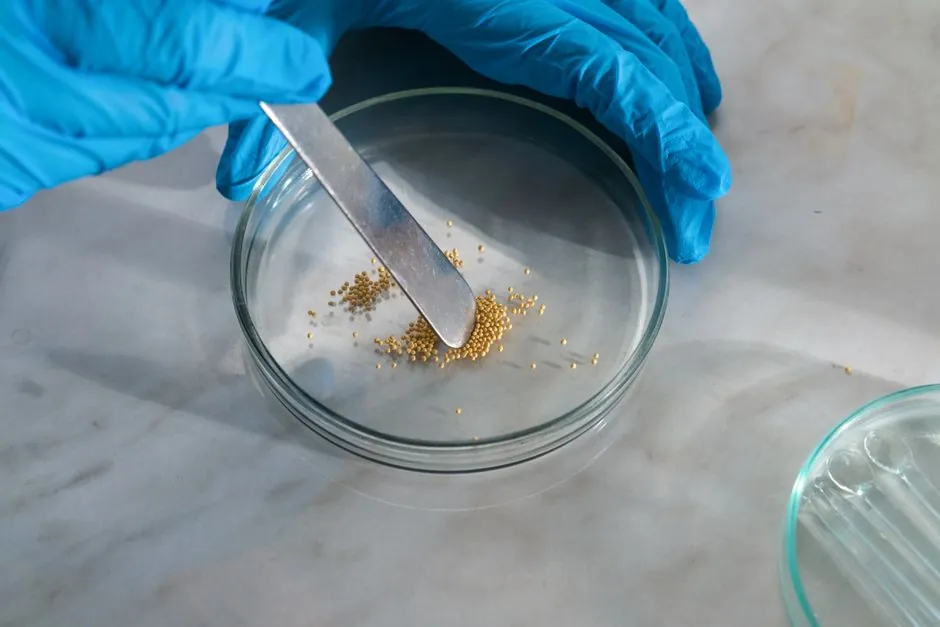
The Hausner ratio (HR) is the single number most often pulled from a metal-powder certificate of analysis to judge whether a lot will feed reliably into a build chamber, a press hopper, or a spreading blade. For additive-manufacturing steels, superalloys, and titanium, HR values above 1.35 are routinely treated as a flow warning, and values above 1.60 are classed as very, very poor flow per the USP 1174 scale that most powder suppliers still reference [S2][S3][S4].
The metric is mechanical, not magical: HR equals tapped density divided by bulk density, so a high ratio means a loose pour packs down a lot under vibration, which in turn means the particles are sticking to each other rather than sliding past one another [S5]. For a process engineer, the practical question is not "what is the formula" but "where exactly does the line between acceptable and unacceptable sit," and that line shifts with alloy, particle size distribution, and process.
What the Hausner ratio actually measures
HR is defined as the ratio of tapped density (ρt) to bulk density (ρb), so HR = ρt / ρb; it is mathematically equivalent to a transformed Carr compressibility index (CI), where CI = 100 × (1 − ρb/ρt) [S5][S8]. A powder that barely settles (tapped density close to bulk density) has an HR near 1.00, indicating free flow; a powder that settles aggressively (large void-filling under tapping) has a high HR, indicating cohesive, interlocked particles [S2][S5].
The test is deliberately crude: a known mass of powder is poured into a graduated cylinder, the loose volume is read as bulk density, the cylinder is mechanically tapped a fixed number of times (commonly 100, 500, or 1250 taps per USP 1174 and similar pharmacopoeia/ISO protocols), and the new volume is read as tapped density [S1][S4]. The simplicity is also its limit: the result is sensitive to operator technique, drop height, and how the powder was charged, so USP explicitly states that compressibility index and Hausner ratio are not intrinsic powder properties [S4].
The published flowability scale and where "poor" begins
The widely cited scale, reproduced across pharmaceutical, food, and now metal-AM literature, places HR 1.00 to 1.11 in the excellent-flow band, 1.12 to 1.18 in the good band, 1.19 to 1.25 fair, 1.26 to 1.34 passable (or "fair-to-passable"), 1.35 to 1.45 poor, and anything above 1.46 climbing toward 1.60, which is the USP 1174 threshold for "very, very poor" [S2][S4]. Multiple secondary sources simplify this to a binary: HR under 1.25 free-flowing, over 1.35 poor [S3].
For metal powders specifically, the AM community has converged on a slightly tighter interpretation: HR under 1.10 is "ideal" for fresh gas-atomized feedstock, 1.10 to 1.25 is the typical working range for production-grade 316L, 17-4PH, and Inconel 718, 1.25 to 1.35 is acceptable with process derating, and HR above 1.35 already predicts recoater streaking, uneven layer thickness, and void formation in laser powder-bed-fusion builds [S3][S7]. A 2019 thesis on characterising flowability of metal powders notes that a high HR is associated with high interparticle cohesion, which in metals is driven by irregular morphology, satellite particles, and high surface-area-to-volume ratios from fine PSDs [S7].
Why the threshold for "poor" sits where it does
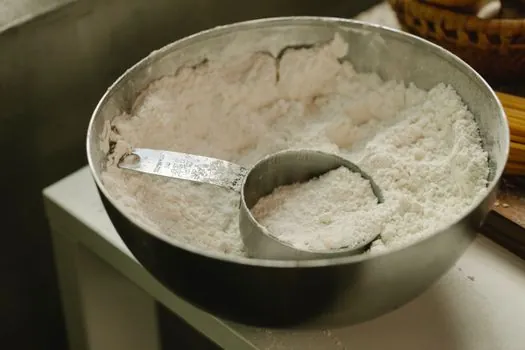
The cutoff is empirical, not theoretical. Carr's original work correlated compressibility index and HR with observed hopper behaviour: powders in the 1.00 to 1.25 range discharged from small hoppers with no rat-holing or arching, while powders above 1.35 reliably produced erratic flow, surging, and dead zones in production vessels [S1]. For metal-AM hoppers and coater blades, the same physics applies with tighter tolerances because the layer thickness is often 20 to 80 micrometers, and a local starve line in the powder bed becomes a defect line in the part.
USP 1174 (official May 1, 2024) repeats the scale and adds the caveat that no single test fully characterises flow; the chapter is harmonized with the European and Japanese Pharmacopoeias, so the HR thresholds are now an internationally consistent reference point even for non-pharmaceutical users who borrow the scale [S4]. The 2026 Stable Micro Systems review notes that HR is mathematically equivalent to a transformation of Carr's Index and shares its known blind spots, particularly the inability to predict dynamic behaviour in real process equipment [S8].
Comparison of HR bands against process impact
Looking at HR bands side by side, the free-flow band (HR under 1.25) typically corresponds to coater speeds of 100 to 300 mm/s with no raking, the passable band (HR 1.25 to 1.35) requires either slower coater speeds, a coarser sieve cut, or a flow aid, and the poor band (HR above 1.35) is where layer defects and density-loss-driven porosity start appearing unless the build is specifically derated. For context, the Hall flowmeter time of the same powder will roughly triple from the 1.10 to the 1.45 HR range, and apparent density can drop 10 to 15 percent in the same interval, which is why metal powder suppliers will frequently flag a lot as "flow-limited" rather than simply rejecting it. [S4]
Against the wider metal material feed-stock landscape, HR is the cheapest and most universal flow proxy: it requires only a 100 mL cylinder and a tap densitometer, both of which are standard on a powder-receiving inspection bench. The same instrument set also produces the Carr compressibility index, so the two numbers move together, and a typical cert of analysis reports both for traceability.
What HR does not tell you, and where it fails
HR is a static, single-axis test, and the 2026 industry literature is blunt about its limits: a powder can score HR 1.20 and still flood in a real hopper, or score HR 1.40 and run cleanly in a vibratory feeder [S8]. The test cannot capture humidity-conditioned cohesion, electrostatics, the effect of PSD tails below 10 micrometers, or the difference between spherical gas-atomized powder and angular plasma-atomized powder of the same nominal size.
This is why the field is moving toward dynamic methods: rotating drum, Freeman FT4 rheometer, Hall flowmeter, and shear-cell data, with HR retained as the cheap first-pass screen rather than the final arbiter. For powder-bed-fusion in particular, parts of the community now pair HR with avalanche energy, basic flowability energy, and the angle of repose to bracket the powder against a known-good lot, which is the practical cement-like baseline that experienced AM operators use before a build.
How to act on a poor HR value
When a powder lot arrives with HR above 1.35, the first move is to compare it to the lot that last produced acceptable parts on the same machine, not to an abstract scale; small drifts in PSD, surface oxygen, or moisture can push HR by 0.05 to 0.10 without changing chemistry. The second move is to sieve the powder to remove the sub-20 micrometer fraction, which typically drops HR by 0.05 to 0.15; if that does not bring it back into the 1.10 to 1.25 range, the lot is usually quarantined for reclassification or used only for non-critical builds. [S2]
Trackable signals to watch between now and the next procurement cycle: suppliers publishing Hausner ratio alongside Hall flow and apparent density as a three-number flow spec; OEMs documenting recoater-derate curves as a function of HR; and standards bodies (ISO/ASTM powder-metallurgy committees) publishing round-robin data on HR repeatability. For deeper reading on related process-spec engineering, see the 2026 spec-level comparison of Ethernet-APL versus 4-20 mA HART on temperature transmitters and what traditional powder flow tests miss about production behaviour, both of which cover the same broader theme of choosing the right test for the right decision.