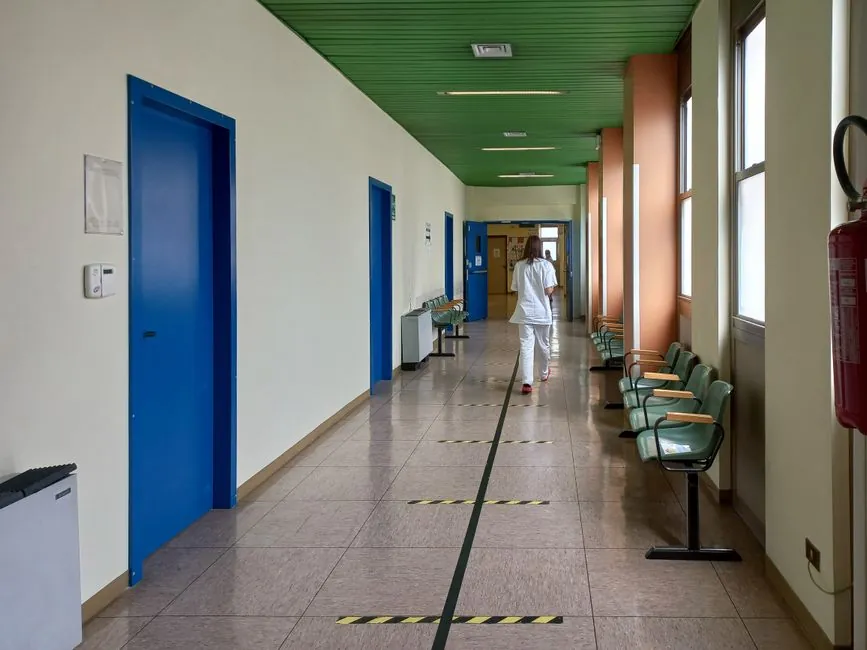
Hospital projects require rigid foam boards that combine ASTM C518 thermal performance with fire-rated facings and low moisture absorption, because operating rooms, MRI suites, and sterile corridors cannot tolerate outgassing or mould growth behind walls [S1][S2].
Specifiers typically choose between extruded polystyrene (XPS), expanded polystyrene (EPS), and polyisocyanurate (PIR) boards in 50-100mm thicknesses, with hospital cold-storage and pharmaceutical rooms demanding the higher end of the 32-45 kg/m³ density range and 300 kPa or higher compressive strength under racking loads [S1].
Material Types and Hospital Application Fit
XPS, EPS, and PIR dominate the rigid foam board market, but their behaviour diverges once moisture, load, and fire exposure enter the picture. XPS offers R-5.0 per inch with very low water absorption, EPS delivers R-3.6-3.8 per inch at lower cost, and PIR reaches R-6.0-6.5 per inch but is more sensitive to long-term moisture intrusion [S1][S2].
For hospital interior walls, MRI shielding enclosures, and below-grade foundations, XPS is the default because its continuous extrusion process creates a uniform closed-cell structure that resists water migration under sustained exposure [S1][S3]. EPS remains common in non-load-bearing partitions and budget wall assemblies, though its bonded-bead structure leaves small inter-cell pathways that can allow limited moisture migration under certain conditions [S3].
Density, Compressive Strength, and R-Value Thresholds
Density governs cell wall integrity and blowing agent retention, which in turn determine R-value; for closed-cell foam boards, gas occupies 95% or more of total volume, so polymer matrix represents less than 5% [S2]. Cold storage floors under forklift traffic often require 300 kPa or higher compressive strength, while standard wall applications may only need 150-200 kPa [S1].
Hospital cold rooms for vaccine storage and pharmacy refrigeration typically call for 32-45 kg/m³ density boards with tighter dimensional tolerances to resist freeze-thaw cycling, whereas general wall insulation can often use lighter 25-32 kg/m³ boards [S1]. R-values are tested under ASTM C518/C1289 standard conditions and reported as long-term thermal resistance (LTTR) to account for aging, since blowing agents diffuse out over time and reduce thermal performance [S2].
Fire Performance and Code Requirements
Hospital fire codes demand flame-retardant B1-class certification for many interior applications, and roofing projects prioritise both compressive strength and fire rating in regions with strict building regulations [S1]. PIR facings commonly carry factory-applied foil facers that improve fire performance but also create vapour-retarder behaviour that designers must account for in wall assembly design [S4].
Fiberglass remains unacceptable in any hospital location where moisture is even remotely present, because trapped moisture leads to mould and mildew growth that compromises infection control [S4]. For basement walls touching masonry, exterior continuous insulation, and rim joists around the foundation, rigid foam outperforms fiberglass because it does not change dimensions, split, or crack when subjected to moisture [S4]. Designers evaluating rigid foam insulation board applications for healthcare projects should match board type to moisture exposure, not just R-value targets.
Moisture Control in Sterile and High-Humidity Zones
Operating rooms, sterile corridors, and laundry facilities generate high humidity loads that demand closed-cell foam with very low water absorption. XPS resists water penetration better than lower-density EPS products because the extrusion process produces a denser material with a consistent cellular structure [S3].
For continuous insulation across framing members, rigid foam reduces thermal bridging through wood or steel studs, a critical factor in maintaining stable temperatures for pharmaceutical storage and blood bank refrigeration [S3]. In MRI suite walls, where thermal stability and electromagnetic shielding both matter, XPS boards paired with appropriate facings prevent the moisture migration that would otherwise degrade adjacent materials over a 20-30 year building lifecycle [S1].
Comparison of Rigid Foam Options for Hospital Projects
Three criteria drive hospital board selection: moisture resistance, compressive strength, and fire rating. XPS scores high on moisture resistance and compressive strength, moderate on fire rating unless a B1-class facing is specified. EPS scores moderate on moisture resistance, low on compressive strength, and moderate on fire rating at higher densities. PIR scores high on R-value per inch, low on long-term moisture stability, and high on fire rating with foil facings [S1][S3].
Cost per R-value favours EPS for budget wall assemblies, cost per kPa of compressive strength favours XPS for loaded applications, and cost per inch of thickness favours PIR where maximum R-value in minimal cavity depth is required [S1]. The differences between EPS and XPS board selection become decisive once a hospital project includes below-grade foundations, cold storage, or any location with sustained moisture exposure.
Selection Criteria Specific to Healthcare Facilities
Hospital projects add infection control and cleanability constraints that residential or commercial projects do not face. Boards with paper facings, which simplify attachment to framing in standard construction, are unsuitable where they can trap moisture against the wall assembly [S4]. Unfaced boards or foil-faced boards paired with proper sealing at panel joints perform better in sterile environments.
For roof insulation layers and exterior continuous insulation, polyurethane insulation and PIR facings dominate healthcare specifications because they deliver the highest R-value per inch and carry fire-rated facings that meet hospital corridor requirements. Foundation insulation and beneath-slab applications typically specify XPS at 50-75mm thickness with 300 kPa or higher compressive strength to handle concrete pour loads and long-term hydrostatic pressure.
Limitations and Failure Modes to Avoid

Ordering boards below required strength rating to save on unit cost almost always costs more later, since replacing insulation inside a finished operating room or under a completed roof membrane is far more expensive than the original material difference [S1]. Density drift during manufacturing can compromise labelled R-value, because small variations in mixing ratios or line speed cause the cell structure to shift and reduce blowing agent retention [S2].
PIR boards can degrade with moisture over the product's service life, which matters for buyers planning a 20-30 year building lifecycle, so specifying PIR in below-grade or high-humidity hospital locations without a robust moisture management strategy is a common error [S1]. For masonry and below-grade applications, masonry insulation choices should favour XPS over PIR to avoid the long-term moisture degradation risk. Designers should also confirm dimensional tolerances across large shipments, because inconsistent panel dimensions multiply across every pallet in a bulk hospital order.
Related Selection Resources and Next Signals
For data center and cleanroom projects with similar thermal-stability and moisture-control demands, the data center insulation board selection spec map covers server-hall enclosure requirements. Commercial office and mixed-use healthcare buildings can reference the commercial buildings insulation board spec map for non-clinical zones. Track the following signals before finalising hospital specifications: factory-direct density certifications per shipment, ASTM C518 LTTR test reports dated within 12 months, and B1-class fire certificates from the board manufacturer rather than a distributor's generic spec sheet [S1][S2].