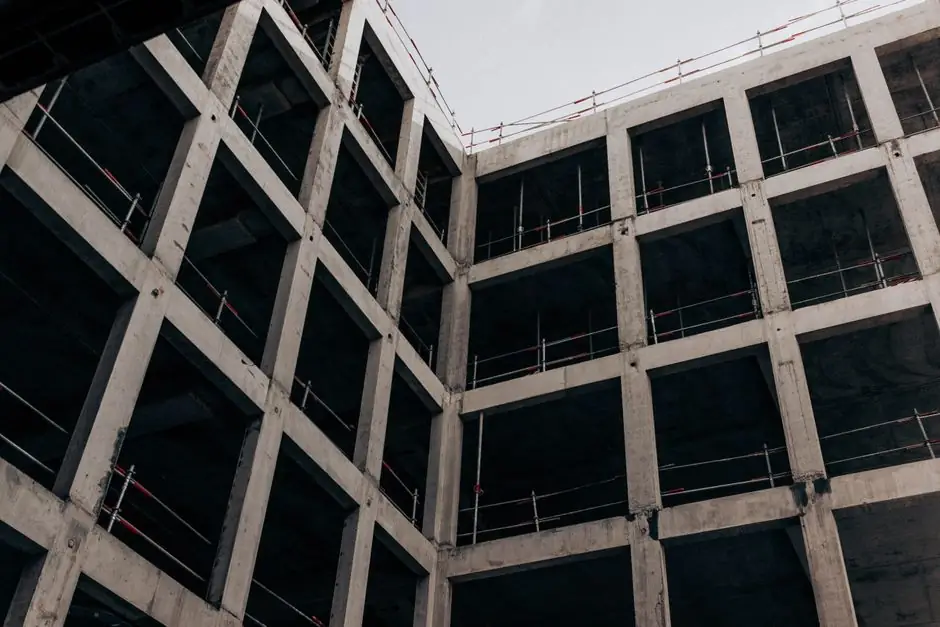
Hospitals are a special case in concrete curing: the slab has to support a flooring manufacturer's warranty, not just a cylinder break result, so the default cure method on most U.S. health-system projects is water-cure, with dissipating chemical cures accepted only when substrate prep compensates [S1].
BJC's published Hospital Standards (Manual of Practice 203.201, B1010 Floor Construction) require interior slabs that will receive floor finishes to be water-cured, and flag that chemical curing compounds (including dissipating types) "void most flooring manufacturer's warranties" unless the surface is subsequently prepared to the floor-maker's spec, typically by mechanical scarifying or grinding [S1]. The same document explicitly bars synthetic macro and micro-fiber reinforcement unless the BJC Director of Design and Corporate Architect signs off in writing [S1].
Why hospitals are different from a typical industrial slab
Hospital floor assemblies carry concentrated wheel loads from beds, gurneys, and mobile imaging carts, and they almost always receive a finished floor (sheet vinyl, LVT, rubber, resinous coatings, or ESD tile) that is bonded directly to the slab, so the chemistry of the top 1-3 mm of concrete is a controlled interface, not an expendable wear surface [S1]. Live-load criteria from the same BJC document include 100 psf for patient/clinical areas plus a 2,000 lb concentrated load over any 6.25 sf within a structural bay, rising to 150 psf for mechanical/telecom rooms and 250 psf for loading docks, all of which raise the cost of any later delamination [S1]. That is why curing is treated as a flooring-interface decision, not a strength-development decision. A slab that hits 4,000 psi at 28 days but leaves a waxy film on the surface will still fail a flooring pull-off test, and the BJC standard explicitly anticipates that: when chemical cures are used, the contractor must prep the substrate "according to flooring manufacturer's requirements," which the standard equates with "mechanical scarifying and grinding" [S1].
ASTM C309 product options and the dissipating vs. pigmented call
When the spec does permit a chemical cure, ASTM C309, "Standard Specification for Liquid Membrane-Forming Compounds for Curing Concrete," is the governing performance document, and the two C309 product types that show up on health-care jobs are dissipating and white-pigmented [S2][S5]. Dissipating curing compounds are formulated to break down under UV, traffic, or the floor-prep abrasion step, which is exactly the behaviour you want when a densifier, hardener, or finished floor is going down later [S2]. White-pigmented C309 compounds are common on bridge decks and pavements where the white TiO2 pigment reflects solar gain and gives visual coverage confirmation, not on interior hard-troweled hospital slabs, because the pigment is essentially impossible to fully remove before flooring installation [S2]. The C309 umbrella also covers clear/transparent versions, which are tested under the same moisture-retention performance criteria but leave no visible residue to track during application.
Substrate prep and the C309-to-densifier handoff
The standard hospital workflow when a chemical cure is permitted runs: place and finish the slab, apply a dissipating ASTM C309 compound at the manufacturer's coverage rate, allow the dissipation period, then mechanically prepare (shot-blast, diamond-grind, or scarify) to a surface profile the flooring manufacturer will accept, and only then apply a silicate concrete densifier or the specified finish system [S1][S2]. SpecChem's published guidance aligns with this: acrylic cures form a thin film that "aids in moisture retention" and that the next trade must either remove (dissipating) or bond through (C1315-type cure-and-seal), which is why C1315 products are usually rejected on finished-floor hospital slabs because they can "prevent proper adhesion of coatings, coverings, and toppings" [S2][S3]. Reactive silicate curing materials are an alternative path that some specialty hospital floors use because they do not leave a film at all, but they still have to be specified intentionally rather than chosen by default [S2].
Comparison: curing options on a hospital floor slab
Three approaches dominate the bid sheet on U.S. health-care projects, and they line up against four decision criteria that actually move the floor-failure risk: [S2]
1. Water-cure (ponding, wet burlene, or soaker hoses): highest moisture retention, zero residue to interfere with flooring adhesives, but the BJC standard is the only major U.S. health-system standard that mandates it, and it needs a tight construction schedule plus 7+ days of protection [S1]. 2. Dissipating ASTM C309 compound: meets spec where chemical cure is allowed, breaks down under UV or abrasion so the substrate can be prepped, but the spec must require mechanical prep after dissipation or the residue will haunt the flooring pull-off test [S1][S2]. 3. White-pigmented ASTM C309 compound: still C309-compliant, gives visual coverage on exterior or deck pours, but leaves pigment that interferes with thin-set and resinous floor adhesion, so it is the wrong default for any slab that will receive a finish [S2]. The decision gate is therefore the presence and type of finished floor, not the structural-design strength gain: if the slab will be exposed steel-troweled and densified only, any of the three can work; if it will receive vinyl, rubber, resinous coating, or terrazzo, water-cure or a fully removed dissipating C309 is the only safe answer [S1][S2].
Safety, ventilation, and crew handling on occupied hospital sites

Many hospital slab pours happen in active wings, so VOC content and odour become hard constraints on top of the spec. Daytonsuperior and other C309 manufacturers publish MSDS guidance requiring "adequate ventilation," protective clothing, gloves, and eye protection (goggles, safety glasses, or face shield) during spray application, and the same MSDS literature flags that prolonged or repeated skin contact can cause irritation and that eye contact requires immediate flushing and medical follow-up [S4]. W. R. Meadows' CC-309-10WS with red fugitive dye is a water-based C309 product whose dye serves the same visual-coverage function as the white pigment on roads and bridge decks, but the dye is fugitive (designed to weather off), which is why a water-based, low-VOC, fugitive-dyed C309 is often the least-bad chemical option when a hospital slab has to be chemically cured and the owner is pushing back on water-cure logistics [S6]. Hospital ILSM (interim life safety measures) during solvent-borne cure application will routinely require relocating adjacent patients or shutting down air handlers, and that operating cost alone tends to drive the spec toward water-based C309 or back to plain water-cure.
Specification language and what to put in the bid
The cleanest specification for a hospital floor slab that may be chemically cured is a three-part assembly: reference ASTM C309 plus ASTM C171 for sheet-materials backup plus ASTM D2103 for polyethylene film, require submittal of product data, MSDS, and application coverage rates, and require the contractor to state in writing which flooring manufacturer's surface-prep procedure the cure system is compatible with [S5]. For pre-acceptance and owner-side QC, the MoDOT EPG Category 1055 workflow is a useful template: it breaks C309 acceptance into clear-or-white-pigmented (with pre-acceptance lists, manufacturer/brand-name approval, sampling, and on-site manufacturing-facility inspection) and a separate track for dissipating curing compounds, which forces the spec writer to call out the dissipating type by name rather than letting the supplier substitute a standard wax-based C309 [S8]. On the reinforcement side, the BJC standard's flat prohibition on synthetic macro and micro-fiber without written approval is a separate spec gate that the structural engineer's general note will not satisfy on its own; the approval has to come from the BJC Director of Design and Corporate Architect, and the submittal log has to capture that sign-off before the fiber arrives on site [S1].
Adjacent spec gates: what not to confuse with the curing call

Two nearby decisions routinely contaminate hospital slab specs, and both belong in the same review meeting as the curing-compound selection. First, concrete fiber choice: synthetic macro/micro-fiber is restricted under BJC 203.201 without written approval, which means a value-engineering submittal that swaps rebar for fiber to save placement time can be rejected on the fiber side even when the curing side is clean [S1]. Second, concrete admixture selection, particularly accelerators or high-early-strength admixtures that change the surface chemistry and the moisture-retention window, must be coordinated with the chosen cure system because a C309 coverage rate that works on a plain Type I/II slab can under-perform on an accelerated mix and leave the floor contractor fighting a dusting surface [S3]. For a more general industrial-slab view of the same C309 selection problem, the spec map at concrete curing compound selection for industrial facility slabs covers the dissipating-vs-pigmented call without the hospital floor-finish overlay, and the residential reference at residential curing compound selection: ASTM C309 spec map is the contrast case where interior finish compatibility is less stringent.
Track, on the next pre-installation meeting: (1) whether the project has been formally granted an exception to the BJC 203.201 water-cure requirement, with that exception naming the allowed C309 type and the mechanical-prep scope; (2) the flooring manufacturer's published surface-prep procedure and how it interacts with the dissipating cure's breakdown timeline; (3) confirmation that the synthetic-fiber submittal, if any, carries the written approval of the BJC Director of Design and Corporate Architect rather than only the structural engineer of record [S1].
For the relevant spec sheets and selection criteria, see concrete curing compound.