
Cleanroom slabs are curing-membrane problems first and dust problems second: the wet slab is the largest particle source for the first 28 days, so the membrane choice and the floor finish schedule must be locked together at spec time, not after pour [S1][S3].
For ISO 14644-1 Class 5 and cleaner spaces (semiconductor fabs, hard-disk assembly, aseptic pharma fill-finish), the practical decision is whether to use a Type 1 (clear) or Type 2 (white-pigmented) concrete curing compound under ASTM C309, and whether to allow a water-based, exempt-solvent, or full-solvent vehicle inside the building envelope.
ASTM C309 framework: the four binary switches a spec must set
ASTM C309-25 (active, last updated 2025-11-13) groups liquid membrane-forming compounds by Type and Class, and any agency spec (NRCS, RTCS, MHFD) is just a C309 derivative with a single Type defaulting to Type 2 [S1][S3][S5][S6].
Type 1 is clear or translucent (no dye load), Type 2 is white-pigmented (TiO₂ or ZnO), Type 3 is a fugitive dye, and Type 4 is dark (carbon black) for cold-weather visibility [S1]. Class 1 is unrestricted, Class 2 is wax-based, and the Class D designation marks a compound tested for low moisture retention loss; many US state DOTs default to Type 2 Class 1 unless the engineer overrides it [S3].
Cleanroom decision map: water-based vs exempt-solvent vs full-solvent
Water-based acrylics (e.g. Kurez DR-100, Tammscure WB, EverClear VOX) are the default for interior slabs where a floor finish is planned, because they allow subsequent coatings to bond once scrubbed or shot-blasted [S2].
Exempt-solvent grades (EverClear 350, Super Diamond Clear 350, Diamond Clear 350, Luster Seal 350, BrownTone CS 350) use solvents excluded from VOC definitions (acetone, PCBTF, t-butyl acetate) and are preferred when ambient temperature is below the water-emulsion MFFT or when the slab is in an unconditioned phase-1 shell [S2]. Full-solvent grades (Super Diamond Clear, EverClear, Diamond Clear, Luster Seal 300, Super Rez-Seal, Rez-Seal, BrownTown CS) generally exceed 350 g/L VOC and are excluded from occupied or near-occupied cleanroom builds by most owners [S2].
Coverage, reflectance, and the floor-prep interface
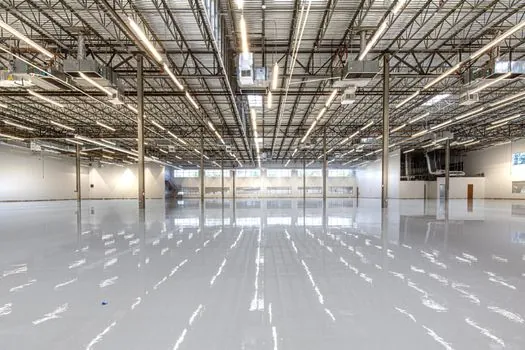
Manufacturer coverage for spray-applied C309 membranes runs 200–400 ft²/gal depending on substrate roughness; a troweled hard-troweled slab at 3,000 psi sits near 350 ft²/gal, a rough broom-finished slab sits near 250 ft²/gal [S1][S2].
Type 2 white-pigmented compounds double as a hot-weather reflectance aid (solar reflectance typically 0.70–0.80 fresh, dropping with age), which is useful on roof decks and unconditioned mezzanines but is irrelevant to a sealed cleanroom envelope. The hidden cost: white pigment residues must be removed by mechanical abrasion or detergent scrub before any penetrating sealer, epoxy, or urethane topcoat is applied, and most epoxy manufacturers require a CSP 3–4 profile per ICRI 310.2R before primer [S1][S2].
Admixture and fiber interactions the spec must coordinate
If the slab mix includes a concrete admixture for shrinkage reduction (SRA) or a Type F high-range water reducer, the membrane must still meet the C309 moisture-retention requirement (typically ≤ 0.55 kg/m² in 72 h for Type 1, with a Class B/D variance) or the warranty chain breaks [S1][S3].
Site handling: the rules that fail the membrane long before chemistry does

Water-emulsion compounds must be protected from freezing during delivery and storage; a frozen emulsion breaks and the lot is unusable even if the chemistry tests clean [S3]. Spray equipment must be dedicated (no residual solvent from a prior chlorinated-rubber job), and applicators must read the SDS before handling, as repeated skin contact is the documented exposure route for acrylic and wax emulsions [S4].
Submittals under CSI 03 39 00 should include the C309 Type/Class designation, the manufacturer’s VOC sheet, the application coverage rate, and a reference to a sister spec section (ASTM C171 sheet goods or ASTM D2103 poly) so the engineer has a backup method if membrane spraying is delayed by weather [S5].
Comparison: membrane options against four cleanroom-relevant criteria
Type 1 clear water-based acrylic scores well on VOC and recoatability, but has no heat-reflectance benefit and is hard to verify for uniform coverage on a 10,000 ft² pour. Type 2 white-pigmented water-based (e.g. Kurez DR-100) is the workhorse for occupied interior cleanroom slabs: low VOC, visible coverage, scrubbable before topcoat, but adds a mandatory abrasion step. [S2]
Exempt-solvent Type 2 (EverClear 350, Luster Seal 350) handles cold-weather and overnight-cure schedules without freezing risk, but the acetone/PCBTF carrier pushes the odor envelope into the GC-MS range that pharma owners often flag. Full-solvent wax or chlorinated-rubber grades give the best moisture retention and dust suppression on exterior or temporary slabs, but are disqualified inside most cleanroom envelopes by VOC, odor, and outgassing limits [S2].
What to verify with the owner before signing the submittal

Three items should be in writing before any membrane hits the deck: the maximum allowed VOC in g/L, the maximum allowed residual solvent outgassing at 30 days (often 50 µg/m³ TVOC for Class 5+ spaces), and whether the owner requires a C309 Type 2 white or will accept Type 1 clear if the slab is going to be polished before occupancy. A spec that locks all three is rare; a spec that locks only the first forces a change order when the GC-MS data comes back from the test slab. [S2]
For slabs that will be polished (typical Class 5–7 hard-disk and back-end semiconductor spaces), a Type 1 clear water-based acrylic plus a 7-day wet cure and a 14-day densifier burnish is the cleaner path; for slabs that will receive an epoxy or MMA topcoat, Type 2 white-pigmented water-based plus a CSP 3–4 mechanical profile is the safer path [S1][S2]. Cross-reference the concrete vibrator selection and the concrete batching plant ticket review so the mix water, the W/C ratio, and the membrane application window are all consistent with the same 28-day spec.
For related coverage, see Tapered Roller Bearing vs Ball Bearing: Selection Map for Load, Speed, and Service Life.