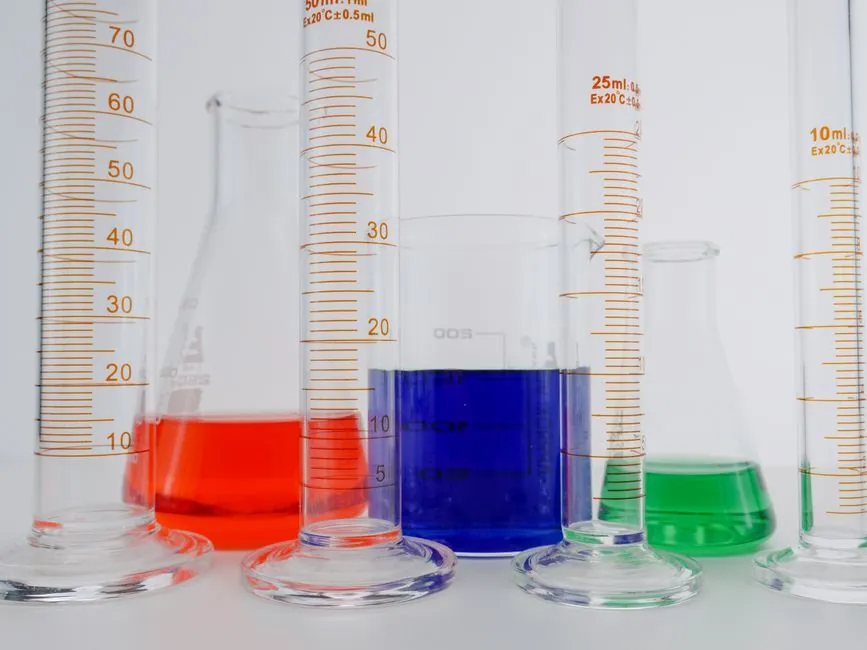
Selection starts with three questions: what assay or process is downstream, what purity tier does that step tolerate, and what container material will hold the chemical without leaching or degrading [S2].
Seven grades dominate the market: ACS, Reagent, Laboratory, Technical, Pharmaceutical, Food, and USP/NF, each pinned to a different purity, documentation, and regulatory envelope [S2][S3]. Skip the grade and the rest of the buying decision is guesswork.
The Seven Common Grades, Ranked by Purity and Use Case
ACS grade is the benchmark: chemicals meeting or exceeding American Chemical Society specifications, with a stated purity of ≥95%, accepted for food, drug, and medicinal work, and used where stringent quality specs are non-negotiable [S3]. Reagent grade is generally equivalent to ACS (≥95%) and is the workhorse for general laboratory and analytical applications [S3]. USP and NF grades meet the United States Pharmacopeia or National Formulary monographs and are mandatory inputs for pharmaceutical compounding and most lab procedures bound to those monographs [S3].
Below the ACS/Reagent tier: Laboratory grade is a lower-cost option for general lab use where high purity is not critical, while Technical grade is reserved for industrial and manufacturing applications such as cleaning, processing, or synthesis where trace impurities do not derail the process [S2]. Pharmaceutical and Food grades add manufacturing-process controls, sanitation records, and traceability on top of purity, which is what auditors look for, not the assay number itself [S2].
Common mistakes include buying ACS for a routine wash (overspend, no data gain) or buying Technical for trace-metal analysis (interference, failed runs) [S2]. The decision rule: tier the grade to the most sensitive downstream step, not the cheapest acceptable option [S2][S3].
Grade Selection Criteria Mapped to Application
Four decision criteria separate the tiers: assay purity, impurity profile, documentation, and cost. ACS and Reagent grade both demand ≥95% purity and batch-specific certificates, making them interchangeable for most analytical work [S3]. USP/NF layers pharmacopeia compliance on top, which Pharmaceutical and Food grades supplement with process-side controls and sanitation records [S2][S3].
For trace-metal analysis, AA spectroscopy, or any procedure where impurities distort the signal, ACS or Reagent grade is the only defensible choice. For teaching labs, buffer prep, and routine cleaning, Laboratory grade cuts cost without compromising outcomes. For industrial synthesis where the reagent is consumed in a process step with built-in purification, Technical grade is the rational pick [S2][S3].
Choosing the right chemical reagent on grade alone still leaves the container, the label, and the storage conditions open. Those three variables determine whether the grade you paid for is still the grade you use on day ninety.
Container Materials: Match the Bottle to the Chemical
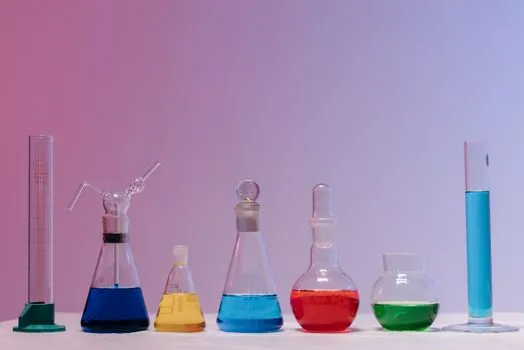
Borosilicate glass (Pyrex-type) handles thermal shock and resists most acids, making it the default for high-temperature work and aggressive inorganics [S1]. Quartz extends the ceiling for extreme heat and UV exposure, at a meaningful cost premium. Soda-lime glass is cheap and widely available, but vulnerable to strong bases and hydrofluoric acid, so it should be ruled out for those chemistries [S1].
On the plastic side, polyethylene (PE) suits non-polar solvents and is flexible and shatter-resistant. Polypropylene (PP) tolerates a broader temperature range and handles many acids and bases. Polyethylene terephthalate (PET) is transparent and convenient for visual volume checks, but is not suitable for aggressive reagents [S1]. When in doubt, the manufacturer's compatibility chart is the fastest path to avoiding a corroded cap and a wasted batch.
Common bottle volumes span 10 mL to 2 L, with wide-mouth formats easing fill and narrow-neck formats limiting vapor loss for volatile organics [S1]. Cap selection also matters: screw caps with PTFE liners for corrosive contents, stopper caps for slow-venting gases, spray dispensers for volatile organics with the pump material matched to the solvent [S1].
Labeling, Documentation, and CAS Number Discipline
A compliant label carries at minimum the chemical name, CAS number, concentration, and the date the bottle was opened [S1]. Solvent-resistant inks survive alcohol wipe-downs where standard markers smudge, and QR codes linking to the Safety Data Sheet (SDS) keep the digital trail one scan away [S1]. Color-coded hazard symbols give a fast visual cue, useful when several bottles share a bench.
Purity and documentation travel together. ACS, Reagent, and USP/NF grades arrive with batch-specific certificates of analysis, residual solvent profiles, and trace-metal panels; Laboratory and Technical grades may not [S2][S3]. Where regulatory alignment is part of the deliverable, the certificate is the deliverable.
Storage Conditions That Hold the Purity You Paid For
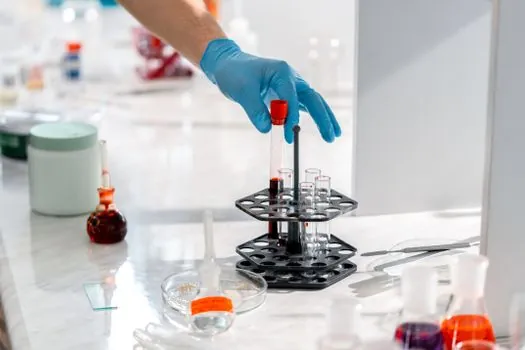
Temperature, light, and humidity each have a story to tell about a reagent's stability [S5]. Refrigerated reagents belong on the back shelf, away from the door where temperature spikes hit hardest; freeze-sensitive chemicals move to a cryogenic locker [S1]. Light-labile substances, including hydrogen peroxide and many organometallics, belong in opaque amber bottles or foil-wrapped clear bottles stored in a dark cabinet [S1][S5].
Segregation rules are non-negotiable: acids away from bases, oxidizers separated from organics to prevent runaway reactions, and flammable liquids in fire-rated cabinets [S1]. A red tray for acids, a separate bin for oxidizers, and a dedicated flammables cabinet make compliance feel mechanical rather than memorised.
Who Should Skip the Mainstream Option
ACS or Reagent grade is overkill for routine glassware washing, buffer preparation for non-critical cell culture feeds, and bulk industrial synthesis with downstream purification [S2][S3]. In those settings, Laboratory or Technical grade delivers the same process outcome at a fraction of the cost, freeing budget for the sensitive steps that genuinely need top-tier purity.
Conversely, Technical grade is the wrong pick for any analytical method with sub-ppm detection limits, any pharmaceutical compounding bound to a USP monograph, and any food-contact application. Saving on grade there creates a data-quality or compliance risk that dwarfs the unit-price difference [S2][S3].
Working With Adjacent Process Inputs

Selection logic for a chemical anchor such as a primary standard, pH buffer concentrate, or titration agent follows the same rules: grade the purity, then verify the container and the certificate. Process engineers who lock in a reagent shortlist by grade tier, container compatibility, and storage footprint rarely have to re-spec a bottle mid-run, and they can plug those selections into the same vendor-evaluation framework used for chemical material inputs across the plant. [S1]
Track the next node on 2026-09-17: re-audit the active bottle inventory against this grade and container matrix, and flag any Technical-grade stock that has drifted into an analytical workflow since the last review. A second signal: confirm the SDS QR-code links on every label resolve to the current revision, since reagent documentation and regulatory monographs update on different cadences.
This topic is covered further in IGBT key components and bill of materials: a process engineer's reference.