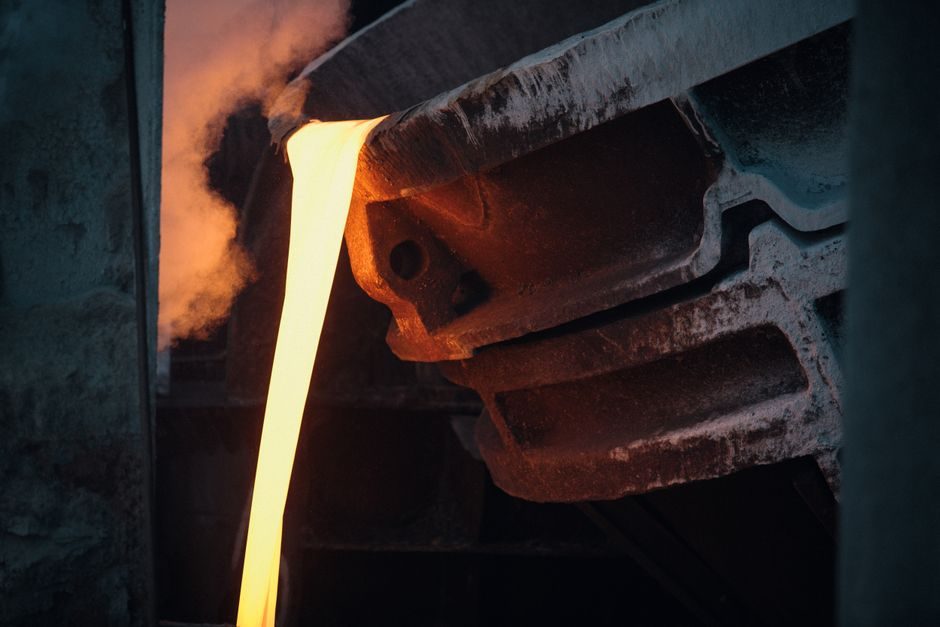
Urethane casting delivers functional, production-grade parts in batches of 10 to 1,000 units, with typical prototype lead times of 1-5 business days and standard production runs completing in 10-12 business days [S2].
The process builds a soft silicone mold from an SLA, FDM, or CNC-machined master pattern, then pours or injects two-part polyurethane resin under vacuum to produce parts that mimic injection-molded surface quality without the hard-tooling investment [S2][S5].
Process Boundaries vs. Injection Molding and 3D Printing
Urethane casting occupies a defined economic window: quantities between one-off 3D prints and the 5,000+ unit threshold where aluminum tooling for injection molding becomes economical, with 50+ resin formulations available including rigid, rigid clear/tinted, and medical-certified grades [S2].
Maximum build volume reaches 90" × 65" × 40" at large-chamber service providers, while minimum feature size, embossed details, engraved details, hole diameter, and pin diameter all bottom out at 0.025" [S2]. Supported and unsupported walls both require a minimum thickness of 0.040" — a critical constraint when designing thin-wall enclosures or snap-fit geometries [S2].
Material Selection: Shore Hardness, Chemistry, and Compliance
Polyurethane casting systems divide into polyether and polyester base chemistries, with formulation tweaks controlling Shore A hardness, tear strength, and chemical resistance — a single chemistry shift can move elongation-at-break by a factor of two or more [S9].
Standard polyether/polyester cast parts suit general industrial rollers, gaskets, and linings, while medical-grade and FDA-cleared formulations exist for diagnostic device housings and skin-contact prototypes [S2]. For overmolded parts, in-mold fiber additives strengthen sections by a factor of 10, enabling thin reinforced ribs that pure urethane cannot hold [S2].
Tolerance Stack and Surface Finish Targets
Standard urethane cast tolerances land at ±0.007" on the first inch and ±0.003" on each additional inch — looser than CNC machining but tighter than most FDM prints, and reproducible across the 10-1,000 unit run because the silicone mold itself is the limiting variable [S2].
Color matching runs the full spectrum, and texture is pulled directly from the mold cavity surface, meaning the master pattern's surface finish (polished, bead-blasted, EDM, or as-machined) carries through to every cast part without secondary operations [S2]. This is the same surface-transfer principle used in silicone-based casting-mold workflows across the broader casting industry [S1].
Decision Criteria: When to Pick Urethane Casting
Pick urethane casting when: (1) volumes land between 10 and 1,000 units, (2) you need injection-molded aesthetics without hard-tooling lead time or cost, (3) your geometry fits within 90" × 65" × 40" and respects 0.040" minimum walls, and (4) ±0.007"/±0.003" tolerances are acceptable for fit and function [S2].
Do not pick urethane casting when: production volumes exceed ~1,000 units (aluminum tooling amortizes faster), tolerances tighter than ±0.005" are required (CNC or injection molding wins), or wall sections must drop below 0.040" unsupported (mold tear-out risk rises sharply) [S2][S5]. For high-pressure metal-forming or die-casting-style production volumes above this band, a die-casting machine workflow is the correct upstream choice.
Comparison: Urethane Casting vs. Adjacent Low-Volume Processes

On four buyer-critical criteria — lead time, unit cost at 50 parts, tolerance, and surface finish — urethane casting sits between 3D printing and bridge injection molding: lead time of 1-5 days for prototypes beats aluminum tooling (3-6 weeks), unit cost at 50 parts typically lands at 20-40% of an injection-molded equivalent, tolerance of ±0.007"/±0.003" is looser than CNC (±0.001"-±0.005") but tighter than FDM (±0.005"-±0.020"), and surface finish matches injection-molded grain right out of the mold [S2][S5].
Compared with sand-casting for metal prototypes, urethane casting trades material versatility (plastics only, no ferrous or non-ferrous alloys) for tighter tolerance, faster iteration, and lower per-part cost at sub-100-unit volumes [S1].
Master Pattern and Mold Production Workflow
The master pattern is typically SLA-cured resin, FDM-printed polymer, or CNC-machined ABS or aluminum, finished to the required surface texture before being encased in liquid silicone that cures into a multi-cavity tool [S2][S5]. Once cured, the silicone mold is sectioned, the master is removed, and the mold is ready for vacuum-cast urethane pours — the entire mold-build cycle runs in days, not weeks [S5].
Mold life typically reaches 20-50 casts per silicone tool before tear or dimensional drift forces replacement, which is why service providers gate the process at 10-1,000 parts and recommend bridge tooling for higher volumes [S2][S5]. Each batch goes through a five-point inspection at three separate manufacturing stages to catch dimensional drift before it propagates [S2].
Sourcing and Standards Reality Check

Urethane casting is not governed by a single ISO or ASTM material standard the way die-casting alloys are — instead, buyers specify Shore A hardness (commonly 60-95 A for industrial elastomers), tensile strength in psi or MPa, elongation percentage, and any FDA/USP Class VI medical compliance needed for the end use [S2][S9].
Domestic US service providers (Forecast 3D, protoCAD, ARRK) and Chinese suppliers (FacFox/Makeit, LeadRP) both list urethane casting alongside CNC, injection molding, and 3D printing as core offerings, with rapid quoting and free DFM feedback as standard practice [S2][S4][S5][S6][S7]. For specialty extrusion, cast molding, and compression molding of polyurethane belts and custom profiles, dedicated polyurethane product manufacturers handle runs that fit outside the prototype-casting service bureau model [S8].
Cost Drivers and Lead-Time Variables
Three variables dominate the quote: (1) master pattern complexity — multi-cavity molds and intricate textures add mold-build days, (2) post-processing — painting, inserts, and overmolds add 3-7 days, and (3) batch size — going from 25 to 500 parts roughly doubles the silicone mold life consumed and the per-batch setup time [S2][S5].
Resin cost is the secondary driver, with medical-grade and high-Shore rigid clear grades costing 2-4× general-purpose polyether/polyester systems; for buyers running a controlled material test program, pull both the technical data sheet and the lot-trace certificate before signing off on production [S2][S9].
Track the next quote against the published 10-12 business day rigid urethane lead time and the 0.025" minimum feature floor — if your design sits inside both envelopes, urethane casting is the lowest-cost path to 10-1,000 production-grade parts in 2026 [S2].