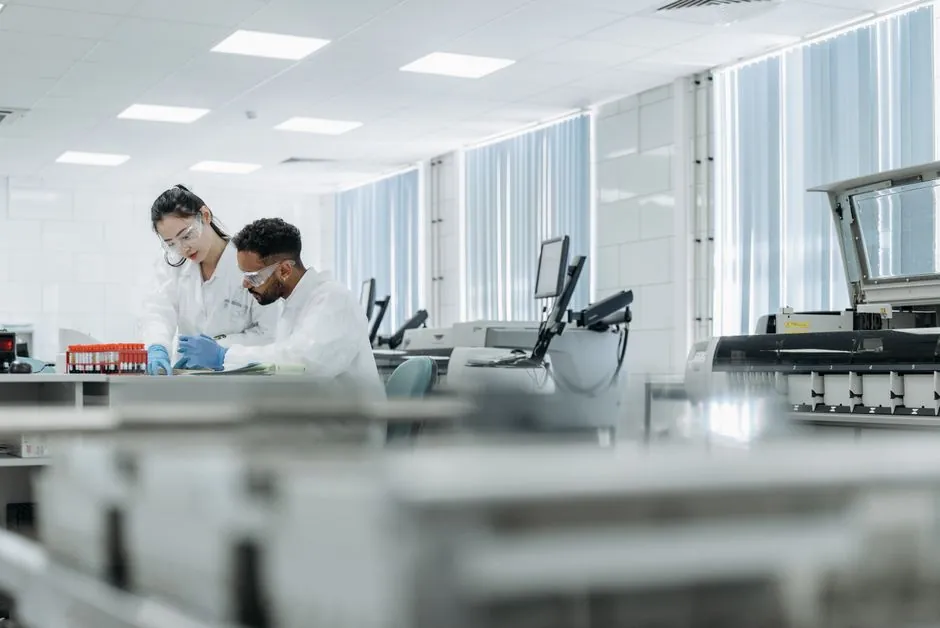
Type 4 IEC/EN 61496-1 finger-resolution (14 mm) curtains with OSSD outputs and IP65+ housings are the baseline for lab benches, robotics cells, and analyzer zones, with ATEX-rated variants reserved for solvent-handling enclosures [S6].
Selection pivots on five concrete axes: detection resolution, protective field height, operating range, safety type (Type 2 vs Type 4 per IEC/EN 61496-1), and enclosure rating (IP65 minimum, IP67 where washdown or condensation occurs) [S1][S6][S8].
Resolution: 14 mm Finger vs 30 mm Hand Protection
14 mm resolution SLC14-series curtains are specified when the operator's fingers can reach the hazard during normal use, for example robotic-pipette stations, microtome interfaces, and small-press guarding inside fume hoods; Pepperl+Fuchs lists 14 mm resolution with up to 750 mm protective field height and 5 m sensing range for this duty [S6]. 30 mm resolution curtains suit hand-only access points such as centrifuge bays, analyzer racks, and conveyor transitions where the hazard is reachable but fingers are not, with Pepperl+Fuchs SLCT30 offering protection field heights up to 2400 mm and the SLC30-1500-S reaching 1650 mm at 15 m range [S7][S8]. Sub-14 mm detection is not common off-the-shelf and is generally unnecessary; the cost premium over a Type 4 finger-resolution unit rarely justifies itself outside semiconductor and micro-assembly cells.
Safety Type and SIL Rating: Type 4 / SIL3 for Most Labs
Type 4 self-testing curtains to IEC/EN 61496-1 are the de facto default for laboratory guarding because the redundant, fail-safe design allows them to be used on Category 4 / PLe / SIL3 control circuits without an extra safety relay in many cases [S6][S8]. Type 2 / SIL1 devices such as the SLCT30 series are restricted to lower-risk applications and most risk assessors will reject them for hazards that can cause irreversible injury, which covers almost every lab machine [S7]. The SLC14 and SLC30 families use OSSDs in potential-separated semiconductor design with optional monitored NC contacts, so the safety output is a 24 V DC signal pair, not a relay contact, and the receiving controller must accept OSSD inputs or the wiring will not achieve the rated SIL [S6][S8].
Protective Field Height, Operating Range, and Beam Spacing

Modular curtains such as the Fiessler BLCT series allow protective field heights from 100 mm to 1500 mm in 100 mm increments, and the BLCT is rated to 5 m operating range at IP65, which covers most benchtop-to-fume-hood and across-the-room spans inside a lab [S1]. For longer runs, the Pepperl+Fuchs SLC30-1500-S pushes sensing range to 15 m at 30 mm resolution and 1650 mm height, which is useful when a curtain has to guard a long robotic track or a multi-station assembly island [S8]. Beam spacing sets the minimum object the curtain can detect; on a 14 mm finger-resolution unit the optical pitch is 14 mm, on a 30 mm hand-resolution unit the pitch is 30 mm, and the protective height is the active stack of beams rather than the physical housing length [S6][S7][S8].
Enclosure Rating and the ATEX Question
Most lab air is clean and dry, so IP65 (dust-tight, jet-proof) is the practical floor; if the curtain sits near a sink, autoclave, or outdoor-ducted analyzer, IP67 is the safer call because it tolerates temporary immersion, and the Pepperl+Fuchs SLC14 and SLC30 lines are both IP67-rated [S6][S8]. Solvent, hydrogen, or dust-explosive atmospheres change the spec entirely: Pepperl+Fuchs offers the SLC14-150-S and SLC30-1500-S with optional ATEX certificates for zone 2 and zone 22, which adds certification cost and a longer lead time, but no lab with a flammable atmosphere should be guarded by a non-rated curtain [S6][S8]. A real-world example is the Safety Light Curtain Specs for Chemical Plant Hazardous Areas reference, which documents the same Type 4 / OSSD / ATEX stack on process plant skids.
Functions That Matter: EDM, Restart Interlock, Muting
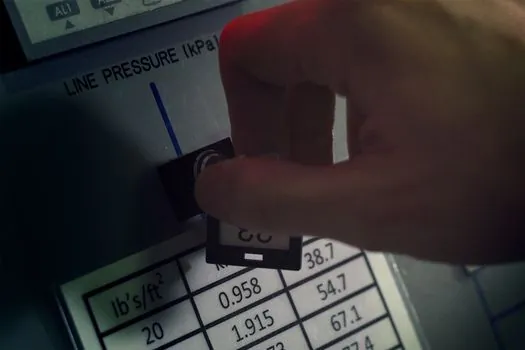
Start/restart disable (restart interlock) and EDM (external device monitoring) should be treated as required, not optional, in any lab installation because a curtain that auto-restarts on clearance is a documented incident pattern in academic and pharmaceutical labs. Master/Slave cascading on the Pepperl+Fuchs SLC series lets two or more curtain pairs share a single controller, which is the cleanest way to guard a U-shaped or L-shaped hazard without dead zones [S6][S8]. If a lab needs material to pass through the curtain, muting and override must be specified explicitly, with the muted pair timed and bypass-limited; a safety light curtain without these blocks cannot be used for through-traffic without defeating the safety function.
Selection Comparison: Curtain Families on Five Criteria
Fiessler BLCT (Type 4, IP65, 5 m range, 14 mm or finer, modular 100–1500 mm height) is the bench-friendly default for general indoor labs [S1]. Pepperl+Fuchs SLC14 (Type 4, IP67, 5 m, 14 mm, 750 mm max height, optional ATEX) fits finger-hazard benches and solvent-handling enclosures [S6]. Pepperl+Fuchs SLC30-1500-S (Type 4, IP67, 15 m, 30 mm, 1650 mm height, optional ATEX) covers long hand-hazard tracks and outdoor analyzer skids [S8]. Pepperl+Fuchs SLCT30 (Type 2, SIL1, 30 mm, 2400 mm height, -30…60 °C) is only acceptable for low-risk duty in labs where a full risk assessment has cleared it [S7]. Keyence GL-S and GL-R are the slim, IP-rated slim-profile alternatives with a 15 m maximum operating range on the GL-R, useful where housing cross-section must stay under ~10 mm; the discontinued Keyence SL-C series illustrates how fast model lines churn in this category, so spec by function, not by model number [S2][S4][S5].
Lab-Specific Failure Modes and Constraints

Reflective surfaces within 200 mm of the optical axis can cause optical bypass on a single-beam channel, so a lab with polished stainless or glass analyzer housings needs the curtain installed with either corner mirrors and tested for optical bypass, or a Type 4 device with a tolerance window narrower than the reflection path. UV-curing enclosures, plasma cleaners, and arc-lamp spectrometers emit broadband IR/UV that can desensitize photodiode receivers over time, so check the vendor's ambient-light immunity figure; a machine safety stack that pairs the curtain with a tested safety relay at the controller is the conservative choice. Condensation is the silent killer in cold-room and BSL labs: a curtain rated IP65 but not IP67 will mist over and nuisance-trip, so IP67 or heated optics are needed for any guard crossing a temperature gradient. [S1]
Standards, Certification Documents, and What to Ask For
The controlling standards are IEC/EN 61496-1 for electro-sensitive protective equipment and IEC 61508 for functional safety SIL, with Type 4 / SIL3 / PLe being the target for almost every lab hazard [S6][S8]. For EU installations, a Declaration of Conformity referencing the Machinery Directive and the EMC Directive must accompany the unit, and an ATEX certificate is needed for any zone 1, zone 2, zone 21, or zone 22 atmosphere [S6][S8]. The wiring interface to the lab's safety relay or safety PLC must use OSSD pairs, not volt-free contacts, and the receiving device must be rated to the same SIL/PL, otherwise the chain drops to the lowest-rated component. For a deeper dive on the surrounding safety stack, the machine safety reference page covers relay selection and stop-category wiring.
Spec-First Sizing Procedure for a New Lab Installation
Step 1: define the hazard and the body part that can reach it; this fixes the resolution at 14 mm (finger) or 30 mm (hand). Step 2: measure the reach distance from hazard to operator station and add 100 mm safety margin; this fixes the protective field height. Step 3: measure the span between emitter and receiver columns; this fixes the operating range, with 5 m, 10 m, and 15 m being the common bracket points. Step 4: classify the atmosphere (clean, wet, flammable) and pick IP65, IP67, or IP67 + ATEX accordingly. Step 5: pick Type 4 / SIL3 unless a documented risk assessment clears Type 2, and require OSSD outputs plus EDM by default. Step 6: confirm the controller side can accept OSSD inputs and is rated to the same SIL, because the fire safety and machine-stop chain is only as strong as its weakest link. For cross-reference on protective enclosures used in adjacent rooms, see the glass curtain wall and door window curtain wall reference pages, which cover the architectural boundaries that often frame a lab's safety envelope. [S1]
Two trackable signals for the next sourcing window: monitor the Pepperl+Fuchs successor part numbers for the SLC14 / SLC30 / SLCT30 lines, since those SKUs are flagged as no longer for sale and the replacements will be the de facto lab defaults once published [S6][S7][S8]. Separately, watch the Keyence GL-S / GL-R slim-line catalogue for an updated CAD/CAE package, since the slim form factor is the most common reason lab retrofits upgrade from older 30×30 mm cross-section housings to the newer ~10 mm profile [S4][S5].