Mining plants should not buy a factory-floor light curtain and hope it survives, because dust ingress, vibration, and explosive atmospheres drive the spec toward IP67 or higher sealing, ATEX Zone 2 certification, and Type 4 self-monitoring per IEC/EN 61496-1 [S7][S8].
Selection hinges on four numbers: resolution (14 mm finger vs 30 mm hand), protective field height (up to 750 mm or 1650 mm in the Pepperl+Fuchs SLC series), sensing range (5-15 m for compact builds, 70 m for long-distance perimeter), and OSSD safety output topology [S1][S7][S8].
Mining duty imposes a harder environmental envelope than general manufacturing
Safety light curtain performance degrades when airborne coal dust, silica, diesel mist, and water spray coat the optical window, so IP67 is a baseline for any open-pit or wash-down underground zone, not an upgrade [S7][S8]. Pepperl+Fuchs publishes IP67 ratings on the SLC14-150-S and SLC30-450-S lines, with the same housing supporting optional ATEX certificates for Zone 2 [S7][S8]. For methane-rich longwalls, a single-beam through-beam device like the SICK WSU/WEU26-3 with infrared optics and a 70 m operating range gives the optical margin needed to see through intermittent dust clouds, though it must be paired with a separate certified enclosure for Group I applications [S1].
Engineers should also consider mechanical shock from haul-truck vibration and rib movement; ruggedized housings and potted electronics outlast standard factory units within 6-12 months of continuous mining duty. Refer to the related safety light curtain reference page for a baseline of operating principles before mapping specs to a specific mining zone.
Resolution, range, and field height: matching detection to the hazard
Resolution drives the safety distance calculation: 14 mm resolution is required for finger protection near press or crusher infeed points where operators reach into the danger zone, and 30 mm resolution covers hand and arm detection for perimeter guarding around conveyors and stage loaders [S7][S8]. The 14 mm SLC14-150-S delivers up to 5 m sensing range and up to 750 mm protective field height, while the 30 mm SLC30-450-S reaches 15 m and 1650 mm [S7][S8]. Both are self-monitoring Type 4 per IEC/EN 61496-1 with OSSD semiconductor outputs or monitored NC contacts, plus integrated start/restart disable [S7][S8].
For long-range access control, such as guarding the perimeter of a haul-truck dispatch booth or a conveyor transfer, single-beam through-beam sensors like the SICK WSU/WEU26-3 trade field height for distance, reaching 70 m with infrared optics [S1]. SICK also offers the WSU/WEU26-3 in a rugged hazardous-area housing, which is the configuration to specify when diesel equipment routinely passes within 1-2 m of the optical axis. Compare resolution and range in a simple table before purchase:
Finger protection: 14 mm resolution, 5 m range, 750 mm field height, Type 4, ATEX Zone 2 optional, IP67, OSSD outputs [S8]. Hand protection: 30 mm resolution, 15 m range, 1650 mm field height, Type 4, ATEX Zone 2 optional, IP67, OSSD outputs [S7]. Perimeter access control: single-beam, 70 m range, infrared, rugged hazardous-area housing, Type 4 [S1].
ATEX Zone 2 vs Zone 1: pick the certification that matches the classified area
Open-pit crushing stations and outdoor conveyor transfer points typically sit in ATEX Zone 2, where an explosive atmosphere is not likely during normal operation, so a curtain with an optional ATEX Zone 2 certificate is usually sufficient and avoids the cost premium of Zone 1 hardware [S7][S8]. Underground coal longwalls and battery charging bays can fall into Zone 1, requiring certified flameproof enclosures around the optoelectronic pair, since the Pepperl+Fuchs Zone 2 option does not by itself satisfy Group I, M2 requirements [S7][S8]. Buyers should confirm the certificate scope covers the specific mine's gas group (I for methane, IIA-IIC for surface chemicals) and temperature class before issuing a PO.
For coal-handling conveyor galleries, see how an equivalent selection logic applies to construction-site safety light curtain sizing, where the same Type 4 + IP67 baseline applies but dust loading is usually lighter.
Wiring, OSSD outputs, and integration with mining PLCs
Mining control systems usually run on Rockwell ControlLogix or Siemens S7-1500F safety PLCs, so the curtain's safety output must be OSSD-compatible or wired through a monitored NC contact arrangement, exactly as the Pepperl+Fuchs SLC series specifies [S7][S8]. OSSD (Output Signal Switching Device) is a self-monitored semiconductor output that pulses to detect cross-faults, a hard requirement for any Type 4 device per IEC/EN 61496-1 [S7][S8]. Master/Slave detection and Plug-and-Play cascade reduces wiring in long conveyor runs where two or three curtains share a common safety relay [S7][S8].
For coal-handling conveyors running 200-400 m between transfer points, the slim form factor of the Keyence GL-S series (half the cross-section of conventional units) helps in tight structural galleries [S4]. The GL-S selection tool groups devices into Standard GL-R, Slim GL-SS, and Flat GL-SF bodies, with a 15 m maximum operating distance on the GL-R high-power tier [S5]. Avoid specifying the GL-S series for Zone 1 coal faces, since its published protection class is industrial rather than ATEX-certified for mining.
Where light curtains fail in mining: known limitations
Light curtains do not detect thin cables or loose drawstrings entering the protected field, and a 14 mm beam pitch remains the practical minimum resolution, so test stations with cabling often need additional guarding [S2]. Safety distance calculations must assume 10-30 cm of reach-through distance beyond the light curtain, and mechanical stops must be timed to de-energize the hazard before the operator's hand reaches the crush point [S2].
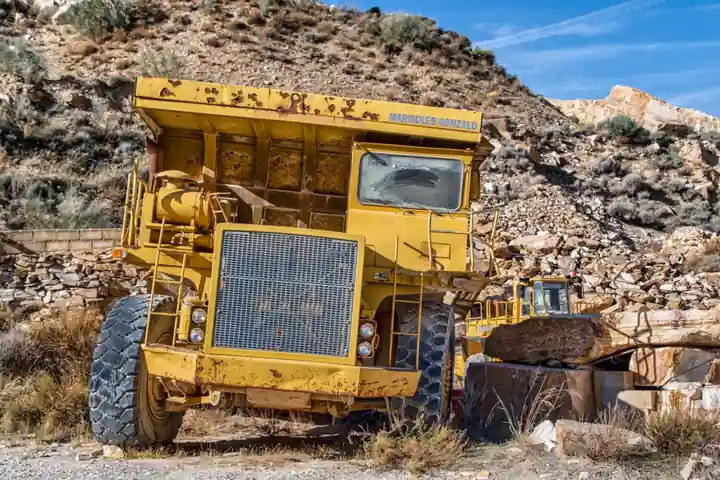
Single-beam devices cannot resolve human body parts, only interrupt the line of sight, so they are restricted to perimeter access control where a full body breach is the shutdown trigger [S1][S2]. A curtain that optically sees through accumulated dust will false-trip or fail to detect a finger; periodic lens cleaning every shift is mandatory, not optional, in any dusty load-out or crusher house. For broader context on safety architecture in heavy industry, the fire-safety overview and the related mining dump truck reference page cover adjacent risk domains that often share the same PLC and shutdown logic.
Selection checklist for mining procurement
Specify Type 4 self-monitoring per IEC/EN 61496-1 as non-negotiable, and reject any Type 2 device for new builds in any zone where a fatality could result from a single fault [S7][S8]. Require IP67 minimum for wash-down and dust-laden zones, ATEX Zone 2 certificate for surface crushing and screening, and a separate flameproof enclosure for Zone 1 underground duty [S1][S7][S8]. Lock resolution to 14 mm for finger reach zones and 30 mm for hand/arm perimeter guarding, and match sensing range to the longest straight-line guarding distance plus a 20% optical margin [S7][S8].
Track the SICK WSU/WEU26-3 datasheet revision and the Pepperl+Fuchs SLC series status, since both reference products have carried "no longer for sale" notes during prior catalog refreshes [S7][S8], and confirm lead time for ATEX-certified variants before locking a project schedule. Mining conveyor systems, dump-truck service bays, and rail load-outs are the most common adjacent applications; reference mining equipment rebuild pricing and tier maps and pillow block bearing selection for mining when the same procurement team is sourcing both guarding and structural components.