A safety fence should be selected from the hazard geometry, not from a catalogue image: mesh opening, distance to the danger zone, fence height, and the possibility of reaching through must be checked together.
Rigid welded mesh panels suit machine cells, warehouses, and equipment zones, while flexible safety netting or debris netting serves different containment duties. The decision process starts by identifying what the barrier must prevent a person from reaching or entering.
Start with the hazard and the required safety distance
Mesh size is selected by assessing the hazard and the worker’s possible reach. For a machine or automation cell, measure the reach envelope around robots, conveyors, presses, and processing equipment, then establish the fence line and separation distance from those moving or hazardous parts [S2].
The fence position, openings, gates, and safety distances should be determined with the equipment supplier or a qualified safety professional based on a risk assessment. The relevant reference is safety fence, but the risk assessment remains the controlling document.
Opening size and safety distance cannot be checked in isolation. The opening must be small enough relative to the fence-to-hazard distance to prevent a body part from passing through, while fence height must also prevent reaching over the top. A denser mesh does not, by itself, validate the installation.
Match openings to reach-through and overreach risks
Those two values show why opening size and fence geometry must be reviewed together. A 20 mm slot does not authorize a 20 mm installation clearance. The required clearance is determined by the hazard geometry, the opening, and the reachability of body parts.
These are product dimensions, not universal safety thresholds. They become acceptable only when the selected panel satisfies the project’s risk assessment and applicable requirements.
Compare rigid mesh, safety netting, and debris netting
Rigid welded mesh provides a fixed structural barrier for machinery, automation cells, warehouse partitions, and equipment zones [S2]. It offers defined panel geometry, posts, bases, gates, and anchoring, allowing the fence position and openings to be reviewed against project drawings.
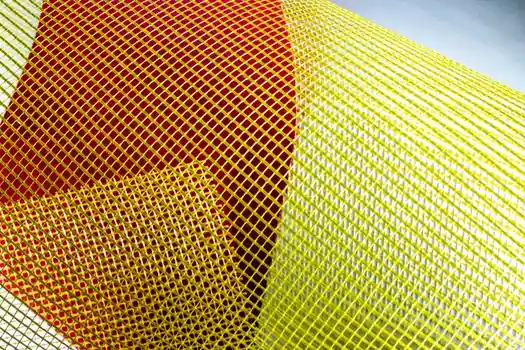
Flexible safety netting uses 1/4-inch mesh for visibility, perimeter marking, temporary separation, and scaffold or fence coverage. Debris netting uses a finer 1/16-inch mesh for debris containment, scaffold wrap, and smaller-debris control.
For access control around a machine hazard, rigid mesh is the relevant comparison. Safety netting uses a larger 1/4-inch mesh for visibility, perimeter marking, and temporary separation. For containment of small falling debris, 1.25 mm debris netting is the more appropriate option. Wire rolls, chain link, and hexagonal mesh serve boundary, livestock, and general fencing duties rather than automatically qualifying as machine guards [S4].
Define who the barrier serves and what it excludes
A safety mesh fence is suitable for workers who must be separated from robots, conveyors, presses, processing equipment, electrical assets, or controlled inventory zones [S2]. It also supports internal partitions where visibility, access gates, cleaning, and future layout changes matter.
It is not the default choice for falling objects from elevated storage. Rack-specific safety netting or load-stop systems require a separate engineering assessment, and flexible construction debris netting should not be treated as interchangeable with rigid machine guarding [S2]. Facility perimeter security, climb resistance, and public access control can also require a different fence system.
Temporary visitors, contractors, and maintenance personnel still need controlled entry. Gates must be considered with the mesh because an unprotected opening can defeat the selected barrier. Where personnel can enter hazardous zones for maintenance or emergency-stop reset, gate interlocks and the complete safeguarding arrangement must be designed as a system.
Check panel strength, frame, gate, and floor fixing
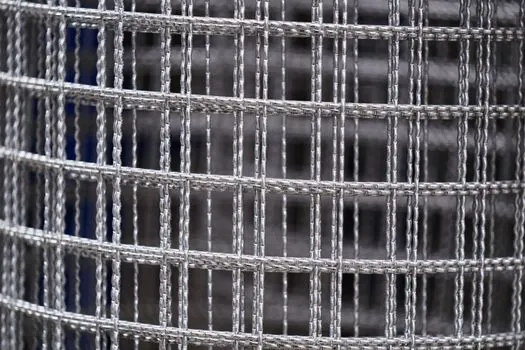
Mesh opening is only one purchase criterion. A rigid system also includes welded panels, frames, posts, connectors, gates, and floor bases; specification should cover wire diameter, panel dimensions, frame section, post size, connection method, and anchoring details [S2].
These ranges illustrate why layout coordination matters: panel modules, gate positions, post spacing, and floor conditions must form a compatible installation.
Strength should match the environment. For machine guarding, impact resistance must still be tied to the hazard and risk assessment, not treated as a substitute for separation distance.
Control corrosion, visibility, and access requirements
Specify the base metal, coating or galvanizing, edge treatment, weld protection, and exposure environment. Indoor cleaning, outdoor moisture, chemicals, and collision exposure can affect panel life and maintenance frequency [S2]. The fence should be specified for the actual site conditions rather than protected by an unsupported generic corrosion rating.
Visibility can affect supervision, operator awareness, and the ability to observe work without entering the guarded zone. Larger openings improve visibility but must still satisfy reach-through limits, while smaller openings improve containment and restrict access [S1][S2]. Color and warning markings can improve visual recognition, but color does not resolve an unsuitable opening size.
Access frequency also affects the design. Specify single or double doors, opening direction, handle type, latch arrangement, and the intended maintenance route before ordering panels [S5]. A safety interlock switch may be required where a gate must be monitored, but it does not substitute for correct mesh geometry or a complete safety validation.
Apply the governing standards and acceptance checks

OSHA 29 CFR 1910.212 requires safeguards for relevant machine hazards, while the applicable safeguarding method depends on the hazard rather than on a prescribed fence format [S2]. ISO 13857 provides the safety-distance framework illustrated for opening size and fence height [S5]. A project-specific risk assessment must connect those requirements to the actual machine, layout, and maintenance tasks.
Before release, document the opening dimensions, fence height, horizontal clearance, panel and post specifications, gate arrangement, anchoring, finish, and hazard boundaries [S2]. Confirm that no opening provides access to dangerous moving parts, and validate the installed fence rather than relying only on the procurement record [S2].
For the next project, the trackable engineering outputs are the calculated safety distance for each opening and the approved fence-to-hazard separation. Those two values, together with the risk-assessment reference and gate arrangement, provide a stronger specification basis than mesh size alone.