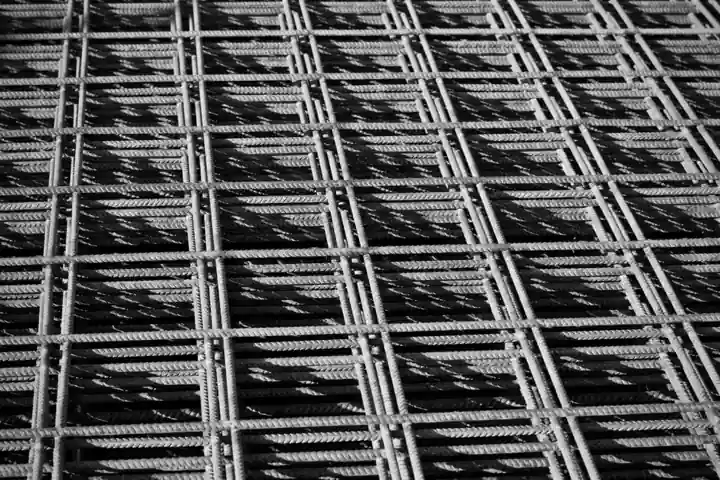
HRB400 carries a 400 MPa minimum yield strength and a 400 MPa tensile designation under GB 1499.2-2018, while HRB500 raises that floor to 500 MPa and HRB400E is the same 400 MPa base with an additional ductility/weldability package for seismic zones [S3][S2].
Typical Chinese mill output spans 6 mm to 50 mm diameters in straight bars, coils (small diameters), and U-bends, with chemistry tuned via vanadium or niobium micro-alloying instead of post-rolling heat treatment, keeping the process route as hot-rolled ribbed bar per GB 1499.2 [S2][S1].
What the Grade Letters and Numbers Actually Mean
HRB is the Chinese national identification for hot-rolled ribbed steel bars used in concrete, and the trailing number is the minimum yield strength in MPa, so HRB400 = 400 MPa minimum yield, HRB500 = 500 MPa minimum yield [S3].
Adding "E" (HRB400E, HRB500E) flags enhanced ductility: tighter limits on the yield-to-tensile ratio, a higher uniform elongation floor, and a guaranteed Charpy impact value, which is the package most international codes now require for seismic frame and shear-wall detailing [S2]. The non-E grades remain acceptable in low- to mid-seismicity regions and in non-structural members where the cost premium of E-grade chemistry is hard to justify.
For buyers sourcing from Chinese mills, the full grade list under GB 1499.2-2018 includes HPB300, HRB335, HRB400, HRBF400, HRB400E, HRBF400E, HRB500, HRBF500, HRB500E, HRBF500E, and HRB600, where the "F" denotes fine-grain steel chemistry [S3].
Mechanical Properties Side by Side
On the headline numbers, HRB400 and HRB400E both sit at 400 MPa yield with 400 MPa grade identification in tension, while HRB500 climbs to 500 MPa, giving designers a 25% higher yield ceiling for the same bar cross-section [S3][S2]. The practical consequence: for an equivalent designed moment capacity, a column or beam using HRB500 needs roughly 20% less bar weight than the same member in HRB400, which is the figure mills quote when pushing the upgrade on material-cost grounds [S2].
Ductility is where the E-grades earn their premium. HRB400E carries a lower maximum yield-to-tensile ratio and a higher minimum elongation than plain HRB400, so it can absorb more strain before strain-localisation and bar buckling kick in during a seismic event [S2]. HRB500 without the E suffix is acceptable in vertical members and foundations in low-seismicity areas, but in ductility-controlled limit states (beam plastic hinges, coupling beams) HRB500E or HRB600E is normally specified.
For North American projects, ASTM A615 Grade 60 delivers roughly 60,000 psi (~414 MPa) yield, which is the closest direct equivalent to HRB400, and is the rebar most North American contractors are familiar with on foundations, retaining walls, and parking structures [S4].
Where Each Grade Actually Fits
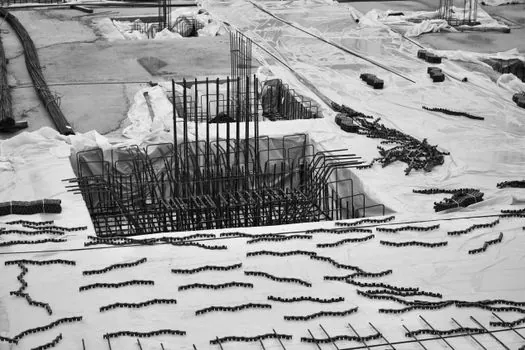
HRB400 (non-E) remains the workhorse grade for general mid-rise residential, commercial slabs, beams, and columns in regions with moderate or low seismic demand, and it is the cheapest of the three in most Asian mills' price lists [S4][S6]. Its balanced strength and ductility make it the default where code minimums only require 400 MPa yield, and where the project does not push into high-load or ductility-critical detailing.
HRB400E is the right pick for seismic frame and shear-wall reinforcement, bridge piers in moderate-to-high seismic zones, and any member where the design relies on plastic-hinge rotation capacity rather than elastic strength. The cost step from HRB400 to HRB400E on the same diameter is small (micro-alloying only, no extra heat treatment), which is why most structural drawings in seismic regions of China now call out the E-grade by default [S2][S5].
HRB500 and HRB500E target high-load applications: high-rise columns, transfer structures, long-span bridge decks, and industrial facilities where the 25% higher yield lets designers reduce bar congestion in heavily reinforced joints. The trade-off is that HRB500 without the E suffix needs stricter welding procedure qualification because of its higher carbon-equivalent, and designers should re-check anchorage and lap lengths against the higher yield used in capacity design [S4].
Manufacturing Route and Weldability
Chinese HRB400/HRB500 production runs through walking-beam reheating, controlled thermomechanical rolling, and either TMT (Thermo-Mechanical Treatment) or Tempcore quenching, where the surface is rapidly cooled to form a hard martensitic rim while the core stays ductile, so the bar combines a high yield floor with useful elongation [S2]. Cooling-bed handling is then slow and uniform to keep residual stress low and dimensions stable to the diameter tolerances buyers expect on 6 mm to 32 mm bars [S2].
Weldability is a function of carbon equivalent (CE), not of the grade name. The E-grades deliberately cap CE so that standard E6013/E7018 shielded metal arc procedures work without preheat on most bar sizes, while a non-E HRB500 with the same diameter may demand preheat or a different consumable to avoid hydrogen-assisted cracking in the HAZ [S2][S4]. For rebar splice work on HRB400E/HRB500E, mechanical rebar couplers are increasingly used instead of lap splices in congested beam-column joints, since they avoid the weld-CE question altogether and shorten congestion on site.
Cost, Availability, and Sourcing Notes
The 20% tonnage saving on HRB500 designs usually more than offsets the per-tonne premium, which is why the grade is gaining share on long-span and high-rise projects [S2][S4].
Stocked diameters from Chinese exporters commonly cover 6 mm, 8 mm, 10 mm, 12 mm, 16 mm, 20 mm, 24 mm, and 32 mm in 5 m to 14 m straight lengths, with coils available for the smaller diameters, and standard mill certification plus optional SGS/BV third-party inspection [S1][S2]. Buyers should confirm the mill cert explicitly references GB 1499.2-2018 and the E-grade sub-clause rather than just the trade name, and should verify Charpy impact values when the project is in a seismic zone.
For site cutting and bending, rebar cutters and rebar benders sized for HRB500 should be used where 500 MPa material is being processed, because the higher yield drives higher cutting forces and tighter bend-radius control, particularly on 20 mm and larger bars.
Comparison Matrix: HRB400 vs HRB400E vs HRB500
The three grades line up against the four criteria that drive a specifier's call:
Yield strength: HRB400 / HRB400E = 400 MPa; HRB500 = 500 MPa; ASTM A615 Grade 60 ≈ 414 MPa (60,000 psi) [S3][S4][S2].
Seismic suitability: HRB400E and HRB500E carry the ductility package required for plastic-hinge design; plain HRB400 and HRB500 are restricted to non-ductility-critical or low-seismicity members [S2].
Material cost vs HRB400 baseline: HRB400 ≈ 1.00×; HRB400E ≈ 1.02–1.05× (micro-alloy premium only); HRB500 ≈ 1.05–1.12× per tonne, but overall member steel weight can drop up to 20% on equivalent designs [S2].
Typical application: HRB400 for general slabs/columns in low-seismicity zones; HRB400E for seismic frames, bridge piers, shear walls; HRB500/HRB500E for high-rise columns, transfer beams, long-span bridges, heavy industrial foundations [S4][S6].
Constraints and Failure Modes to Watch

Carbon-steel rebar in all three grades remains vulnerable to chloride-induced corrosion in coastal environments and in cold-climate decks exposed to de-icing salts, so epoxy coating, galvanising, or increased concrete cover should be specified where exposure is high, regardless of grade [S4]. HRB500 with a higher carbon-equivalent can be marginally more susceptible to stress-corrosion cracking if the concrete cover is breached, which is another argument for protective coating on aggressive-exposure projects.
Stainless rebar or fibre-reinforced polymer (FRP) substitutes are specified in some tunnel and marine projects where corrosion risk dominates the lifecycle-cost case, but those are outside the HRB400/HRB500 comparison. For projects that stay on carbon steel, the grade choice should track design yield, seismic ductility demand, and welding procedure qualification, not headline price per tonne.
Track for the rest of 2026: continued uptake of HRB500E on Chinese high-rise and bridge projects as designers chase the 20% tonnage saving, and more international projects outside China adopting the E-grade nomenclature in their material specifications alongside the existing ASTM A615 Grade 60 reference. For related comparisons on construction-process equipment where the same spec-versus-cost logic applies, see this breakdown of inverter vs transformer arc welders for site rebar splicing.