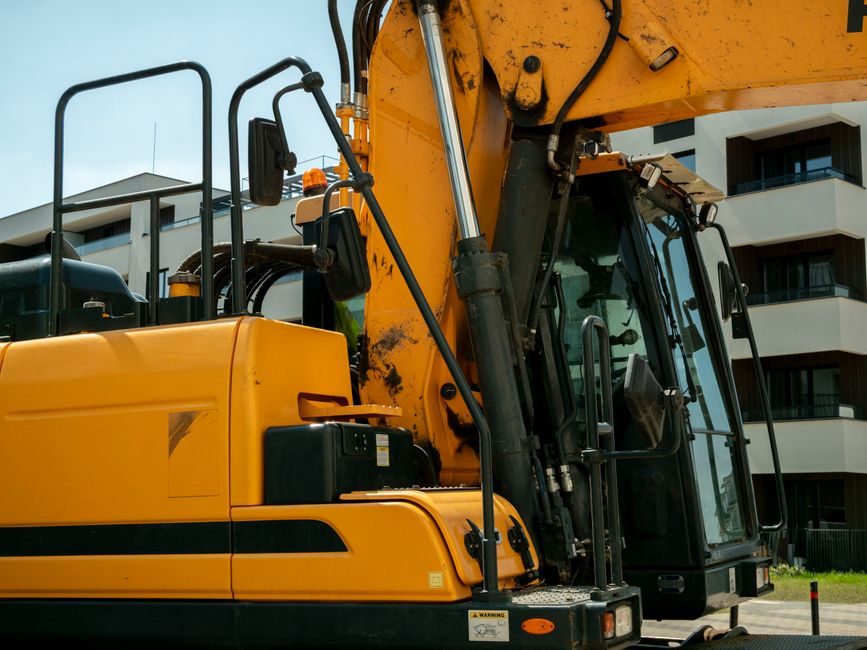
Outdoors, a hydraulic cylinder fails first on the rod: pitting under the wiper, white rust on chrome, and seal-bite corrosion that scores the gland — not from working pressure but from salt, UV, and thermal cycling.
The reference protocol is SAE J1333, MAR2015 revision, a four-page SAE Surface Vehicle Recommended Practice titled "Hydraulic Cylinder Rod Corrosion Test" that scopes cylinders used in self-propelled work machines per SAE J1116 [S1]. SAE pairs J1333 directly with ASTM B117 (neutral salt spray) and ASTM B368 (CASS) for the corrosion exposure itself, and ties fluid cleanliness to ISO 4406 particulate coding [S1].
Scope of SAE J1333 and What It Covers
SAE J1333 applies to hydraulic cylinders that are sub-assemblies of off-road self-propelled work machines defined under SAE J1116, and it provides a laboratory method to determine two distinct things: the rod's capacity to resist corrosion, and the rest of the cylinder's capacity to withstand corrosion products generated by a failing rod [S1]. The 2015-03 revision is a minor-clarification update to the original 1990-03 issue; ISO references were added and the substantive procedure is unchanged, which is why engineering specifications written 20 years ago can still cite it without revalidation [S1].
The method is built on a small set of named variables: rated pressure (the manufacturer's continuous-duty operating pressure), cycle (one extension plus retraction over a specified stroke), cycle rate, average rod velocity (twice stroke divided by total movement time), and side load (perpendicular to axial loading, simulating external forces) [S1]. Each of these must be reported in the test dossier so an audit reviewer can reproduce the duty cycle the cylinder was qualified against.
Corrosion Exposure Methods: Salt Spray vs CASS
Two ASTM corrosion exposure methods are named inside J1333 itself, and the choice between them changes everything downstream [S1]. ASTM B117 is the neutral 5% NaCl continuous salt-spray (fog) test at 35°C, the baseline outdoor-corrosion reference used across most industrial standards. ASTM B368 is the Copper-Accelerated Acetic Acid-Salt Spray (CASS) test, run at roughly 49°C with added copper chloride and acetic acid, which accelerates decorative and copper-bearing plating failures in a fraction of the B117 hours.
For OEM acceptance of heavy-equipment rod plating, the practical pattern is: 500 h ASTM B117 minimum on hard-chromed piston rods, with a 240 h ASTM B368 supplementary run when the rod is supplied with nickel-plus-chrome or duplex nickel-chrome systems — the CASS exposure surfaces porosity in the chrome layer that B117 alone misses. Common vendor documents list "NSS 500 h" or "CASS 240 h" in the test-results block; both are subsets of the J1333 framework when the underlying protocol is J1333 itself [S1].
Rod Material, Plating, and Surface Finish Stack
Rod selection for outdoor service is a stack: substrate steel grade, optional induction-hardened underlayer, plating system, post-grind surface finish, and seal interface hardness. The J1333 method is plating-agnostic — it tests the assembled rod as supplied — so the same corrosion report can support induction-hardened 1045/1050 rods, 4140 chrome-plated rods, or 17-4PH stainless rods if the test data was generated on that exact SKU [S1].
Hard-chrome plating thickness on outdoor mobile equipment typically lands in the 0.0005"–0.0010" (12.5–25 µm) range, with post-grind surface finishes specified at 8–16 µin Ra on the seal run. Stainless or chrome-plated options are a different cost and lead-time bucket, and the corrosion-test dossier that comes with a custom-engineered double-action build needs to be tracked per hydraulic cylinder part number, not per the order line [S2].
Seals, Wipers, and Fluid Cleanliness
Corrosion does not stop at the rod surface. J1333 explicitly checks whether the gland, bushing, and piston seals survive a corroding rod — pitted chrome flaking into the seal land scores the polyurethane or nitrile rod seal within a few hundred hours [S1]. The 2015 revision's added ISO references make this concrete: ISO 4406 sets the fluid cleanliness target, with mobile-equipment OEM targets typically at 18/16/13 or 17/15/12 per ISO 4406:1999 coding.
Material pairing matters: nitrile (NBR) rod seals are common in -30 to +110 °C service and handle standard mineral hydraulic oil, while polyurethane (AU/EU) gives better wear and extrusion resistance but is more sensitive to water-in-oil and certain phosphate-ester fluids. For salt-air or washdown duty, specify EU seals with back-up rings, paired with a metal-energized wiper that physically excludes brine from the seal cavity. A qualification report that pairs SAE J1333 results with seal elastomer lot data and ISO 4406 fluid reports is the minimum an audit will accept [S1].
Side Load, Stroke, and Duty-Cycle Recording
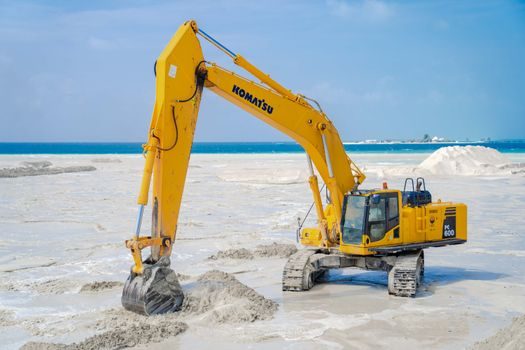
J1333 defines average rod velocity as "twice the stroke length divided by the sum of the movement time for the rod to extend and retract" — a precise metric that ties corrosion cycling to real motion profile [S1]. Cycle rate is recorded in cycles-per-minute, side load is reported as a continuous force perpendicular to the cylinder axis, and rated pressure is the manufacturer's continuous-duty value (not the peak relief setting) [S1].
In the supplier's test dossier, expect a table of: stroke (mm), rated pressure (bar or psi), side load (N or lbf), average rod velocity (mm/s), cycle rate (cpm), fluid ISO 4406 code, fluid temperature (°C), ambient temperature (°C), and B117 hours or CASS hours. Any cell left blank is a flag — outdoor-mobile audits reject dossiers where the side-load column is missing, because the side load drives mechanical wear on the corroded surface and directly changes the pass/fail threshold [S1].
Failure Modes and Common Audit Rejections
Three failure modes account for the majority of outdoor-cylinder rejections. First, red rust creep from scribe line on the rod after B117 — typically a plating-thickness or porosity issue rather than a substrate problem. Second, seal-bite scoring, where chrome flakes from a pitted rod carve grooves into the rod seal; the cylinder still strokes but leaks internally, and the failure shows up in a J1336 leakage test rather than visually [S1].
Third — and the most common paperwork rejection — fluid cleanliness not on the test report. A cylinder can pass the J1333 corrosion test cleanly and still be disqualified at incoming inspection because the test fluid was filtered to a different ISO 4406 code than the production fluid. Other recurring problems: missing ASTM method version, B117 chamber temperature drifted above 35 °C, CASS copper chloride concentration outside the ASTM B368 recipe, and side-load set to zero when the real duty cycle is loaded. For a specifier writing the RFQ, mirror the J1333 test conditions row-for-row in the data-deliverable section, and require the supplier to attach the J1333 report with the shipment, not email it on request [S1].
Comparison: Plating Systems on Three Selection Criteria
Three plating systems are common on outdoor hydraulic rods, and a specifier can line them up against three criteria: B117 salt-spray rating, cost, and lead time. Hard chrome (0.0005"–0.0010" on 4140 or 1045) typically reaches 500 h B117 with no red rust at the scribe and is the cost baseline, with 4–6 week lead times from most custom shops [S2]. Electroless nickel plus hard chrome (duplex) pushes the B117 rating past 1000 h and survives CASS exposure, at roughly 1.4–1.8× the hard-chrome cost and a 6–10 week lead time.
Stainless 17-4PH (H900 or H1025 condition) bypasses the plating question entirely, with documented B117 survival in the 1000+ h band, but at 3–5× the hard-chrome rod cost and 8–14 week lead time, and with a different seal pairing (PTFE or hard polyurethane rather than NBR). The right pick depends on the corrosion category: C3/C4 (urban or industrial) is hard-chrome territory, C4/C5 (industrial to marine) wants duplex, and C5+ continuous marine or offshore justifies the stainless premium. Pair this with a precision filter RFQ for the maintenance area, since fluid ISO 4406 cleanliness drives long-term corrosion risk as much as plating choice (precision filter RFQ spec for outdoor maintenance areas) and with a structured total-cost view on the surrounding packaging line (capping and sealing machine 10-year TCO stack).
Standards Stack, Certificate Verification, and Audit Trail
The minimum cert stack for an outdoor hydraulic cylinder is: SAE J1333 corrosion report (dated, signed, with revision "MAR2015" called out), ASTM B117 and/or ASTM B368 chamber logs, ISO 4406 fluid cleanliness report, raw material certificates for the rod and barrel, plating thickness measurement log, and a leakage test per SAE J1336 [S1]. For custom-engineered double-action or double-ended builds, the cylinder's hydrostatic test report and weld procedure record (typically AWS D14.3 or D1.1 for ground-engaging mobile equipment) round out the dossier [S2].
Verification at incoming inspection: confirm the J1333 report references the exact part number on the shipping paperwork, the ASTM method numbers match a current version, the B117 hours match the purchase order, and the seal elastomer lot data is attached. The SAE J1333 standard itself is published by SAE International, 400 Commonwealth Drive, Warrendale, PA 15096-0001, with document orders via 877-606-7323 (US/Canada) or +1 724-776-4970 (international) and feedback accepted at sae.org [S1]. For a side-by-side read on the hydraulic actuator component family and how cylinder materials compare across product categories, the engineering encyclopedia holds the baseline specs.
Track these signals over the next 12 months: any new revision of SAE J1333 (SAE reviews technical reports at least every five years, so the next revision window opens in 2020–2025 per the 2015 issue's own notice — watch sae.org for a reaffirmed or revised J1333 against part numbers already on order [S1]); and ASTM B117 and B368 revisions, which historically change salt-solution preparation and chamber geometry and can invalidate a 2-year-old test report at incoming inspection.
The underlying component specifications are covered under hydraulic motor.