
An industrial borescope on a food-contact line is specified as visual inspection equipment, not as a process instrument, so the RFQ line must call out probe diameter, articulation, depth of field, ingress protection, and the wetted-material evidence the auditor will ask for. The buyer who writes only "videoscope, 6 mm probe" leaves the vendor to choose optics, light source, sheath material, and sterilisation tolerance, which is exactly where food-grade suitability is decided [S1][S3].
Three numbers dominate food-plant borescope specification: probe diameter (commonly 1.8 to 8.4 mm on videoscope systems), working length (1 to 10 m), and articulation type (2-way versus 4-way versus 360° full direction) [S3][S4]. Once those are pinned, the rest of the line item is hygiene, documentation, and operating envelope.
RFQ line 1: probe diameter, length, and articulation
Probe diameter must be matched to the smallest port on the equipment being inspected, not to the borescope vendor's stock list: 0.95 to 6 mm probes fit micro-port inspection of heat-exchanger tubes and small-bore valves, while 6 to 8.4 mm probes are the working size for food-plant pipework, pump volutes, and separator bowls [S3][S4]. Buyers should write the acceptable diameter as a range (e.g. 4.0 to 6.0 mm) with the minimum bend radius the line geometry requires, because a single fixed number forces a requote if the port turns out to be one size smaller than the drawing.
Working length is the second requote trigger: 1 to 2 m covers valve manifolds and short piping, 3 to 6 m covers vessel and tank internal inspection, and anything above 6 m is custom with a corresponding lead-time penalty [S3]. Articulation choice changes the price band by 30 to 50 percent on the same probe, since 360° full articulation (as on the AE-SGP) commands a premium over 4-way joystick control (as on the AE-DGX), and 2-way is the budget option for straight-shot inspections [S3][S4].
RFQ line 2: optics, lighting, and depth of field
Camera resolution on current industrial borescopes runs from 1 MP HD (about 1280 × 720) up to 1080P full HD, and the choice depends on whether the inspector needs to read a crack tip or just confirm residue presence [S3][S4]. Depth of field is a separate parameter that must be specified: 3 mm to infinity is typical for general inspection, while 5 mm to infinity suits pipework where the operator cannot refocus constantly [S3][S4]. Buyers who omit DOF often receive a wide-DOF probe that cannot resolve biofilm or pitting at close range.
Lighting for food-plant work should be fibre-optic or high-intensity LED routed through the probe sheath, not a tip-mounted bulb that can shed glass into the product zone. The AE-SGP uses optical-fibre illumination with a 120° viewing angle; the AE-DGX uses high-intensity LED with a >120° viewing angle and adds noise-reduction and glare-suppression software, which is the real difference on reflective stainless surfaces [S3][S4]. For clean-in-place residue work, anti-glare processing is a paid line item, not a free upgrade, and should be written on the RFQ.
RFQ line 3: wetted material, ingress rating, and CIP/SIP envelope
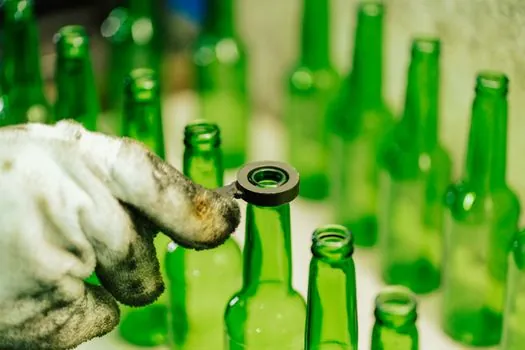
The wetted part of a borescope is the probe sheath and the distal tip window; both contact the product zone when inserted through a sample port or open valve, so food-contact material evidence belongs on the RFQ even though the borescope is "inspection equipment" [S1]. Tungsten-braided flexible sheaths (as on the AE-SGP) and stainless-steel sheaths (as on the AE-DGX) are the two common constructions, and the buyer must specify which is required based on the actual chemistry: caustic, nitric acid, peracetic acid, hot water above 80 °C, or steam [S1][S3][S4].
Ingress protection is the line that food auditors check first: IP67 on the probe tip is the working minimum for washdown areas, and the operating-temperature envelope of −25 °C to 80 °C (AE-SGP) or −10 °C to 80 °C (AE-DGX) must cover both cold-room storage and hot-CIP return lines [S3][S4]. Buyers should also ask for a sanitisation tolerance statement, not just an IP rating, because IP67 is a water-ingress test at room temperature, not a validation that the probe survives 80 °C caustic daily [S1].
RFQ line 4: documentation and traceability pack
The documentation pack for a food-contact borescope should mirror the pack required for hygienic fittings: material traceability for the sheath and wetted metals, surface-finish evidence for any part that touches product, gasket compound records if a sealing ferrule is fitted, and a cleaning-chemical compatibility statement signed against the actual CIP/SIP recipe [S1]. A buyer who accepts a generic CE or ISO 9001 certificate without these four items is exposed at the next audit, because the auditor will trace each wetted component back to a lot file.
Three documents are the usual requote trigger if missing: (1) a material declaration listing the sheath alloy, tip-window material, and any potting compound; (2) a surface-finish Ra value for the wetted probe section, with a typical food-contact target of Ra ≤ 0.8 µm; (3) a calibration certificate for any measurement or annotation tool on the videoscope, because the AE-DGX-style on-screen measurement features are only audit-defensible if the calibration is current [S1][S4]. The first RFQ round should list these three by name, with a delivery target of "with shipment" rather than "on request."
Comparison: AE-SGP versus AE-DGX on food-contact RFQ criteria
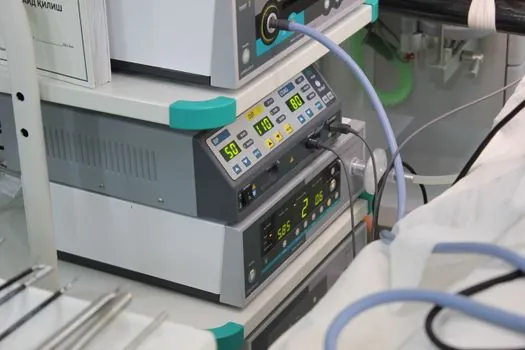
For a standard food-plant RFQ, the AE-SGP (1 MP HD, 360° articulation, 0.95 to 6 mm probes, IP67, fibre-optic illumination, 8+ hour battery) fits general residue and weld-inspection work where full probe orientation matters more than measurement [S3]. The AE-DGX (up to 1080P, 4-way articulation, 1.8 to 8.4 mm probes, on-screen measurement and annotation, image processing, 4+ hour battery) fits crack measurement, pitting depth assessment, and audit-defensible visual records where measurement tools are paid for by the line item [S4].
On the four decision criteria that drive food-plant selection, the comparison is: (a) probe-diameter range, AE-SGP 0.95 to 6 mm versus AE-DGX 1.8 to 8.4 mm, with the AE-DGX winning for larger-bore piping; (b) articulation, 360° full direction on the AE-SGP versus 2-way/4-way on the AE-DGX, with the AE-SGP winning for tortuous paths; (c) battery life, 8+ hours on the AE-SGP versus 4+ hours on the AE-DGX, with the AE-SGP winning for full-shift inspections; (d) measurement tooling, absent on the AE-SGP and built-in on the AE-DGX, with the AE-DGX winning for quantitative audit records [S3][S4]. A buyer should match the model to the dominant criterion, not average across all four, because the price band is set by the worst-spec'd parameter.
Selection criteria: who this equipment is for and who it is not for
An industrial borescope is the right tool when the inspection target is internal, accessible only through a small port, and the cost of disassembly outweighs the cost of the scope: heat-exchanger tube sheets, pump volutes, valve bodies, separator bowls, and homogeniser pistons are the standard use cases [S3][S4]. A borescope is the wrong tool when the inspection target is full volumetric coverage (use a boroscope with a scan head, not a single fixed camera), when the lumen is smaller than 1 mm, or when quantitative defect sizing is required to a tolerance tighter than ±0.1 mm, which is below the resolution of a 1 MP probe [S3][S4].
Food-contact suitability is a separate gate from general industrial suitability: a probe with an IP67 rating and a stainless sheath is necessary but not sufficient, and the buyer must also confirm that the sheath alloy, the tip-window sealant, and any internal adhesives are listed against the actual product and CIP/SIP chemistry [S1]. A borescope vendor who cannot produce a signed compatibility statement against the buyer's specific cleaning recipe is the wrong vendor, regardless of optical performance.
Common RFQ mistakes that force a requote
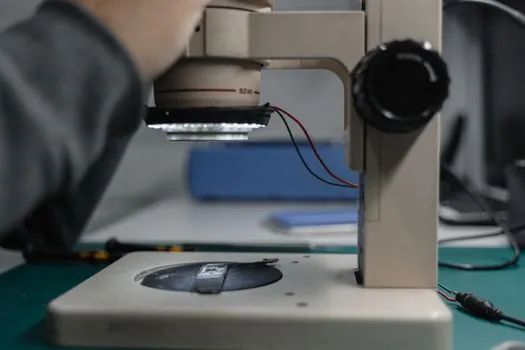
Five mistakes account for most requote cycles on borescope RFQs: (1) writing only "borescope" without probe diameter, length, and articulation, which forces the vendor to assume and price the worst case; (2) omitting the operating-temperature envelope, which excludes cold-room or hot-CIP models; (3) asking for "waterproof" instead of naming an IP rating, which lets the vendor offer IP54 when IP67 is required; (4) ignoring the documentation pack, which is the most expensive omission because the vendor quotes a standard commercial unit and the buyer later has to pay for a custom compliance file; (5) specifying a measurement feature without naming a tolerance, which lets the vendor skip the calibration line and the buyer loses audit traceability [S1][S3][S4].
A related article on hygienic component selection for food lines, gearbox selection for food processing, runs through the same documentation logic for a different equipment class and is a useful cross-check when building the borescope RFQ. Buyers who already have a hygienic-fittings or hygienic-gearbox spec map can copy the documentation block straight across and reduce requote risk on the borescope line [S1].
Trackable signals for the next 30 to 90 days
Two signals are worth watching between now and the end of 2026: first, the publication of any vendor update adding Ra-value certificates or 3-A / EHEDG-style cleaning-compatibility statements to standard borescope quotes, which would close the documentation gap for hygienic buyers; second, the appearance of 4K-resolution probes in the 4 to 6 mm diameter range, which would shift the resolution-versus-bend-radius trade-off for food-plant work. Both signals show up first on the wetted-material declaration, not on the marketing brochure, and any RFQ written in August 2026 should leave room for either change without triggering a requote [S1][S3][S4].
For the relevant spec sheets and selection criteria, see industrial borescope, angular contact bearing, and control panel component.