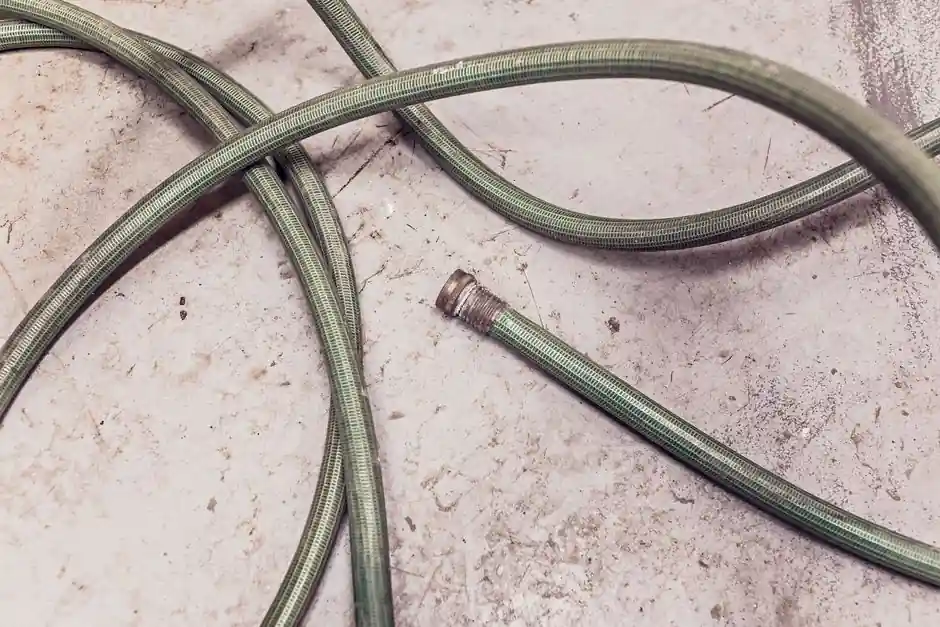
Genuine Bauer stainless-steel hose tail sets list from £2.58, stainless BSP threaded adaptors from £65.92, and stainless flanged adaptors S70/S73 from £278.40 at authorised UK distributor IHP as of 2026-08-11 [S2]. The spread is roughly 100x across a single coupling family, and the spread is wider across hose types: rubber, PVC, silicone, PTFE, and metal ducting each carry different unit economics.
For procurement, the question is never "what does a hose cost" but "what does the correctly specified hose + coupling + certification cost, and what is the failure-driven replacement rate over five years." This guide walks through the price bands, the cost drivers, and the realistic comparison points a process engineer or buyer should hold to in 2026.
Price bands by material family (rubber, PVC, silicone, PTFE, metal)
Industrial hose list prices in 2026 track the raw-polymer market, with rubber and EPDM at the entry tier, PVC slightly above, silicone a step up for temperature, PTFE and metal ducting at the top for chemical or zero-permeation service [S1][S4]. J.W. Roberts, a Houston wholesale distributor, stocks all five families (rubber, PVC, silicone, PTFE, metal ducting) and groups them by application rather than by SKU price, because the operating envelope dictates the family before length or diameter does [S1].
For chemical service, PTFE and UHMWPE hoses are specified for aggressive solvents, acids, and caustic materials; for offshore and refining, marine-grade and metal hoses address salt exposure, dynamic flexing, and zero permeation [S1]. Chinese OEM Ecoosi, founded 2006, covers TPU, PVC, PTFE, and PFA in inner diameters from 8 mm to 1000 mm, and explicitly markets a private-label portfolio to reduce total cost of ownership across the supplier base [S4].
What moves the price: material, certification, volume, lead time
Four drivers explain most of the spread between a £2.58 O-ring and a £278.40 stainless flanged adaptor on the same product page [S2]. First, raw material: stainless 304 vs mild steel roughly doubles the fitting price; PTFE vs rubber liner can multiply hose price by 3 to 5x for the same diameter. Second, certification: FDA food-grade, ATEX/IECEx for explosive atmospheres, and USP Class VI for pharma each add audit, testing, and documentation cost that the OEM recovers in the unit price [S1].
Third, volume tier: Made-in-China.com aggregates 2026 industrial hose fitting offers from audited factories, with hydraulic and stainless hose fittings dominating the search-results mix and explicit "factory price" framing visible on category pages [S3]. Fourth, lead time: IHP advertises next-working-day shipping on standard Bauer items from UK stock, with expedited options priced separately [S2]. A 4-week lead-time difference on a non-stocked PTFE assembly can swing effective unit cost by 10 to 20 percent once downtime risk is priced in. For a deeper look at how related process equipment lifecycle costs interact with plant uptime, see the analysis of industrial automation software licensing and 2026 sourcing shortlists.
Couplings and fittings: the line items buyers actually negotiate on
On an industrial hose assembly, the coupling or fitting is frequently more expensive than the hose itself, and it is also the part that fails first under vibration, thermal cycling, or cross-threading. IHP's August 2026 Bauer catalogue gives a clean benchmark: O-rings S4/S5 from £2.58; mild-steel hose tail sets S77/S2/S78/S4 from £2.58; stainless hose tail sets from £4.62; stainless weld ends from £29.30; stainless BSP threaded adaptors from £65.92; stainless plugs and caps S8/S9 from £174.76; and stainless flanged adaptors S70/S73 from £278.40 [S2].
These prices are for genuine, UK-stocked product; IHP explicitly warns that counterfeit "Bauer Type" fittings circulate at a fraction of the price and tend to fail under pressure onsite [S2]. Procurement should treat the spread between genuine stainless and unknown mild-steel imitation as a quality gate, not a bargain. For an adjacent spec-driven selection process on protective equipment that uses the same authenticity-and-certification logic, the ISO 11611 welding clothing class guide lays out a comparable decision frame.
Comparison: rubber vs PVC vs silicone vs PTFE vs metal ducting
On four decision criteria a process engineer uses to write a hose spec, the five material families line up as follows. (1) Temperature range: silicone typically outperforms EPDM rubber and PVC at both low and high ends; PTFE handles continuous service up to roughly 260 degrees C; metal ducting covers the highest temperature and pressure window but sacrifices flexibility. (2) Chemical compatibility: PTFE and UHMWPE lead for aggressive solvents, acids, and caustics; rubber suits hydrocarbons and water; PVC is limited to milder chemicals [S1]. (3) Cost per metre: rubber and PVC are the entry tier, silicone a moderate premium, PTFE and metal at the top. (4) Flexibility vs pressure: rubber and silicone win on flexibility; metal ducting wins on pressure rating and zero permeation. Buyers selecting industrial hose assemblies for abrasive slurry, food-grade, or chemical service should match the family to the worst-case chemical and temperature, then optimise cost within that family.
Use cases and where each family earns its premium
Agriculture typically takes lay-flat discharge and suction hoses, plus chemical-resistant tubing for irrigation and fertilizer transfer; cost dominates, and rubber/PVC families cover it [S1]. Food processing requires FDA-compliant hoses for beverages, dairy, oils, and dry bulk; silicone and specific food-grade rubber dominate, with PTFE used for high-temperature or flavour-sensitive lines [S1]. Chemical plants run PTFE and UHMWPE for aggressive solvents, acids, and caustics, with the correct couplings selected for the chemistry.
Offshore and oil patch service is where metal ducting and marine-grade hose assemblies earn the premium: salt exposure, dynamic flexing, subsea pressure, and produced-water transfer all push selection toward metal and PTFE internals [S1]. Material handling with abrasive slurries, sand, and aggregate uses heavy-wall suction and discharge rubber hose; the cost driver here is wall thickness and wear life, not raw polymer. Petroleum fuel transfer adds static-dissipation and vapour-recovery requirements, which again moves the spec, and the price, upward.
Failure modes, limitations, and what "cheap" actually costs
The largest cost in industrial hose ownership is not the purchase invoice; it is the unplanned shutdown, the spilled load, and the OSHA/EH&S report. IHP's own counterfeiting warning puts the failure mode in plain terms: a failed connection can mean a burst hose, a spilled load, a stalled shift, or worse, and counterfeit couplings rarely announce themselves until they are already onsite and under pressure [S2]. The same logic applies to a misapplied hose: a PVC hose on a hot chemical line softens, a rubber hose on an aromatic solvent swells, and a non-FDA hose in a dairy line contaminates the batch.
For maintenance planners, the practical guardrails are: match material to chemistry and temperature before negotiating price; specify couplings and clamps rated for the same pressure class as the hose; treat the assembly as one certified unit rather than three line items; and budget for periodic hydrostatic test replacement on critical service lines. Total cost of ownership over a five-year window typically splits as roughly 20 to 30 percent purchase price, 40 to 50 percent installation and commissioning labour, and 25 to 35 percent unplanned-failure and replacement cost on aggressive service.
Sourcing channels, standards, and the August 2026 market signal

Three sourcing channels dominate industrial hose procurement in 2026: authorised brand distributors carrying named lines (Bauer, Novaflex, Pureflex, Pacific Echo, Hose Master, Sun-Flow), wholesale specialists with consultative application support, and factory-direct platforms listing audited suppliers [S1][S2][S3][S4]. The trade-off is direct: brand distributors carry higher unit cost but short UK/EU lead times and documented certification; factory-direct on Made-in-China.com offers aggressive unit pricing on hydraulic and stainless hose fittings with the buyer's responsibility to validate the supplier audit and test reports [S3].
On the standards side, buyers should anchor specs to the governing document for the service: FDA for food contact, ATEX 2014/34/EU and IEC 60079-series for explosive atmospheres, ISO 3821 for gas welding hose, and EN 12115 for chemical rubber/plastic hose. Always request the test certificate and lot number, not just the catalogue page, before releasing a PO on critical-service hose. Trackable signals to watch over the next quarter: raw-polymer index movement (rubber and PTFE precursor pricing), stainless 304/316 surcharges, and EU warehouse stock levels on genuine-coupling lines such as Bauer S77/S2/S78/S4, which are the most commonly counterfeited SKUs and the cleanest indicator of distributor-channel health [S2]. For related process-side specification work that follows the same materials-and-certification logic, the forestry crane 2026 spec-cut analysis covers a comparable OEM-vs-aftermarket decision frame.
The underlying component specifications are covered under lighting equipment and electric lamps, and linear guide.