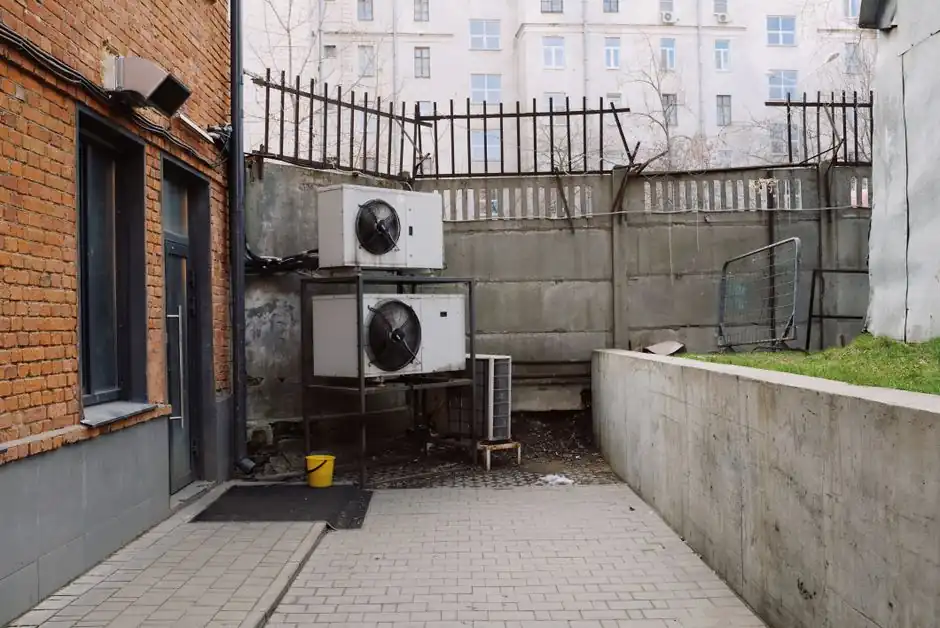
Industrial HVAC equipment lead times in 2026 range from 8 weeks for selected standard heat pumps and chillers to 52 weeks for some constrained equipment categories [S1][S2].
The range addresses chillers, rooftop units, and air-handling units, for which delayed procurement can affect HVAC design, MEP coordination, construction schedules, and project costs, making model-level quotations more useful than a single project-wide estimate [S1].
Two-speed market changes the planning basis
The 2026 market operates at two speeds: some standard commercial heat pumps and chillers can be delivered in 8 working weeks, while applied chillers and large centrifugal units can carry lead times measured in months and, with installation scheduling, can approach 52 weeks [S1][S2].
That spread makes an average lead time poor procurement data. The relevant number is the committed date for the specified manufacturer, capacity, configuration, and delivery location [S2]. A project requiring a large custom chiller should not plan around the 8-week case, while a standard unit with an available factory slot may be priced using a materially different exposure.
For industrial buildings, the 52-week upper bound is a schedule-planning warning rather than a guarantee for every category; Skanska identified sustained demand for rooftop units and other major HVAC equipment as demand grew for data centers, advanced manufacturing facilities, healthcare buildings, and other complex developments [S1].
Compare the main procurement options
Standardized equipment offers the best lead-time and cash-flow case, with selected heat pumps and small-to-medium chillers available in 8 weeks rather than the prior 10-to-12-week norm [S2]. Large custom units sacrifice schedule certainty for capacity, controls, refrigerants, headers, seismic requirements, or other project-specific performance criteria.
Applied chillers and large centrifugal chillers are the high-risk case because their quotations run into many months and can stretch close to a year [S2].
Replacement coils occupy a separate procurement lane. Data-center construction was reported to be increasing replacement coil lead times and reducing quick-ship availability, so a coil selected outside the standard catalog may move from a weeks-scale order to a project-scale fabrication item [S6].
Lock critical equipment before design freeze

Equipment availability has to be treated as an engineering input, not a procurement follow-up. An HVAC system can be fully designed, approved, and installation-ready on paper while its critical equipment remains unavailable, delaying chillers, rooftop units, and air-handling units [S1].
Industrial project teams should identify long-lead equipment before the design package is frozen, then obtain written quotations containing the model, capacity, configuration, factory, delivery date, and any approved-substitution conditions.
Early procurement also limits redesign exposure. Once equipment release and manufacturing are complete, changes to capacity, coil geometry, controls, or refrigerant can affect price and delivery rather than merely affecting drawings. The engineering value of an early release is therefore the ability to coordinate foundations, utility penetrations, rigging, controls, and installation labor against a real date.
The broader strategy is covered in Early Equipment Procurement for Fast-Track Industrial Projects: Long-Lead Strategy, which addresses long-lead planning for projects where schedule is constrained.
Cash exposure rises with the quoted duration
That calculation should be carried into the project cash-flow plan rather than treated as a procurement footnote. At a 10% deposit, the same $300,000 order would expose $30,000 for 20 weeks; at 50%, it would expose $150,000 for the same period. The economic difference between the two terms is $120,000, even though the equipment and delivery date are unchanged.
Price escalation adds another uncertainty. Project budgets should therefore track quoted prices and factory commitments separately from market escalation assumptions.
A planned 20-week procurement decision should therefore be compared against the full consequence of waiting for failure, including rush pricing, temporary cooling, overtime, and installation disruption.
Refrigerant and design changes can reset the schedule
New commercial HVAC equipment is required to use low-GWP refrigerants such as R-454B and R-32 from January 1, 2026 under the AIM Act transition described in the project-planning material [S7]. Equipment selected for a 2026 industrial building therefore needs to be checked for refrigerant type, transition compliance, and the compatibility of controls, service tools, and replacement parts.
Replacement planning must also account for legacy equipment. Reported R-410A transition costs added 8–15% to equipment pricing as manufacturers moved toward R-32 and R-454B, while R-22 removal carries separate disposal cost [S5]. Those percentages describe reported market conditions, not a universal quotation adjustment.
Controls, building access, and labor can add further time after the equipment reaches the site. BAS or BMS integration was reported at $8,000–$45,000 for larger projects, while rooftop replacements on occupied buildings required crane lifts, temporary roof patching, or after-hours scheduling, adding $2,000–$12,000 per unit beyond equipment cost [S5].
These items belong in the schedule model. A factory delivery date is not a commissioning date, particularly where rigging permits, roof access, shutdown windows, control graphics, or technician availability constrain the installation sequence.
Industrial buildings need equipment-specific contingencies
Large industrial projects are not suited to one generic HVAC allowance. A manufacturing facility with continuous cooling may have less tolerance for a custom chiller delay than an office building with a modular rooftop system. Data centers and semiconductor plants also compete for the same constrained manufacturing categories that affect industrial construction [S1][S3].
Before accepting a delivery commitment, the project team should compare four criteria: documented factory lead time, total delivered cost, operating-performance fit, and schedule flexibility. A standard unit can win on delivery and cash exposure; a custom unit can win on energy performance, resilience, or process-load matching; a replacement-only strategy can shorten engineering time but may carry a 20–35% procurement premium [S5].
The plan should also separate critical-path equipment from replaceable or field-fabricated items. Chillers, cooling towers, air-handling units, rooftop units, and custom coils usually require earlier release than controls components, generic piping, or field-installable accessories. Every long-lead release should identify the design information needed to place a defensible order, including loads, operating schedules, refrigerant, controls interfaces, seismic and access constraints, and approved alternatives.
What to track before the equipment order

The first trackable signal is the manufacturer’s written delivery commitment, measured from approved submittals to shipment, with installation scheduling stated separately [S2]. The second is the cash commitment, including deposit percentage, milestone payments, escalation terms, cancellation exposure, and the date the equipment becomes billable.
Project teams should update these figures at every design and procurement milestone. If the selected configuration changes from standard to custom, if the load grows, or if controls and performance requirements become more restrictive, the quoted duration must be reconfirmed rather than carried forward as a planning assumption [S1][S2].
For 2026 industrial building work, use 8 weeks as a possible fast-case benchmark, 16–28 weeks for many large custom units, and approximately 52 weeks as the upper planning boundary for constrained equipment [S1][S2][S5]. The prudent procurement decision comes from the supplier-specific commitment, not from the fastest published delivery case.