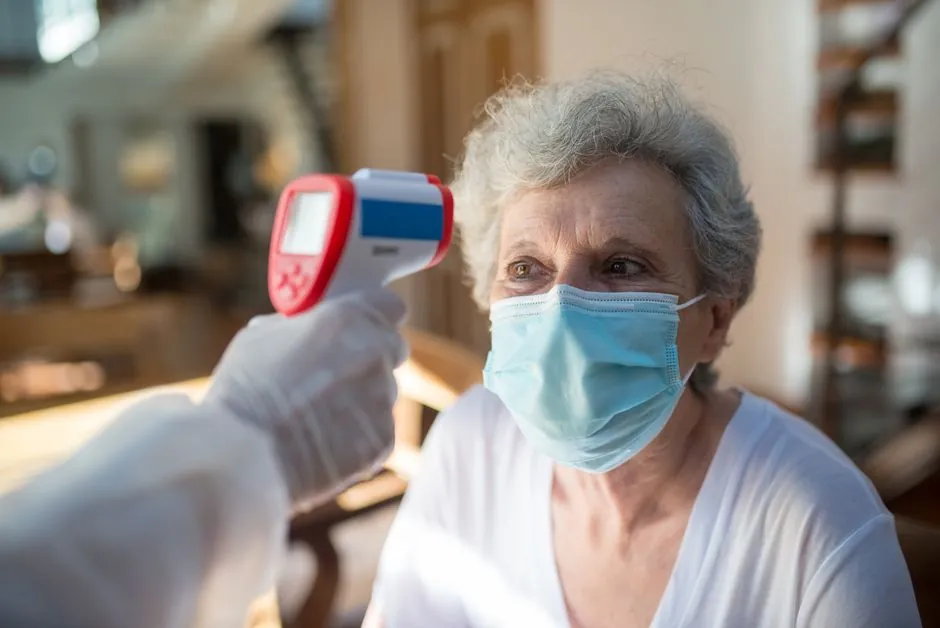
Infrared thermometers use infrared energy, which occupies frequencies between visible light and radio waves [S1][S2].
The dominant general-purpose band is 8–14 µm, while specialized instruments may use narrower bands near 0.7–0.9 µm or approximately 1–3 µm for particular target and atmospheric conditions [S2][S4][S8].
0.7–20 µm is the practical measurement region
That 0.7–20 µm interval is a selection boundary, not a claim that every instrument detects every wavelength within it. A lens focuses radiation onto an infrared detector, while optical filters define either a narrow spectral band or a broader response [S3]. The instrument converts absorbed radiation into an electrical signal and applies an emissivity correction to infer target temperature [S3].
For general industrial work, the infrared thermometer category therefore spans different optical designs rather than one universal wavelength setting. The useful specification is the instrument’s stated spectral response, not simply the label “infrared.”
8–14 µm is the general-purpose industrial band
The 8–14 µm band is the most commonly used spectral range for general-purpose infrared thermometers [S4]. It also occupies the long-wavelength infrared category used for temperature measurement, heating and cooling, thermal imaging and night vision [S2].
Selection based on 8–14 µm is therefore a sound default for ordinary surface-temperature work, but it does not remove the need to consider target size, distance, field of view, emissivity and atmospheric transmission. A broader view of this hardware family appears in the guide to industrial cameras, while thermometers and thermal imagers should still be selected by their individual spectral-response specifications.
Specialized bands serve high-temperature and specialized targets

Other instruments operate at very narrow wavelengths. A dual-color system can use channels near 0.7 and 0.8 µm, while filtered sensors can operate near 0.8 and 0.9 µm [S8]. Such selections can support measurements through water with less interference than measurements made in absorption-prone bands [S8]. They are specialized configurations, not substitutes for the 8–14 µm default.
Broadband systems can integrate radiation over a wide interval, whereas narrow-band systems use optical filters over a limited interval [S3]. Narrow bands reduce the emissivity variation that must be corrected across the measured wavelengths, while broadband instruments can be less expensive and easier to use but more dependent on an appropriate emissivity setting [S3].
Band choice alone does not determine measurement accuracy
Infrared thermometers measure the radiation emitted by a target, and every material above 0 K emits infrared radiation relative to its temperature [S2]. Emissivity varies with molecular structure and surface characteristics, so polished metal, oxidation, coatings and surface finish can change the result even when the wavelength band is correct [S1][S2].
The principal selection and use factors include atmospheric absorption, sensor wavelength sensitivity, target emissivity, target size, field of view, distance, ambient temperature and stray infrared radiation [S2]. A target must also fill the instrument’s optical footprint.
Accuracy also depends on calibration geometry, source size, measurement distance, temperature stability, source uniformity and the emissivity of the emitting surface [S4]. This is why an industrial borescope may be needed to confirm the intended measurement surface, and why a contact RTD PT100 or thermocouple may be preferred when a representative surface contact can be established.
Comparison of common spectral approaches

General-purpose instruments in the 8–14 µm band offer the most common industrial solution and fit ordinary surface-temperature measurements across many plant environments [S2][S4].
For a thermal-imaging purchase based on long-wave infrared, the decision criteria, operating range and application limits are covered in Select an 8–14 Micron LWIR Thermal Imager. A thermometer used for process control should also be assessed as a complete measurement chain rather than judged by its laser sight or spot-size ratio alone [S6][S10].
Verify the full instrument specification before purchase
A procurement request should state the spectral response in micrometres, not only “infrared.” It should also identify the intended temperature span, target material, measurement distance, required spot size, atmosphere and emissivity-adjustment method. These are more useful acceptance criteria than a request for a generic non-contact thermometer [S2][S4].
General-purpose instruments typically emphasize the 8–14 µm band, while high-temperature designs may use approximately 1–3 µm and specialized systems may specify channels around 0.7–0.9 µm [S2][S8]. Confirm the manufacturer’s specified band and temperature range against the application, then verify calibration traceability and measurement geometry [S4].
For traceable process records, the measured infrared value can feed a temperature recorder or temperature sensor, but the optical specification determines whether the reading represents the intended process surface. A supplier package should therefore identify spectral band, field of view, distance-to-spot ratio, emissivity range, temperature range and calibration method.