
In a PLC-based control cabinet, the industrial relay sits between the controller output and the field load, and most contact failures trace back to three numbers chosen wrong: contact rating, coil voltage, and surge current headroom [S1].
Selection starts with the load, not the relay catalog. A motor, a resistive heater, a solenoid, a DC bus, and a low-level signal all demand a different contact family, and the 20-25% derating rule on contact current is non-negotiable for any inductive or capacitive load [S3][S4].
Relay Family vs. Load Type: A Four-Way Match
Power relays split cleanly into four integration paths: PCB power relays for board-level control under tight space, general industrial power relays for panel and equipment switching, high-power AC relays for heavier alternating-current loads, and high-power DC relays for battery, photovoltaic, and energy-storage isolation [S4].
DC switching is the trap that catches the most buyers: arc interruption on DC is harder than on AC because there is no zero-cross to quench the arc, so a relay rated for a 30 A AC load is not automatically safe on a 30 A DC bus, even at the same voltage [S4]. Where the equipment includes DC source, storage, or isolation duties, a high-power DC relay must be specified, not retrofitted from an AC-stamped unit.
Contact Rating, Poles and Throws: The Numbers That Fail First
Contact rating must be sized at roughly 125% of the steady-state load current, with additional headroom for inrush on motors, transformers, capacitor banks, and incandescent or LED driver inrush [S2][S4]. Startup current on inductive loads can be several times the running current, so picking the relay by steady-state current alone is the single most common path to welded contacts.
Contact form follows the wiring, not the catalog. SPST covers one on/off path, SPDT (single-pole double-throw) covers a changeover, and DPDT (double-pole double-throw) lets one coil command two independent circuits at once [S1]. Normally open (NO) and normally closed (NC) describe the de-energized state: NO is open until the coil is energised, NC is closed until the coil pulls in, and the failure mode of each is the opposite of the other, which matters for safety circuits and E-stop loops [S1].
Coil Voltage, Pickup and Dropout: The Side That Gets Forgotten
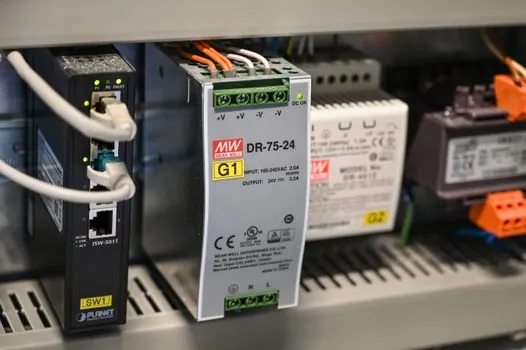
Coil voltage must match the upstream driver exactly. Industrial systems most commonly use 24V DC for PLC-driven relay coils, with 12V DC common on smaller boards and 110-230V AC on legacy cabinets, and the relay's pickup voltage (typically 70-80% of nominal) and dropout voltage (typically 5-20% of nominal) define the working window [S1][S3].
Under-voltage on the coil is a hidden failure mode: the relay chatters, contacts weld, and the coil burns out long before the contact rating is reached. Where supply is marginal, choose a relay with a wide operating range or a built-in hold circuit, and never assume that a 24V AC coil and a 24V DC coil are interchangeable even though the labels match [S1].
Switching Speed, Mechanical Life and Electrical Life
Switching speed decides the family. Solid-state relays (SSR) switch in microseconds with no moving parts, ideal for high-cycle heater control and silent operation, but they leak a small off-state current and dissipate heat through a snubber or heatsink [S2]. Electromechanical relays (EMR) switch in 5-15 ms, tolerate higher inrush, and fail open, which is usually safer for maintenance.
Mechanical life is rated in operations (often 10 million for a small EMR), but electrical life at the rated load is typically 100,000 operations, and that number collapses by a factor of 5-10 when switching near the contact limit or under DC load [S2]. For high-cycle applications above roughly 100,000 operations per year at full load, an SSR or a power relay with an explicitly rated DC load is the lower-risk choice.
Mounting, Terminal Style and Environment

Mounting style is the integration constraint, not a preference. PCB-mount relays fit board-level designs, socket-mount (octal or blade) relays swap in seconds for maintenance, and DIN-rail or panel-mount relays live in control cabinets beside contactors and circuit breakers on the same rail [S1][S2].
Environment drives the final part number. Ambient temperature above 40 deg C, vibration above 5 g, humidity above 95% RH, or any presence of oil mist, dust, or corrosive gas pushes the spec toward sealed or hermetically sealed relays with conformal coating, and outdoor cabinets often pair that with an IP65 enclosure [S2]. For full operating envelope and enclosure guidance, the industrial relay encyclopedia entry covers contact families, mounting, and standards in detail.
Who Should NOT Pick a General-Purpose EMR
Four duties defeat a stock general-purpose electromechanical relay: DC switching above 24V at more than a few amps, sub-millisecond switching, more than 10 million operations at the rated load, and any safety-rated output where a welded contact would re-energise a hazard [S2][S4]. In each case the right answer is a different component family: an SSR for speed and silent operation, a high-power DC relay for DC interruption, a latching relay for low hold-power memory, and a force-guided (mirrored contact) relay where the safety circuit must detect contact welding [S1].
Buying only on unit price is a trap: comparing suppliers by unit price alone can result in contact failure, overheating, short service life, PCB redesign, or unstable performance in the final equipment [S4].
Sourcing, Standards and the Right Supplier Question

Standards to verify on the datasheet, not the box, include the contact rating at the actual load type (resistive, inductive, motor, DC), the electrical life at that rating, the coil voltage tolerance, the operating temperature range, and the certifications (UL, CE, CCC, VDE, TUV) required by the end market [S1][S4]. Coil power consumption, dielectric strength between contacts and coil, and creepage/clearance distances for the pollution degree of the installation are the three spec lines that distinguish a serious industrial relay from a hobby-grade part.
The industrial relay reference page collects the contact-form nomenclature, common certifications, and a comparison of EMR, SSR, reed, and latching families for sourcing teams.
Component reference pages worth checking: industrial adhesive, and industrial borescope.