An industrial relay is an electrically operated switch that uses a small control signal to open or close one or more separate, often higher-power, circuits. In an electromechanical relay an energized coil pulls an armature that moves the contacts; in a solid-state relay a semiconductor performs the same isolation and switching with no moving parts. Relays are the workhorse interface between low-power logic (PLC outputs, thermostats, safety controllers) and the field loads, contactor coils, solenoids, valves, and indicators they command.
This guide treats the relay as a control-circuit device under IEC 61810-1, distinct from the power-circuit contactor under IEC 60947-4-1. It covers the contact-form vocabulary, the electromechanical-versus-solid-state decision, contact metallurgy, coil behavior, and the spec-sheet figures that actually determine service life in a control panel.
This guide is written for control-panel designers and purchasing engineers. It spans 6 chapters, from what a relay is, through contact forms and pole/throw notation, electromechanical versus solid-state technology, contact materials and coil behavior, key spec-sheet parameters, to a step-by-step selection sequence, with 7 selection FAQs and manufacturer comparisons. All parameters reference the public standards IEC 61810-1 and IEC 61810-2 (electromechanical elementary relays), IEC 60947-5-1 (control-circuit devices and utilization categories AC-15 and DC-13), and UL 61810-1, which is replacing UL 508 for relays.
Chapter 1 / 06
What is an Industrial Relay
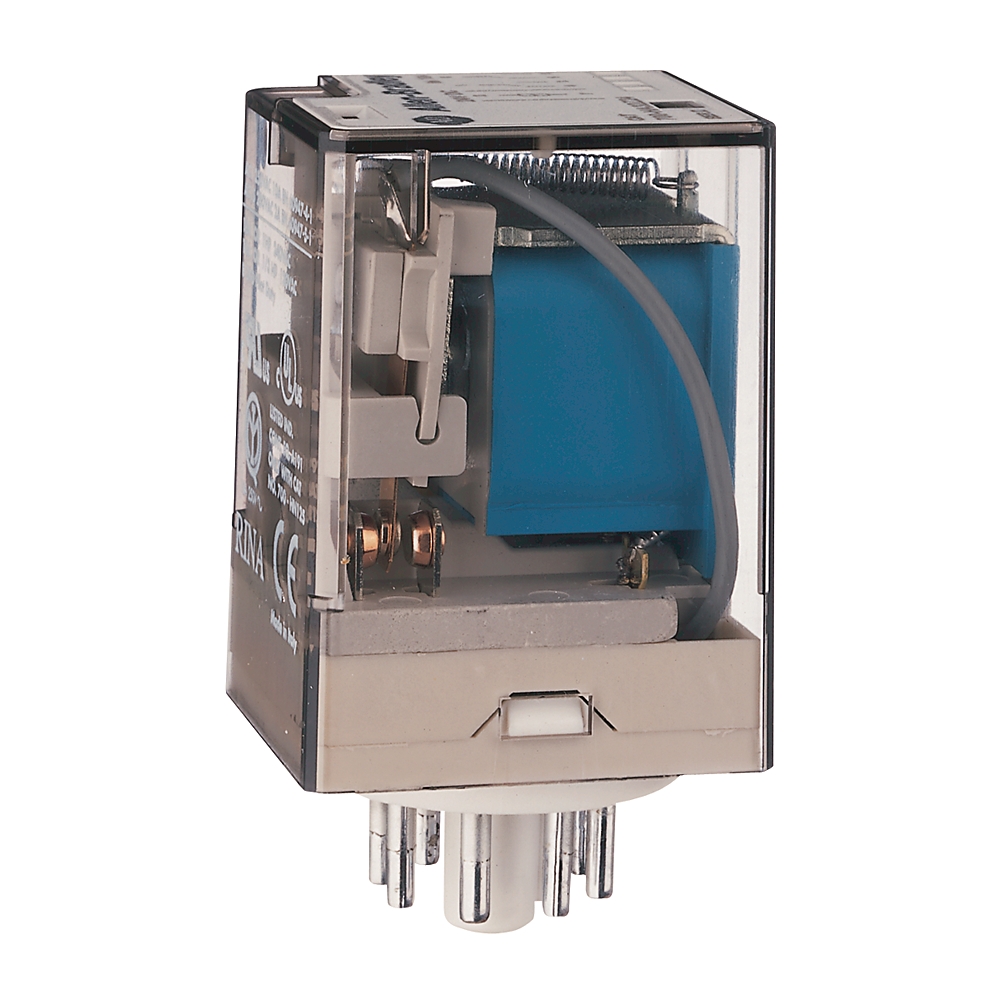
An industrial relay is an electrically operated switch that uses a small input signal to control one or more independent output circuits, providing galvanic isolation between the controlling side and the controlled side. The classic electromechanical relay (EMR) consists of three functional blocks: a coil that becomes an electromagnet when energized, a movable armature held by a return spring, and one or more contact sets that the armature opens or closes. When the coil current exceeds the pull-in threshold, the magnetic field overcomes the spring, the armature snaps over, and the normally open contacts close while the normally closed contacts open. Remove the current and the spring restores the original state. This simple mechanism amplifies authority: a few milliamps in a 24 V DC coil can switch several amps at 250 V AC on the contacts.
The relay sits firmly on the control side of the control-power boundary. International standards reflect this split. IEC 61810-1 governs electromechanical elementary relays for incorporation into low-voltage equipment in circuits up to 1,000 V AC or 1,500 V DC, while IEC 60947-5-1 governs control-circuit devices and defines the utilization categories, such as AC-15 and DC-13, that describe how a contact behaves under inductive control loads. Power switching, by contrast, belongs to the contactor under IEC 60947-4-1. The practical consequence is that a relay carries the signal and a contactor carries the load: a PLC output drives a relay, that relay drives a contactor coil, and the contactor switches the motor.
The relay is one of the oldest devices in electrical engineering. American physicist Joseph Henry demonstrated an electromagnetic switch in 1835, and the relay became the regenerating element of the electric telegraph, restoring weak line signals over long distances, which is the origin of the name. Through the first half of the twentieth century, banks of relays formed the logic of telephone exchanges, railway signaling interlockings, and the earliest electromechanical computers. From the 1970s onward, the programmable logic controller absorbed most sequencing logic into software, but it did not eliminate the relay; instead it created enormous demand for the interface relay, the small coupling device that translates a low-current PLC transistor output into a robust, isolated dry contact in the field.
Today the industrial relay survives because of four properties that semiconductors do not fully replace: true galvanic isolation between input and output, an extremely low on-state voltage drop and power loss across closed metal contacts, the ability to switch AC or DC of either polarity with the same device, and high tolerance to electrical surges and noise. A modern control panel may contain dozens of slim 6 mm DIN-rail interface relays in a row, each coupling one PLC channel to one field actuator, alongside larger plug-in power relays and a handful of solid-state relays reserved for fast or high-cycle duties.
Four engineering metrics decide whether a relay is fit for an application and what it will cost over its life: the contact rating (current, voltage, and utilization category), the coil characteristics (voltage, power, pull-in and dropout), the contact material, and the mechanical and electrical endurance. A relay chosen on price alone, then driven beyond its inductive rating without arc suppression, can weld its contacts within months; the same relay correctly derated and snubbed can run for a decade. The rest of this guide unpacks these four metrics so they can be specified deliberately rather than by habit.
Chapter 2 / 06
Contact Forms and Pole Notation
Before any rating is read, a relay must be described by its switching geometry: how many independent circuits it switches (poles) and how many positions each circuit can reach (throws). Two parallel naming systems coexist on datasheets: the pole-throw abbreviations (SPST, SPDT, DPDT) and the contact-form letters (Form A, B, C). Reading a relay order code wrongly here is the most common procurement error, because it produces a part that is electrically rated correctly but wired in the wrong configuration. The table below maps the two systems.
Contact form
Pole / throw
Symbol notation
Default (de-energized) state
Typical use
Form A
SPST-NO
1NO
Open
Switch a load on when commanded
Form B
SPST-NC
1NC
Closed
Fail-safe drop-out, interlocks
Form C
SPDT
1CO
Common to NC
Changeover, signal routing
2 Form C
DPDT
2CO
Both commons to NC
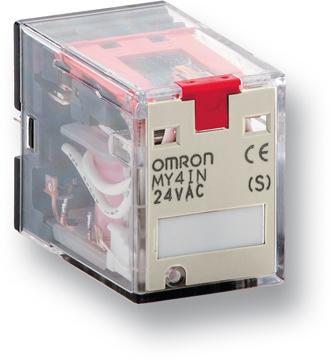
General-purpose plug-in relay
4 Form C
4PDT
4CO
All commons to NC
Multi-circuit sequencing
The pole is the terminal common to every path that a single switching circuit can take; it is the moving wiper. The throw is each fixed position the pole can connect to. A single-pole single-throw (SPST) relay therefore makes or breaks one circuit, while a single-pole double-throw (SPDT) relay transfers one common terminal between two fixed terminals. A double-pole device repeats the same throw arrangement on two electrically isolated circuits driven by the one coil, and a four-pole device repeats it four times. The pole count says nothing about current rating; a 4PDT relay does not carry four times the current, it switches four separate circuits at the same per-pole rating.
Normally open (Form A, NO) contacts are open when the coil is de-energized and close when it is energized. They are the natural choice for switching a load on under command, such as energizing an indicator lamp or a contactor coil. Normally closed (Form B, NC) contacts are closed at rest and open when energized; they are used for fail-safe functions, because a loss of coil power or a broken coil wire leaves the protected circuit in its closed, default condition. Designing safety interlocks around normally closed contacts is a core principle of fail-safe wiring.
Form C (SPDT, changeover) combines both: a single common terminal rests against the normally closed throw and transfers to the normally open throw when energized. Critically, industrial changeover contacts are break-before-make: the common breaks from the NC side before it makes on the NO side, so the two throws are never momentarily bridged. This prevents a short circuit between two sources but creates a brief instant when neither destination is connected, which matters when the relay routes a continuous signal. The general-purpose plug-in relay that fills most control panels is a 2 Form C (DPDT) device, giving two independent changeover circuits from one coil, while sequencing and matrix applications use 4 Form C (4PDT).
One further distinction belongs in this chapter: the difference between a relay and a contactor, which share the same electromagnetic principle but live on opposite sides of the power boundary. A relay is a control-circuit device, typically rated 5 to 16 A, governed by IEC 61810-1 and the AC-15 and DC-13 control categories. A contactor is a power-circuit device, rated from roughly 9 A to more than 1,000 A, governed by IEC 60947-4-1 and the AC-3 motor category, and it adds arc chutes and larger contact gaps to interrupt heavy fault and motor currents. When a relay is used to drive a contactor coil, the contactor coil is an inductive control load and must be sized against the relay AC-15 rating, not its resistive rating, a point developed in the next chapters.
Chapter 3 / 06
Electromechanical vs Solid-State
The single largest technology decision is whether to use an electromechanical relay (EMR) or a solid-state relay (SSR). An EMR switches with metal contacts moved by a coil; an SSR switches with a semiconductor, typically a triac or back-to-back thyristors for AC and a MOSFET for DC, with an opto-isolator providing input isolation. Neither is universally better. The EMR offers true open-circuit isolation, near-zero on-state loss, and AC-or-DC versatility; the SSR offers microsecond switching, silent operation, and enormous endurance at high cycling rates. The table below compares the two on the metrics that drive the choice.
Property
Electromechanical (EMR)
Solid-state (SSR)
Switching speed
5 to 15 ms
Microseconds (sub-ms)
Electrical endurance
~10^5 operations
~10^7+ operations
Mechanical endurance
~10^7 operations
No moving parts
On-state voltage drop
~tens of mV
~1 to 1.6 V (heat)
Off-state isolation
True open gap
Leakage current (mA)
Contact bounce / arcing
Yes
None
Failure mode
Usually open
Usually shorted
Cooling
None
Heatsink required
Switching speed and endurance are where the SSR is decisive. Because it has no armature to accelerate, an SSR changes state in microseconds versus the 5 to 15 ms of a typical EMR, and because it has no contacts to erode, its electrical life at high cycling rates is on the order of one hundred times that of an EMR. The textbook example is time-proportioning heater control, where a PID loop pulses the load roughly once per second: an EMR would exhaust its electrical life in months, whereas an SSR runs for years. SSRs also eliminate contact bounce, the brief chatter as metal contacts settle, which removes a source of electrical noise and false counts.
On-state loss and cooling are where the EMR wins. Closed metal contacts drop only tens of millivolts, so the conduction loss is negligible and no heatsink is needed. A semiconductor, by contrast, drops roughly 1 to 1.6 V while conducting, dissipating heat proportional to the load current; an SSR switching 25 A must shed on the order of 25 to 40 W and therefore requires a sized heatsink and panel ventilation. For continuously closed circuits carrying significant current, the EMR is both simpler and cooler.
Isolation and failure mode often decide safety-related applications. An EMR opens a real air gap, giving true galvanic isolation that a meter reads as infinite resistance, and it typically fails to the open state as contacts erode. An SSR never fully opens: it leaks a small off-state current of a few milliamps, which can be enough to keep a sensitive load or a neon indicator partly active, and its dominant failure mode is a shorted output. Where an isolated, verifiably-off state is required, for example removing power for maintenance, the EMR or a forced-guided safety relay is the correct device, and the SSR is supplemented by a series isolating contactor.
A third category, the hybrid relay, combines the two: an SSR makes and breaks the load to avoid arcing during the switching transient, then an EMR contact closes in parallel to carry the steady-state current with low loss. This captures the SSR long switching life and the EMR low conduction loss, at the cost of greater complexity, and is used in high-cycle power applications such as capacitor switching and large heater banks.
Chapter 4 / 06
Contact Materials and Coil Behavior
For an electromechanical relay, the contact alloy and the coil define real-world performance more than the headline ampere number. The contact material determines resistance to welding, erosion, and film build-up; the coil determines how the relay responds to supply voltage and how it must be protected. Both must be matched to the load, and a mismatch shows up as early failure rather than an obvious specification violation.
Silver nickel (AgNi) is the economical general-purpose contact, a true alloy with a small nickel content that hardens the silver and improves erosion resistance. It is ideal for resistive and light inductive AC loads at or near the rated current, and is the default for many power and plug-in relays. Silver tin oxide (AgSnO2) is made by sintering and excels at high inrush: it strongly resists contact welding, performs well with high peak currents from tungsten lamps, capacitors, and motor starting, and shows low material migration under DC loads. It is also the RoHS-compliant successor to silver cadmium oxide (AgCdO), a long-popular anti-weld material now being phased out because cadmium is a restricted substance.
Gold-plated and AgNi+Au contacts solve a different problem: low-level or dry-circuit switching. When a contact switches only millivolts and milliamps, as on a PLC input or a measurement loop, it lacks the energy to burn through the thin oxide and sulfide films that form on silver, producing intermittent or open contact. A few micrometers of gold flash keep the surface conductive at low energy. The trade-off is that gold is soft and burns off quickly under higher loads, so AgNi+Au contacts are specified only for signal-level duty, never for power switching. The table below maps load types to recommended contact materials.
Load type
Recommended contact material
Avoid
Resistive AC, near rated current
AgNi
Gold flash (burns off)
High inrush: lamps, capacitors, motors
AgSnO2
AgNi (weld risk)
Legacy anti-weld (being phased out)
AgCdO
New designs (RoHS)
Low-level signal, dry circuit
AgNi + Au (gold flash)
Bare AgNi / AgSnO2
DC load with material migration
AgSnO2
Asymmetric silver
The coil turns the control voltage into magnetic force, and its key thresholds are pull-in and dropout. The pull-in (must-operate) voltage is the level at which the armature reliably closes, typically guaranteed at 70 to 80 percent of nominal for general-purpose DC relays, so a 24 V DC coil should pull in by about 18 V. The dropout (must-release) voltage is where the spring overcomes the decaying field, often around 10 to 30 percent of nominal. The gap between them is hysteresis, which keeps the relay from chattering near the threshold. Coils are offered in standard DC voltages (5, 12, 24, 48 V) and AC voltages (24, 110, 230 V); a 24 V DC coil is the dominant choice in PLC-driven panels. Continuous coil power for a miniature relay is modest, on the order of 0.2 to 0.5 W for DC types.
Inductive-load suppression protects both the contacts and the surrounding electronics. Because an inductive load forces current to keep flowing as the contact opens, it draws a long arc that erodes and can weld the contacts; the same energy appears as a voltage spike that stresses nearby semiconductors. Across DC coils and DC loads, a flyback diode clamps the spike, though it lengthens dropout time, so a diode plus Zener is used where fast release matters. Across AC contacts, an RC snubber absorbs the energy. Conversely, when a transistor drives a relay coil, a flyback diode across that coil protects the driving transistor. Fitting suppression is the single most effective way to reach the relay rated electrical life on inductive duty.
Chapter 5 / 06
Key Specification Parameters
A relay datasheet may list twenty or more lines, but only a handful drive selection. The figures below are typical ranges for industrial general-purpose and interface relays compliant with IEC 61810-1; always confirm against the specific manufacturer datasheet, because endurance in particular depends heavily on the actual load. This is the Key Specifications comparison for the device class.
Parameter
Typical value / range
Notes
Contact rating (resistive)
5 to 16 A at 250 V AC
Per pole, AC-1 / resistive
Inductive rating (AC-15)
~3 A at 230 V AC
Control of contactor coils
Inductive rating (DC-13)
~0.2 A at 24 V DC
Control of DC electromagnets
Min. switching load
4.5 V, 0.1 A (AgNi)
Lower needs gold flash
Coil voltage (DC / AC)
5 to 48 V DC / 24 to 230 V AC
24 V DC dominant in panels
Coil power (DC)
~0.2 to 0.5 W
Miniature plug-in relay
Pull-in / dropout
70 to 80% / 10 to 30% Un
Hysteresis prevents chatter
Operate / release time
~5 to 15 ms
Excludes bounce
Mechanical endurance
~10^7 operations
No-load cycling limit
Electrical endurance
~10^5 operations
At rated resistive load
Dielectric (coil to contact)
~4 to 5 kV AC
Reinforced insulation
Ambient temperature
-40 to +85 °C
Derate contacts at top end
Contact rating is never a single number. The headline figure (for example 10 A at 250 V AC) is the resistive or AC-1 rating; the same contact is rated far lower for inductive control. Under IEC 60947-5-1, AC-15 covers the control of AC electromagnetic loads above 72 VA (AC-14 handles loads at or below 72 VA), and DC-13 covers DC electromagnets, where stored coil energy prolongs the break arc and pushes the rated current well below the resistive value. Always size a coil-driving or valve-driving circuit on the AC-15 or DC-13 figure, not the resistive headline.
Minimum switching load is the lower bound that is easy to overlook. IEC 61810-1 specifies a minimum contact load of around 4.5 V and 0.1 A for standard silver contacts: below this, the contact may not reliably break through surface films, causing intermittent connection. A relay carrying a low-level signal must therefore use gold-flashed contacts; using a high-power silver-contact relay on a millivolt signal is a classic reliability mistake.
Mechanical and electrical endurance are separate figures and must not be confused. Mechanical endurance, on the order of 10^7 operations, is how many times the relay can switch with no current through the contacts, limited by spring fatigue and bearing wear. Electrical endurance, on the order of 10^5 operations at rated resistive load, is how many times it can switch under load before contact erosion ends its life, and it falls sharply as the load becomes more inductive or the current rises. A relay can be mechanically sound long after its contacts are worn out, so size the electrical figure against the actual duty cycle.
Operate and release time describe responsiveness. The operate time, the interval from coil energization to first contact closure, is typically 5 to 15 ms for a general-purpose relay; the release time is similar or shorter, though a flyback diode across the coil can lengthen it noticeably. Contact bounce, the few-millisecond settling chatter after first contact, is specified separately and matters when the relay feeds a fast counter. Where switching must be sub-millisecond or bounce-free, a solid-state relay is required.
Insulation and temperature close out the core set. The dielectric strength between coil and contacts, typically 4 to 5 kV AC for reinforced insulation, defines the safety isolation between the control and load sides. The ambient temperature range, commonly -40 to +85 degrees Celsius, must account for self-heating inside a crowded enclosure; contact current is usually derated at the top of the range, and coil pull-in can drift as winding resistance rises with temperature.
Chapter 6 / 06
Selection Decision Factors
To turn the preceding chapters into a specific order code, work through the sequence below. Most selection errors come not from a single wrong value but from deciding a later step before an earlier one is fixed, for example choosing a contact current before confirming the load is inductive. These eight steps double as an RFQ template.
Load character and category: First classify the load as resistive, inductive (contactor coil, solenoid, motor), capacitive (lamp, power supply inrush), or low-level signal. Then read the contact rating in the matching utilization category, AC-15 or DC-13 for inductive control, not the resistive headline. The load character also drives suppression: diode for DC coils, RC snubber for AC contacts.
Contact form and pole count: Decide normally open, normally closed, or changeover, and how many independent circuits switch together. Fail-safe interlocks use normally closed contacts. General-purpose panel duty is usually 2 Form C (DPDT); sequencing uses 4 Form C (4PDT). Forced-guided contacts are required for many safety functions.
Technology, EMR vs SSR: Use a solid-state relay for high-cycle or fast switching such as PID heater control; use an electromechanical relay where you need true off-state isolation, low on-state loss, AC-or-DC versatility, or surge tolerance. Reserve hybrid relays for high-cycle power loads.
Contact material: AgNi for resistive and light inductive AC, AgSnO2 for high inrush and DC migration, AgNi+Au gold flash for low-level signals. Avoid AgCdO in new designs for RoHS compliance, and never put a gold-flash relay on a power load.
Coil voltage and consumption: Match the available control voltage (24 V DC dominates PLC panels; 110 or 230 V AC in legacy schemes) and check pull-in at 70 to 80 percent of nominal so the relay operates reliably at the worst-case supply. Confirm coil power against the PLC output current limit when the output drives the coil directly.
Endurance against duty cycle: Estimate operations per day, multiply over the design life, and compare against the electrical endurance at the actual load, not the mechanical figure. High-cycle loads either need an SSR or a generous derate. Add arc suppression to reach the rated figure on inductive duty.
Mounting, terminals, and certification: Choose plug-in (octal or blade) versus slim DIN-rail interface format, screw versus push-in terminals, and the matched socket. Confirm EN/IEC 61810-1 and UL recognition (UL 61810-1 replacing UL 508), plus any sector approvals (rail EN 50155, marine, hazardous-area). The relay and its socket must be ordered as a matched pair.
Total cost of ownership: Add the relay, the socket, the field-replacement labor, and the cost of downtime from a welded contact. A pluggable interface relay costs more than a soldered PCB relay but is swapped in seconds without rewiring, which usually wins over a multi-year operating life in a production panel.
One dimension that is easy to overlook is serviceability and standardization. A control panel that uses one relay family throughout, with pluggable modules on coded sockets, mechanical and LED status flags, integral coil suppression, and a stocked spare, can be diagnosed and repaired in minutes by maintenance staff years after commissioning. Omron (MY, G2R), Finder (40, 55, and 38/39 MasterINTERFACE series), Phoenix Contact (PLC-RSC), Weidmuller (TERMSERIES), Wago (857), and Schneider (Harmony RSL, Zelio) all offer matched relay-and-socket systems with regional stock and documentation, which makes them dependable defaults for industrial control panels where uptime is the priority.
FAQ
What is the difference between a relay and a contactor?
Both are electromagnetically actuated switches, but they sit on opposite sides of the control-power boundary. A relay is a control-circuit device: it switches small auxiliary loads, typically 5 to 16 A, and is governed by IEC 61810-1 (with control-circuit categories AC-15 and DC-13 under IEC 60947-5-1). A contactor is a power-circuit device built to make and break motor and heater loads from roughly 9 A to over 1,000 A, governed by IEC 60947-4-1 with categories such as AC-3. Contactors add arc chutes, larger contact gaps, and auxiliary contact blocks. Rule of thumb: a relay carries the signal, a contactor carries the load.
What do Form A, Form B, and Form C contacts mean?
They describe a single contact set. Form A is a normally open (NO) contact, also written SPST-NO or 1NO, which closes when the coil is energized. Form B is a normally closed (NC) contact, SPST-NC or 1NC, which opens when energized. Form C is a single-pole double-throw changeover, SPDT or 1CO, with a common terminal that transfers from the NC throw to the NO throw, break-before-make. A 2-pole relay with two changeover sets is described as DPDT or 2CO, and a 4-pole relay as 4PDT or 4CO. The pole count is how many independent circuits switch together; the throw count is how many destinations each pole reaches.
When should I choose a solid-state relay instead of an electromechanical relay?
Choose a solid-state relay (SSR) when the duty cycle is high or the switching is fast: SSRs switch in microseconds, have no contacts to wear, and routinely exceed the electrical life of an electromechanical relay (EMR) by roughly 100x in high-frequency service such as PID heater control where the load may cycle once per second. SSRs also produce no contact bounce, no arcing, and no audible chatter. Keep the EMR when you need true galvanic isolation in the open state, very low on-state voltage drop and power loss, or robust tolerance to surges and reverse polarity. SSRs must be heatsinked, leak a small off-state current, and fail shorted rather than open, so they are not a drop-in substitute for safety-critical isolation.
What does the utilization category AC-15 or DC-13 tell me?
Utilization categories under IEC 60947-5-1 declare the kind of load a control contact can switch, not just a bare ampere number. AC-15 covers the control of AC electromagnetic loads above 72 VA, the inductive coils of contactors and solenoids, where a high making current and arc on break stress the contact (AC-14 is the sibling category for loads at or below 72 VA). DC-13 covers the control of DC electromagnets, where the inductive energy stored in the coil prolongs the arc, so the rated DC current is much lower than the resistive figure. The resistive rating (such as AC-12 or a bare 10 A) always looks higher; for any coil, valve, or relay-driving-relay circuit, size on the AC-15 or DC-13 figure instead.
How do I read the coil pull-in and dropout voltage?
Pull-in (must-operate) voltage is the level at which the armature reliably closes; for general-purpose DC relays it is typically guaranteed at 70 to 80 percent of nominal coil voltage, so a 24 V DC relay should operate by about 18 V. Dropout (must-release) voltage is where the spring overcomes the weakened magnetic field, often around 10 to 30 percent of nominal, so the same relay may not release until the coil falls below roughly 2.4 to 7 V. The gap between the two is hysteresis, which prevents contact chatter near the threshold. Supply the rated voltage continuously: undervoltage causes contact buzzing and overheating, while sustained overvoltage cooks the coil insulation.
What contact material should I specify for my load?
Match the contact alloy to the load profile. AgNi (silver nickel) is the economical general purpose choice for resistive and light inductive AC loads near nominal current. AgSnO2 (silver tin oxide) resists welding under high inrush and has low DC material migration, making it preferred for tungsten lamp, capacitive, and motor inrush loads; it is also the RoHS-compliant replacement for AgCdO (silver cadmium oxide), which is being phased out for its cadmium content. For dry-circuit or low-level signals (millivolts and milliamps, such as PLC inputs or measurement loops), specify gold-plated or AgNi+Au contacts, because a thin gold flash prevents the oxide and sulfide films that cause intermittent contact at low energy.
Which manufacturers and series fit industrial control-panel duty?
For plug-in general-purpose relays, Omron MY (2 and 4 pole, 5 A) and G2R (10 A 1-pole, 5 A 2-pole), and Finder 55 series (7 to 10 A, 2 to 4 pole) and 40 series PCB relays are long-standing references. For slim 6 mm DIN-rail interface and coupling relays driving PLC outputs, Phoenix Contact PLC-RSC, Weidmuller TERMSERIES, Wago 857, Finder 38/39 MasterINTERFACE, and Schneider Harmony RSL are widely stocked, with push-in terminals and pluggable relay modules for fast field replacement. All carry EN/IEC 61810-1 plus UL recognition (UL 61810-1 now replacing UL 508). Specify the coil voltage, contact form, contact material, and certification together; the socket and relay module must be ordered as a matched pair.
Industrial Relay Manufacturers
Source-backed product routes. Open a company dossier for procurement scope and cited evidence.
Partnership powers Henkel to drive innovation and sustainability in its production sites through Schneider Electric’s energy technology, including monitoring software and advisory services.