
The EVST range covers 6-axis general manipulation arms with payloads from 6 to 210 kg and 6-axis welding robots in a 6 kg extended-reach class [S2].
No universal robot lead time by payload
The first general-manipulation comparison points are therefore model codes within the 6–210 kg payload band, including QJR10-1, QJRB20-1600, and QJR50-1 [S2]. A 50 kg requirement is therefore not interchangeable with a 20 kg requirement even when both appear in a general-handling range.
This distinction matters for procurement. A request stating only “50 kg robot” is incomplete; it omits the 2,012 mm reach represented by QJR50-1, the target cycle, the end effector, the workpiece, and the operating environment [S2][S3]. The selection principle is explicit: use “the simplest robot that meets payload-at-reach within the cycle time,” then match it to the environment and certification [S3].
Payload classes and representative robot envelopes
For 6 kg applications, QJR6-1 is listed as a representative EVST general-manipulation model [S2]. These geometries support compact assembly, general handling, and long-reach light manipulation respectively [S2].
For general manipulation, assembly, and machine tending, EVST lists a 6–210 kg payload band with representative models QJR10-1, QJRB20-1600, QJR50-1, and QJRB210-1 [S2]. EVST lists QJRB20-1600 and QJRB210-1 as representative general-manipulation models [S2].
For continuous arc welding, EVST lists QJR6-1400H and QJR6-2000H in the 6 kg extended-reach class [S2]. Application-specific machinery can carry different delivery constraints from general manipulation even where the nominal payload overlaps.
Heavy payload requires system-level planning
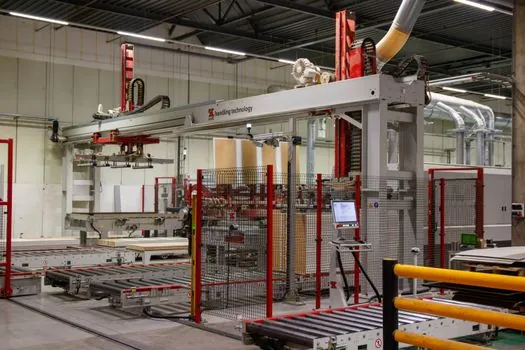
The comparison includes the FANUC M-410 series, ABB IRB 760, and KUKA KR 1000 titan PA, with published payload reaching up to 1,300 kg [S5].
Those robot ratings do not establish cell throughput by themselves. Product plus tooling must be checked against payload, together with reach, wrist inertia, loaded cycle time, stack height, foundation, guarding, and upstream material flow [S5]. The engineering comparison warns that a published reference cycle is not the production rate of a complete palletizing cell, because layer formation, pallet exchange, tooling, and upstream flow determine delivered output [S5].
Extreme capacity also brings integration constraints rather than an automatic schedule advantage. KUKA KR 1000 titan PA options should be evaluated by verifying product-plus-tool payload, reach, wrist inertia, loaded cycle time, environment, and complete cell scope [S5]. Procurement should therefore ask suppliers for a lead time tied to the proposed robot, controller, end effector, and cell scope, not a payload-class promise.
Payload, speed, and cycle time must be quoted together
A larger payload rating does not guarantee a shorter or longer delivery schedule, but it can narrow the mechanical design envelope because payload capacity, speed, motor torque, structural dynamics, and control constraints are interdependent [S4]. Early industrial robotic systems typically handled payloads of 10–50 kg at relatively slow speeds [S4].
For comparison, a 6 kg compact arm with 750.6 mm reach, a 20 kg machine-tending arm with 1,668 mm reach, and an 800 kg palletizer must be evaluated on different criteria [S2]. Compact models prioritize short-reach manipulation and compact integration, mid-range articulated models add machine-tending or structural-handling capability, and high-payload palletizers impose heavier tooling, guarding, foundation, and cycle-analysis demands [S2][S5].
The selection process also needs usable payload after the gripper, reach, cycle time, and repeatability fixed before catalog comparison [S8]. That prevents a nominal payload class from being mistaken for installed capacity. For cobot projects, the same sequence is used before requesting quotes from two or three shortlisted brands [S7].
Configure the quotation before requesting a date

A usable inquiry should identify the target delivery date, payload at the tool flange, required reach, cycle time, repeatability, workpiece and gripper mass, operating environment, and certification needs [S2][S3][S8].
The request should also define whether the purchase covers a standalone robot, a robot with controller, or a production-ready cell. The heavy-palletizing comparison draws a clear boundary: robot-level specifications do not represent a complete cell’s usable product capacity, because tooling and application limits reduce what the system can handle [S5].
End-of-arm equipment is part of that boundary. ABB describes its robotics portfolio as integrated robots, AMRs, and software, so a buyer who defines integration requirements early is better positioned to compare quotations at the same functional scope [S1]. The target timeline should be included at inquiry rather than treated as an afterthought after model selection [S2].
Compare dates on equivalent cell scope
A structured quotation comparison should place each delivery date beside payload, reach, model family, cycle requirement, controller scope, end effector, integration work, warranty, and requested site date [S2][S5]. Comparing a 10 kg robot quotation with an 800 kg palletizer cell quotation without normalizing scope produces an invalid lead-time conclusion.
Two practical thresholds emerge from the published guidance. First, users should finalize payload, reach, and cycle-time requirements during weeks 1–2 of a cobot selection project, before requesting two or three comparative quotes [S7]. Second, industrial robot selection should retain the simplest architecture that meets payload-at-reach and cycle time while satisfying environmental and certification requirements [S3].
For heavy applications, add product stability, stack height, wrist inertia, tooling, guarding, foundation, and pallet exchange to the quote checklist [S5]. This is also where broader logistics constraints can enter an industrial project, as discussed in How Shipping Chokepoints Extend Industrial Lead Times, but the robot quotation must remain the controlling commercial source.
Demand and model availability still need tracking

Industrial robot supply entered 2025 from a four-year period near 550,000 units per year, with 2025 shipments reaching a record 603,000 units [S6]. This market movement does not establish a delivery time for any payload class, but it supports maintaining multiple shortlisted suppliers and checking model availability before committing a production schedule.
The practical answer for 2026 is therefore conditional rather than a false numeric table: a 6 kg machine and an 800 kg palletizer both receive quotation-specific lead times once specifications are complete [S2]. Track the quotation date, requested delivery date, quoted delivery date, model code, and scope revision as the project moves through selection. Reconfirm the selected robot and controller against the manufacturer proposal before placing the order [S5].