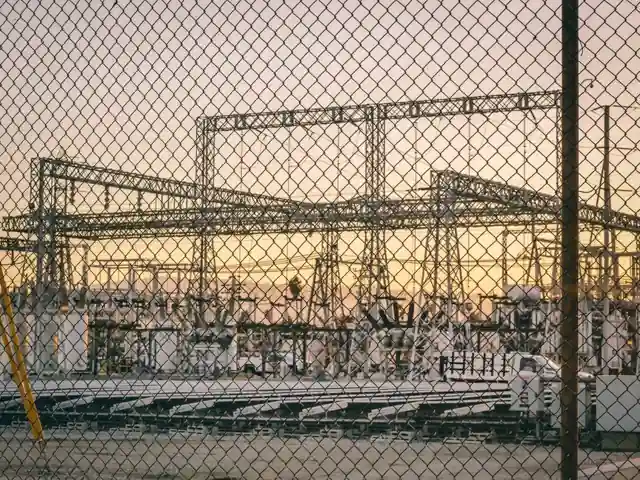
Specifying an engineering plastic into a switchgear housing, inverter bracket, transformer bushing, or PV junction box is a four-gate decision: continuous service temperature, dielectric strength, flammability rating, and chemical/moisture compatibility, with cost and dimensional stability as tiebreakers [S2].
The material families most often cleared by engineering plastic catalogs for energy hardware are PA66 (nylon 66), POM (acetal), PC (polycarbonate), PBT, and PPS; each clears a different gate, so the job is matching the worst-case gate first, then the others [S1][S3].
Four spec gates that drive the shortlist
Continuous service temperature is the gate that knocks out the most candidates: PA66 grades typically run 150-180 deg C with short peaks to 200 deg C, PBT sits near 120-150 deg C, PC caps out near 115-130 deg C, POM near 100 deg C continuous, and PPS holds 200-220 deg C continuous, which is why PPS survives transformer bobbins and PA66 survives motor end-cap duty [S2].
Dielectric strength, expressed in kV/mm at the wall thickness the part will actually mould, is the second gate: dry PA66 typically lands near 10-15 kV/mm, PBT near 16-20 kV/mm, PC near 16-22 kV/mm, and glass-filled PPS around 15-20 kV/mm, all measured under ASTM D149, and moisture-conditioned PA66 drops noticeably, which is why dry-as-moulded PA66 is the rule for low-voltage switchgear [S2].
Flammability rating, usually tracked as UL 94 V-0 at the part's actual wall thickness, is the gate that excludes unfilled PC from many indoor energy cabinets, while glass-filled PA66 and PBT commonly hold V-0 at 0.8-3.0 mm and PPS holds V-0 down to 0.5 mm, so cabinet walls can drop to 1.0-1.5 mm and still pass.
Comparing PA66, POM, PC, PBT, PPS on decision criteria
The four-way matrix below lines the common choices up against the criteria an energy-equipment buyer actually filters on; pick by the cell that fails first, not the cell that scores highest overall [S2].
POM (acetal homopolymer or copolymer) wins on wear, low friction, and dimensional stability in water, with tensile strength near 60-70 MPa and continuous use near 100 deg C, which is why it appears in pump impellers, gear trains inside energy management controllers, and meter movement components, not in hot busbar zones [S2].
PC (polycarbonate) is the optical-plus-tough choice, with light transmission above 85 percent at 2-3 mm, impact strength around 600-800 J/m notched Izod, and heat-deflection near 130 deg C, which is why it is the default for meter windows, indicator covers, and instrument bezels, not for sustained hot spots.
PBT sits between PA66 and PC: 120-150 deg C continuous, low moisture absorption (under 0.1 percent at saturation versus PA66's 8-9 percent), good tracking resistance, and easy mould flow, which is why PBT is the default for connector bodies, MCBs, and smart-meter bases that see humidity cycling [S2].
PPS (glass- or mineral-filled) is the specialty pick: 200-220 deg C continuous, essentially zero moisture absorption, and chemical resistance to transformer oils, which is why it survives bobbin and coil-form duty in dry-type transformers and high-temperature motor insulation stacks where PA66 would age out.
What each family is for, and what it is not for
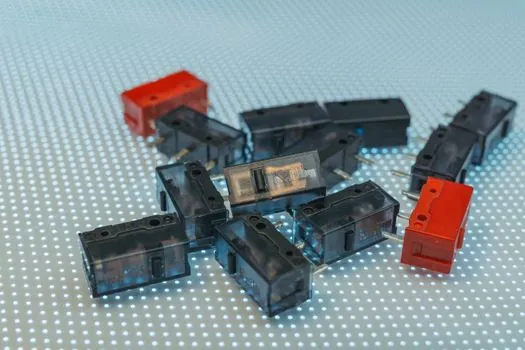
PA66, especially glass-filled, is for high-heat structural parts in switchgear and motors, but it is not for submerged pump parts, not for long-term water-immersed meter bodies, and not for parts where post-moulding conditioning drives warpage, because its 8-9 percent moisture absorption at saturation shifts dimensions [S2].
POM is for moving parts and dimensional precision in water-handling energy hardware, but it is not for sustained hot-air zones above 100 deg C, not for strong acids or chlorine-bearing coolants, and not for UV-exposed outdoor enclosures without a coating, since unfilled POM degrades in sunlight.
PC is for transparent covers, display windows, and impact-loaded indoor enclosures, but it is not for hot busbar supports, not for alkaline detergents, and not for outdoor sun without a UV-stabilized grade, because standard PC yellows and loses impact under UV.
PBT is for low-voltage connector bodies, MCB housings, and smart-meter bases that cycle between dry and humid, but it is not for the hottest zones in motor windings, not for heavy-load wear surfaces, and not for low-temperature impact below roughly -40 deg C without a toughened grade.
PPS is for the hottest, most chemically aggressive zones: dry-type transformer bobbins, high-temperature coil forms, and oil-exposed insulators, but it is not for low-cost brackets, not for transparent parts, and not for thin-wall mouldings where its high melt viscosity and high tooling cost fail the cost gate.
Where selection starts to break: moisture, creep, and UV
Three failure modes kill more energy-equipment plastic parts than raw heat: moisture-conditioned PA66 creeping in sustained-load busbar supports, UV-degraded PC cracking in outdoor PV combiner boxes, and POM attacked by acidic or chlorinated coolants in heat-pump skids [S2].
For outdoor enclosures and any part sitting in a solar field or wind-nacane environment, specify a UV-stabilized grade (carbon-black PC, ASA-capped ASA/PC, or UV-stabilized PBT) and confirm a tensile-impact retention after 1000-3000 hours of xenon-arc exposure, since the unstabilized baseline will drop fast in field service [S2].
For sustained-load structural parts in switchgear, confirm creep data (ISO 899 or ASTM D2990) at the design stress and the design temperature, not just the room-temperature tensile bar; a part that passes room-temperature tensile can still cold-flow at 150 deg C under a 50 MPa busbar clamp.
Sourcing, standards, and what to ask the supplier
For any plastic that lands inside a certified assembly (UL listed MCB, IEC-rated inverter, CE-marked PV combiner), require the actual grade designation, the actual UL 94 file number at the actual wall thickness, the actual RTI (Relative Temperature Index) per UL 746B, and the actual datasheet curve for tensile and impact after moisture conditioning, since generic "PA66 GF25" labels hide the spread [S1][S3].
For tracking and electrical creep, ask for the comparative tracking index (CTI) per IEC 60112, since a CTI of 175-250 V covers most indoor LV switchgear, but outdoor HV insulation often needs CTI of 600 V or above, which is where glass-filled PPS and certain PA66 grades differentiate [S2].
For machining versus moulding, note that precision energy meter components and prototype brackets are commonly machined from extruded stock, where stock-bar spec sheets apply instead of moulded-spec data, and shops such as Applied Engineering Plastics list turning capacity to 15 inch diameter and CNC router capacity to 60 by 120 inch as a baseline for that path [S3].
For processing-side specification on a compounding line, drying, conveying, and pellet-handling equipment (vacuum dryers, vibrating sieves, spiral conveyors, and air-knife dewater units) sets the moisture window the resin sees before moulding, which directly controls the moisture-conditioned properties downstream [S1].
Trackable signals for the next spec cycle
Two signals are worth watching through the rest of 2026: suppliers publishing paired moulded-thickness and conditioned-thickness data (rather than room-temperature bar data only), and a rise in PPS and high-temperature PA66 grades being stocked in metric plate and rod form for machined busbar supports, since both movements indicate buyers are pushing beyond commodity PA66 [S1][S3].
This topic is covered further in Roller bearing selection for automotive production: 2026 spec map.