
The DirectIndustry industrial-vacuum-cleaner index lists 190 manufacturers offering 1,754 products as of 2026-05-26, with Italian firms (DEPURECO 174 SKUs, Delfin 142, DU-PUY 107, KEVAC 61, ghibli & wirbel 36) accounting for the heaviest product density [S1].
On the China side, G-Winner (Tianjin) runs 22 series spanning roughly 200 models after nearly 30 years in industrial vacuum systems, while Villo Cleaning in Dongguan and Changzhou Puyi (Jiangsu, registered 2019) anchor separate clusters focused on single-phase wet/dry units and dust collectors [S3][S5][S8].
European cluster: heavy-product Italian OEMs dominate the catalogue
Italian manufacturers hold the top catalogue positions on DirectIndustry: DEPURECO INDUSTRIAL VACUUMS at 174 products, Delfin Vacuums at 142, DU-PUY at 107, KEVAC SRL at 61, and ghibli & wirbel at 36, with Comac spa (14) and Fimap (8) rounding out the cleaning-machine flank [S1].
Adjacent European and Turkish entries include ESTA Extraction (15), Dustcontrol AB (23), Goodway (17), Biemmedue (10), and Anadolu Teknik Makina (9), giving a buyer roughly 60 product-bearing brands to shortlist before any spec filter is applied [S1]. A practical spec walk-through for airflow, filtration, and ATEX is laid out in the industrial vacuum cleaner spec map.
China cluster: scale, price floor, and supply-chain depth
G-Winner's Tianjin operation publishes a 22-series, 200-model catalogue covering ATEX-rated industrial vacuums, separators, and oil-mist collectors, with the company citing nearly 30 years of operating history [S5].
Villo Cleaning (Dongguan) markets single-phase industrial vacuums, industrial dust collectors, wet/dry units, oil-filter machines, welding fume extractors, and heavy-duty industrial vacuums under one factory footprint [S8]. At the accessory tier, Made-in-China lists flat nozzles sized for 15 L industrial vacuums at US$1.00–5.00 per piece (MOQ 5), evidence of the consumables floor that supports the OEM segment [S2]. For a wider view of how Chinese industrial-equipment suppliers organise by category, the air pollution control system sourcing map profiles the same ecosystem one tier up.
Product types and the decision criteria that separate them
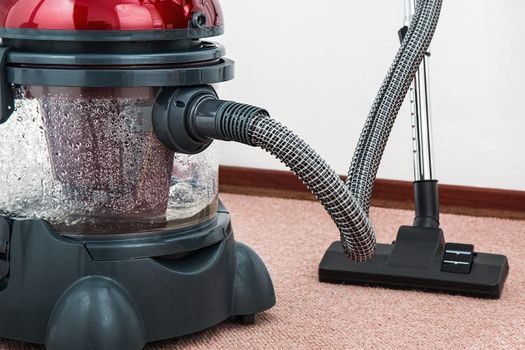
Industrial vacuum cleaners split into four practical types: (1) wet/dry single-phase units for workshops, typified by Villo's 220 V line and Made-in-China's CNWD79 drum-style wet/dry with blow function, optional power socket, and drain port [S6][S8]; (2) three-phase heavy-duty continuous-duty units for metalworking and powder-handling, where DEPURECO, Delfin, and KEVAC concentrate SKUs [S1]; (3) ATEX-rated explosion-proof units for combustible dust, where G-Winner, ESTA, and Dustcontrol publish explicit compliance language [S1][S5]; and (4) dedicated dust collectors and welding fume extractors, often co-located with the vacuum line at the same factory [S8].
Selection then filters on four axes: airflow (m³/h) and negative pressure (mbar), filtration class (M, H, HEPA H14, or ATEX-certified conductive media), power supply (single-phase 220 V vs three-phase 380–480 V), and duty cycle (intermittent workshop vs continuous process). Buyers should treat the vacuum as a vacuum pump-driven system whose filtration head, not just the blower, determines whether the unit meets EN 60335-2-69 dust-class L/M/H requirements.
Where each cluster fits — and where it does not
Italian-heavy DirectIndustry listings fit buyers needing certified three-phase continuous-duty units, ATEX documentation, and large installed bases in the EU; they are a poor fit for buyers chasing sub-US$50 spot buys or for white-label consumer-floor machines [S1].
Chinese clusters (G-Winner, Villo, Changzhou Puyi, GuangZhou HaoTian) fit buyers prioritising price-per-unit, OEM/ODM flexibility, and 220 V single-phase compatibility for Southeast Asia, the Middle East, and Africa; they are a poor fit when the spec sheet must carry ATEX/IECEx certification traceable to a notified body in the EU [S3][S4][S5][S8]. Across both clusters, accessory cost is decoupled from unit cost — a 15 L flat nozzle at US$1.00–5.00 lets a buyer standardise consumables independent of which OEM supplied the head [S2].
Adjacent cleaning equipment and the supplier overlap
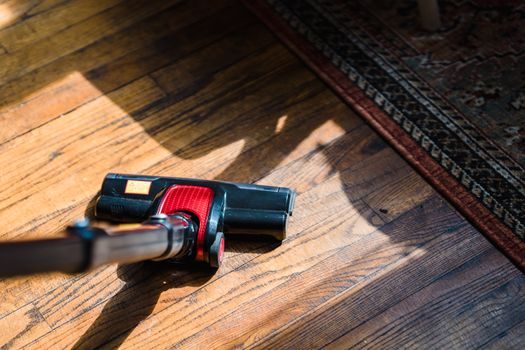
Industrial vacuum suppliers frequently co-produce floor scrubbers, floor polishers, sweeping machines, and washing machines — GuangZhou HaoTian publishes floor scrubber and floor polishing machine lines alongside its vacuum catalogue, and Changzhou Puyi explicitly lists washing machines and sweeping machines in its business range [S3][S4]. This overlap matters when a single tender asks for a bundled floor-care fleet rather than a standalone vacuum.
The same overlap is visible in pneumatic and vacuum generator supply chains, where a single Chinese factory can quote across 220 V industrial vacuums, pneumatic vacuums, and HHO carbon-cleaning accessories in a single inquiry [S7]. Buyers running multi-category RFQs should exploit this bundling rather than treat vacuums, scrubbers, and polishers as three separate sourcing projects.
Filtration, ATEX, and the regulatory ceiling buyers must verify
Filtration class is the single most important spec for any combustible-dust application: dust-class L (light), M (medium), and H (high) maps onto EN 60335-2-69, with H14 HEPA filters typically specified for pharmaceutical and battery-material lines. ATEX conformity for Zone 21/22 dust atmospheres is separately documented and must be carried in the vendor's nameplate, not inferred from marketing copy [S1][S5].
Duty cycle and motor thermal class are the next binding constraints: continuous three-phase units at 5–20 kW require star-delta starting, thermal overload, and a cyclone pre-separator when handling swarf or granulate, while single-phase 220 V units are limited to roughly 2.0–2.6 kW and intermittent use. A buyer should treat the vacuum gauge reading and the filter ΔP trend as the two live indicators of remaining filter life and impending motor overload — both of which show up before the unit trips on thermal cutout.
Sourcing signals worth tracking over the next quarter

Two trackable signals will move this market into late 2026: the count and product-card depth of ATEX-certified SKUs on DirectIndustry, which the May 2026 snapshot shows is still concentrated in fewer than 10 brands out of 190 [S1]; and the addition of new three-phase 380 V SKUs on Made-in-China, where 220 V single-phase still dominates the public listings [S7][S8]. Compare these against the related hydraulic lift table suppliers map and the China solenoid valve sourcing map to see whether Chinese factory capacity is broadening across adjacent industrial categories at the same pace.