A vacuum pump removes gas molecules from a sealed volume to create and maintain a pressure below the surrounding atmosphere. Unlike a liquid pump, which moves an essentially incompressible fluid, a vacuum pump must contend with a gas whose density and flow regime change by many orders of magnitude as the chamber empties, which is why no single pump covers the full vacuum scale.
This guide treats the vacuum pump as a system component selected against a target pressure and gas load. It explains the four vacuum regimes, the gas-transfer versus entrapment classification, the working principles of the main industrial pump families, the gas and material constraints, the parameters on a datasheet, and the decision sequence engineers use to specify a pump.
This guide is written for procurement engineers and design engineers specifying vacuum equipment. It covers 6 chapters: what a vacuum pump is and the vacuum scale, pump classification, working principles by family, gas and wetted materials, key specification parameters, and the selection decision sequence, plus 7 selection FAQs and manufacturer comparisons. All performance terms reference the ISO 21360 series and ISO 3529 vacuum-technology standards, with motor and hazardous-area ratings per IEC 60034, IEC 60529, and IEC 60079 / ATEX.
Chapter 1 / 06
What is a Vacuum Pump and the Vacuum Scale
A vacuum pump is a device that extracts gas molecules from a closed system to lower the internal pressure below the ambient atmosphere, then maintains that reduced pressure against leakage, outgassing, and process gas loads. The two figures that define any vacuum pump are its ultimate pressure, the lowest pressure it can reach at zero gas load, and its pumping speed, the volume of gas it moves through the inlet per unit time. These two numbers sit at opposite ends of the pump-down curve, and a pump is only as useful as that curve is at the pressure where the process actually runs.
The physics of vacuum changes character as pressure falls, which is the single most important idea in pump selection. Near atmosphere the gas behaves as a continuous viscous fluid, and pumps move it the way a compressor does, by trapping and squeezing volumes. As pressure drops, the mean free path of a molecule, the average distance it travels before hitting another molecule, grows from nanometres at atmosphere to metres in high vacuum. Once the mean free path exceeds the chamber dimensions, the gas is in molecular flow: molecules fly independently and bounce off walls more often than off each other. In this regime ordinary compression no longer works, and pumps must impart momentum to individual molecules or capture them on cold or reactive surfaces.
Industrial practice divides the sub-atmospheric scale into four regimes. Rough or low vacuum runs from atmospheric pressure (about 1,013 mbar) down to roughly 1 mbar (100 Pa). Medium or fine vacuum spans 1 mbar to 1x10−³ mbar. High vacuum covers 1x10−³ mbar to about 1x10−⁷ mbar. Ultra-high vacuum (UHV) lies below 1x10−⁷ mbar and extends to 1x10−¹² mbar and lower. The unit equivalents matter: 1 mbar equals 100 Pa equals about 0.75 Torr, and 1 Torr equals 133.3 Pa. These boundaries are conventions, not laws of nature, so a specification should always state the actual target pressure in a defined unit rather than rely on a regime name alone.
The history of vacuum technology tracks these regimes. Otto von Guericke demonstrated the first mechanical air pump and the Magdeburg hemispheres in the mid-1650s, establishing that a vacuum could be produced and held. The incandescent lamp and vacuum tube industries of the early twentieth century drove the development of rotary oil-sealed pumps and the mercury, then oil, diffusion pump. Wolfgang Gaede contributed the molecular drag pump in 1913, and the modern turbomolecular pump was introduced by Willi Becker at Pfeiffer in 1958, making clean high vacuum practical without diffusion-pump oil. The semiconductor era after the 1980s pushed the field toward dry (oil-free) pumps to eliminate hydrocarbon contamination on wafers.
In application scale, vacuum pumps reach across more than fifteen orders of magnitude of pressure, from rough-vacuum packaging and pick-and-place handling near 100 mbar, through freeze-drying and coating at 1x10−³ mbar, to surface-science and accelerator UHV below 1x10−⁷ mbar. Each decade of pressure maps to a different physical principle and material set, so the practical task of selection is to match the process pressure, gas type, and throughput to a specific pump family and, very often, to a staged combination of two pumps in series.
Chapter 2 / 06
Vacuum Pump Classification
ISO 3529, the vacuum-technology vocabulary standard, divides all vacuum pumps into two fundamentally different categories: gas-transfer pumps, which move gas from the inlet to an outlet and discharge it, and entrapment (capture) pumps, which fix gas molecules inside the pump as a solid, adsorbed, or condensed phase and have no continuous discharge. The distinction governs everything downstream, including whether a backing pump is required, whether the pump saturates over time, and how it is regenerated.
Gas-transfer pumps split again into two sub-families. Positive-displacement pumps cyclically isolate a volume of gas from the inlet, then compress and expel it; this group includes rotary vane, liquid ring, dry screw, claw, Roots (mechanical booster), scroll, diaphragm, and piston pumps. Kinetic or momentum-transfer pumps accelerate gas toward the outlet using high-speed rotating blades or a directed vapour jet; this group includes turbomolecular, molecular drag, and diffusion pumps. Entrapment pumps include cryopumps (condensation on cold surfaces), sorption pumps (adsorption on a porous medium), getter and sputter-ion pumps (chemical binding and ionization), all of which capture gas rather than passing it through.
The practical consequence of the gas-transfer versus entrapment split is operational, not academic. A gas-transfer pump runs continuously and tolerates a steady gas load, so it suits processes that constantly introduce gas, such as degassing, drying, or reactive coating. An entrapment pump has a finite gas capacity: a cryopump or ion pump fills up and must be regenerated, which means warming a cryopump to release trapped gas or burying captured atoms in a sputter-ion pump. Entrapment pumps therefore excel at clean, low-throughput UHV where their freedom from moving parts, vibration, and oil is decisive, but they are unsuited to high continuous gas loads.
A second classifying axis is the operating pressure window. Rough-vacuum pumps (rotary vane, liquid ring, dry screw, claw, scroll) work from atmosphere to roughly 1x10−³ mbar and can start against atmospheric pressure. High-vacuum pumps (turbomolecular, diffusion) only operate once the gas is already in molecular flow, typically below 1x10−² mbar, and cannot discharge to atmosphere, so they are always backed by a rough pump in series. This is why a high-vacuum system is fundamentally a two-pump architecture, a point developed in Chapter 3.
Chapter 3 / 06
Working Principles by Pump Family
The seven pump families below cover the overwhelming majority of industrial and laboratory duty. Each has a characteristic ultimate pressure, speed band, and contamination profile that fixes where it belongs on the vacuum scale. The comparison table summarises the engineering figures, and the prose that follows explains the mechanism and the trade-offs that the numbers do not show.
Pump family
Typical ultimate pressure
Pumping speed band
Oil-free
Typical applications
Rotary vane (2-stage, oil-sealed)
1x10−³ mbar
0.7 to 275 m³/h
No
Lab roughing, freeze-drying, backing, mass spec
Liquid ring
~30 mbar
25 to 30,000 m³/h
No (uses service liquid)
Condenser exhausting, paper, wet/dirty gas
Dry screw
~1x10−² mbar
up to 750 m³/h
Yes
Semiconductor, chemical, harsh process
Claw (dry)
~1x10−³ mbar
100 to 800 m³/h
Yes
Packaging, food, central vacuum supply
Scroll (dry)
~1x10−² mbar
5 to 60 m³/h
Yes
Clean backing, analytical, R&D
Roots (mechanical booster)
set by backing pump
100 to 25,000 m³/h
Yes
Boost speed in medium vacuum, drying
Turbomolecular
1x10−¹⁰ to 1x10−¹¹ mbar
tens to a few thousand L/s
Yes
High and ultra-high vacuum, analytics, semicon
Rotary vane (oil-sealed) pumps use an eccentric rotor carrying spring-loaded sliding vanes inside a cylindrical stator. The vanes sweep gas into a shrinking crescent volume and expel it past an oil-sealed exhaust valve; the oil seals the vane clearances, lubricates, and carries away heat. A single stage reaches roughly 1x10−² mbar and a two-stage version about 1x10−³ mbar without gas ballast. They are the low-cost workhorse of rough and medium vacuum and the most common backing pump, but the oil film backstreams a trace of hydrocarbon and the oil degrades when it absorbs solvent or water, so gas ballast and periodic oil changes are part of the duty.
Liquid ring pumps spin a vaned impeller off-centre inside a casing partly filled with a service liquid, usually water. Rotation flings the liquid into a ring that follows the casing wall; because the impeller is eccentric, the liquid-to-vane gap opens and closes once per revolution, drawing gas in and squeezing it out like a self-sealing piston. The ultimate pressure is limited to about 30 mbar by the vapour pressure of the service liquid, but the design is nearly indifferent to wet, dirty, or condensable gas and offers very large speeds, which makes it the standard for steam-turbine condenser exhausting, paper machines, and chemical scrubbing.
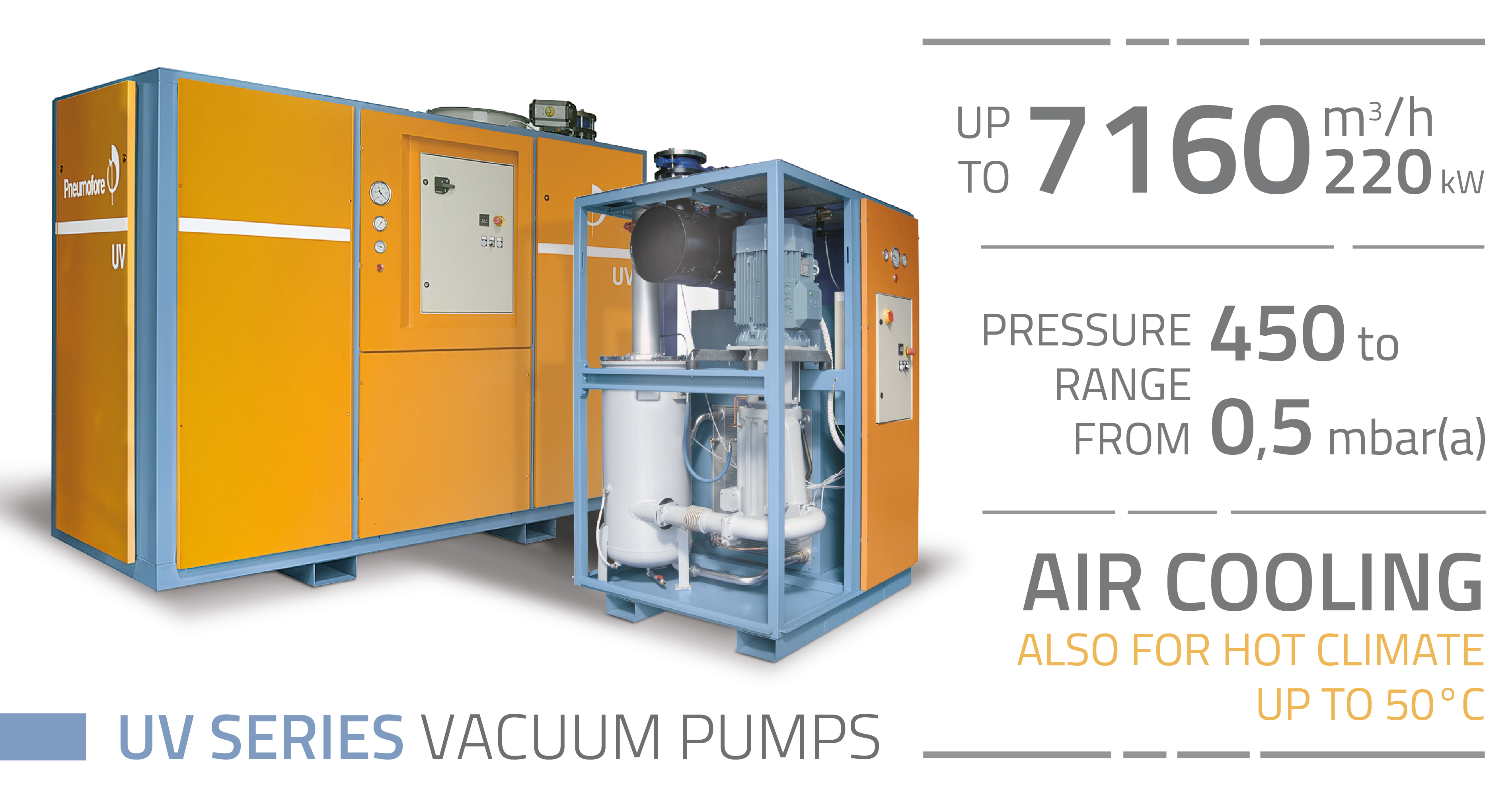
Dry screw pumps run two intermeshing screw rotors that never touch and need no internal lubricant in the gas path, transporting and compressing gas from the inlet end to the exhaust end. A single screw stage delivers a compression ratio of 50 to 100, against only about 10 for a single Roots stage, so a screw pump reaches roughly 1x10−² mbar on its own. Being oil-free and tolerant of particulate and corrosive gas, it is the dominant dry process pump in semiconductor and chemical plants, at higher capital cost than a rotary vane.
Claw and scroll pumps are the other principal dry positive-displacement designs. Claw pumps use two non-contacting claw-shaped rotors and excel at clean, continuous, high-throughput duty such as central vacuum systems and packaging, reaching about 1x10−³ mbar. Scroll pumps nest a fixed and an orbiting spiral so a crescent of gas is progressively compressed toward the centre and expelled; they are quiet, clean, and reach about 1x10−² mbar, making them a favoured oil-free backing and analytical pump, with tip-seal wear as the main maintenance item.
Roots (mechanical booster) pumps use two figure-eight lobes that mesh without contact to move large gas volumes at a modest compression ratio of about 10. A Roots pump cannot reach a useful ultimate pressure alone and cannot exhaust to atmosphere; it is installed in series ahead of a backing pump to multiply system speed in the medium-vacuum range, which dramatically shortens pump-down on large drying and degassing chambers.
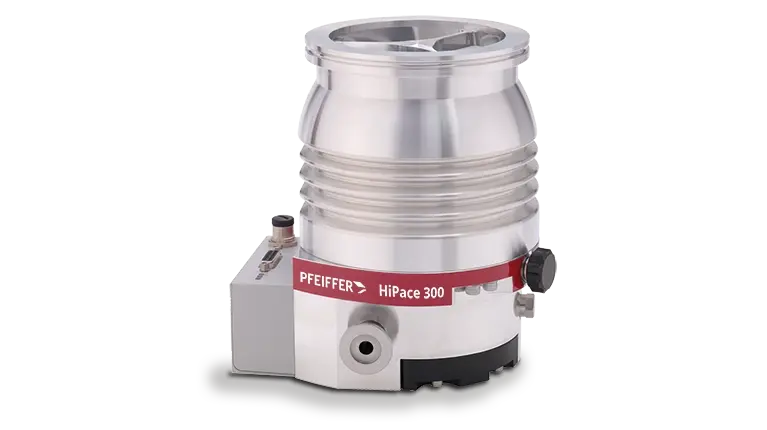
Turbomolecular pumps are the workhorse of clean high and ultra-high vacuum. Stacked rotor blades spin at 24,000 to 90,000 rpm, fast enough that the blade tip speed approaches molecular velocities; each blade strike biases a gas molecule toward the exhaust, transferring momentum the way a multistage axial compressor does, but on individual molecules. They reach 1x10−¹⁰ to 1x10−¹¹ mbar in baked all-metal systems and offer a nearly flat speed curve across the molecular-flow regime, but they only function below about 1x10−² mbar and must always be backed by a rough pump that holds the foreline below the turbo's critical backing pressure.
Chapter 4 / 06
Gas Load, Vapour, and Wetted Materials
The gas a vacuum pump must handle decides the pump family and the materials of its gas-wetted parts as firmly as the target pressure does. Dry inert gas at room temperature is the easy case. Real processes add water vapour, organic solvents, corrosive species, abrasive particulate, and sometimes flammable or pyrophoric gas, each of which attacks a specific weakness of a given pump.
Condensable vapour is the most common complication. When an oil-sealed pump compresses water vapour or solvent past its saturation point inside the pump, the vapour condenses into the sealing oil, emulsifies it, raises the ultimate pressure, and corrodes internals. The countermeasure is gas ballast: a controlled bleed of dry air or nitrogen, typically about 10 percent of the nominal pumping speed, is admitted into the final compression stage so the partial pressure of the vapour never reaches saturation and the vapour is swept out with the carrier gas. The governing specification is water-vapour tolerance, the highest steady water-vapour inlet pressure the pump can pass with ballast open, stated relative to standard conditions of 20 degrees Celsius and 1,013 mbar.
Corrosive and reactive gas rules out cast-iron and standard-steel gas paths. Dry screw and claw pumps for chemical and semiconductor service use corrosion-resistant coatings, nickel plating, or stainless internals, plus a nitrogen purge of bearings and seals to keep process gas away from sensitive surfaces. Particulate erodes vanes and tip seals and can jam non-contacting rotors, so dusty streams are best handled by liquid ring pumps, which tolerate solids in the service liquid, or by inlet filtration and knock-out pots ahead of a dry pump. Flammable or oxygen-enriched streams require ATEX or IECEx rated pumps, inert purge, and careful control of compression heating, because a dry pump's exhaust can run hot.
The table below maps common process gas conditions to a suitable pump approach and the wetted-material or accessory considerations. It is a first-pass guide only; before specifying, confirm chemical compatibility and the manufacturer's materials list against the actual concentration, temperature, and any trace species.
Two material points recur across UHV work. First, ultra-high vacuum requires all-metal sealing, typically copper-gasket ConFlat (CF) flanges, because elastomer O-rings permeate and outgas enough to defeat pressures below 1x10−⁷ mbar. Second, UHV chambers and pumps are baked at 150 to 250 degrees Celsius to drive water off internal surfaces, so every wetted material and seal must survive that bakeout; this is why elastomer-sealed components are confined to high vacuum and above, and metal seals dominate the UHV regime.
Chapter 5 / 06
Key Specification Parameters
A vacuum pump datasheet typically lists fifteen to thirty lines, but only a handful drive a sound selection. The parameters below are the ones to read first, with the ISO 21360 definition where one applies, so that quotes from different vendors can be compared on the same basis rather than on marketing peaks.
Pumping speed (S) is the volume flow through the inlet cross section per unit time, in m³/h or L/s, defined and measured per ISO 21360-1. The single most important caveat is that nameplate speed is the peak of a curve, not a constant: speed falls toward the ultimate pressure and is throttled further by pipework conductance, so the figure that matters is the effective speed at the working pressure read off the manufacturer curve.
Ultimate pressure is the lowest pressure the pump approaches asymptotically at zero gas load with a blanked inlet, per ISO 21360-1. Many pumps quote two values, with and without gas ballast, because ballast raises the ultimate pressure; always note which condition the figure refers to.
Compression ratio (K0) is the ratio of outlet to inlet pressure at zero throughput for a given gas, and it differs sharply by gas: turbomolecular pumps compress heavy gases like nitrogen by 10⁷ or more but light hydrogen by only 10³ to 10⁴, which is why hydrogen and helium set the practical ultimate pressure of a turbo system. Critical backing pressure is the maximum foreline pressure a high-vacuum pump can discharge against before it stalls; the backing pump must keep the foreline below this value at all times.
Water-vapour tolerance and water-vapour capacity govern wet duty, as covered in Chapter 4. Ingress protection follows IEC 60529, with IP54 or IP55 usual for industrial pump motors. Motor efficiency class follows IEC 60034-30 (IE2 to IE4) and increasingly drives lifecycle cost on continuously running pumps.
The remaining datasheet lines that change a selection in practice are the following:
Inlet / outlet connection: ISO-KF (quick-clamp) for rough and medium vacuum, ISO-K or CF (bolted, metal-sealed) for high and ultra-high vacuum. CF is mandatory for bakeable UHV.
Motor power, voltage and frequency: three-phase 400 V / 50 Hz is the European industrial default; confirm 60 Hz speed derating and the available supply on site.
Rotational speed and noise: dry and rotary pumps run at line frequency; turbos run at tens of thousands of rpm. Noise (dB(A) at 1 m) and vibration matter for lab and metrology installations.
Cooling method: air-cooled, water-cooled, or oil-cooled. Water cooling is common on large screw and liquid-ring pumps and adds a utility requirement.
Hazardous-area rating: ATEX (EU 2014/34/EU) or IECEx category and gas group per IEC 60079 for flammable atmospheres.
Service interval: oil-change interval for rotary vane, tip-seal life for scroll, bearing and lubricant life for turbo. These set the real running cost.
One number that is frequently misread is the relationship between speed and throughput. Throughput (Q), in mbar·L/s, is the product of pumping speed and pressure (Q = S × p); it is the conserved quantity along a vacuum line in steady state. Sizing for a continuous gas load, for example a sputtering process gas feed, is done on throughput at the working pressure, whereas sizing for pump-down of a sealed chamber is done on speed and volume. Confusing the two is a classic cause of an undersized pump.
Chapter 6 / 06
Selection Decision Factors
The decision sequence below converts the preceding chapters into a specification. The order matters: most selection errors come from fixing a pump model before the target pressure, gas, and throughput are firmly defined. These steps double as an RFQ template.
Target pressure and regime: Fix the working pressure first, then read off the regime (rough / medium / high / UHV) from Chapter 1. The regime decides whether one pump suffices or whether a backing-plus-high-vacuum chain is required.
Gas load and pump-down requirement: Quantify chamber volume for pump-down duty, or steady gas throughput for continuous duty, then size effective speed at the working pressure from the manufacturer curve, not the peak. Allow for conductance loss in the inlet line.
Gas character: Classify the gas as dry-inert, condensable, corrosive, particulate, or flammable per Chapter 4. This drives oil-free versus oil-sealed, the need for gas ballast or purge, and the wetted-material and coating choice.
Dry versus oil-sealed: Choose dry (scroll, screw, claw, Roots, diaphragm) when contamination, condensables, or oil-disposal cost are concerns; choose oil-sealed rotary vane for lowest capital cost and deepest single-pump ultimate pressure where oil mist is acceptable.
Staging: For high and ultra-high vacuum, specify the high-vacuum pump (turbo, diffusion, or entrapment) together with a compatible backing pump whose speed and critical-backing-pressure margin suit the gas load. For large medium-vacuum drying, consider a Roots booster on a backing pump.
Connections, utilities, and motor: Select flange standard (KF / ISO-K / CF), supply voltage and frequency, cooling method (air / water), ingress protection per IEC 60529, and motor efficiency class per IEC 60034-30.
Certifications: Confirm ATEX / IECEx and gas group per IEC 60079 for hazardous areas, sanitary or cleanroom requirements where relevant, and that quoted performance was measured to ISO 21360 rather than a vendor method.
Total cost of ownership (TCO): Sum capital, energy (continuous-duty pumps run for years), oil or tip-seal or bearing service, utility water, and downtime risk. A cheaper pump with short service intervals and poor wet-gas handling often costs more over a five-year line life.
The dimension engineers most often underrate is serviceability and support: local spare-part inventory, field-service and calibration availability, oil and tip-seal lead time, and rebuild versus replace economics at end of bearing life. Pfeiffer Vacuum, Leybold, Edwards, and Agilent maintain service networks for high-vacuum products, while Busch, Becker, Elmo Rietschle, and NASH cover industrial rough and process vacuum. For deep-vacuum duty, insist that the ultimate pressure and speed be quoted to ISO 21360 with the backing conditions stated, because these figures are sensitive to test method and easily inflated.
FAQ
What is the difference between ultimate pressure and pumping speed?
Ultimate pressure is the lowest pressure a pump can reach at zero gas load, measured per ISO 21360-1 as the value the test dome pressure approaches asymptotically with a blanked inlet. Pumping speed is the volume flow through the inlet cross section per unit time, expressed in cubic metres per hour or litres per second. They describe two different ends of the curve: ultimate pressure tells you how deep a vacuum is achievable, while pumping speed tells you how fast a given volume is evacuated. A pump with very low ultimate pressure can still have modest speed, and a high-speed pump can have a poor ultimate pressure, so both numbers must be read together against the pump-down curve.
How are vacuum ranges classified?
Industrial practice divides the pressure scale below atmosphere into four regimes. Rough (low) vacuum runs from atmospheric pressure down to about 1 mbar (100 Pa). Medium (fine) vacuum spans 1 to 1x10−³ mbar. High vacuum covers 1x10−³ to 1x10−⁷ mbar. Ultra-high vacuum (UHV) is below 1x10−⁷ mbar, reaching 1x10−¹² mbar and lower. Unit equivalents: 1 mbar = 100 Pa = 0.75 Torr. The boundaries are conventions rather than physical laws, so a specification should always state the actual target pressure in a defined unit, not just the regime name.
Why does high vacuum need two pumps in series?
Momentum-transfer pumps such as turbomolecular and diffusion pumps only work once the gas is already in molecular flow, typically below 1x10−² mbar, and they cannot discharge against atmospheric pressure. A backing (fore) pump, usually a rotary vane, scroll, or dry screw pump, first rough-pumps the chamber and then continuously removes the gas the high-vacuum pump pushes to its exhaust. The backing pump must keep the foreline below the high-vacuum pump's critical backing pressure. This staged arrangement is standard for any system targeting high or ultra-high vacuum, and it also sets the system's gas throughput ceiling.
When should I choose a dry pump over an oil-sealed pump?
Choose a dry pump (scroll, screw, claw, multi-stage Roots, or diaphragm) when oil backstreaming would contaminate the process, when the gas stream carries condensable vapours or particles that would degrade oil, or when waste-oil disposal and frequent oil changes raise lifecycle cost. Dry pumps dominate semiconductor, analytical, pharmaceutical, and food applications. Oil-sealed rotary vane pumps remain the lower-capital choice where a small amount of oil mist is acceptable and the deepest single-stage ultimate pressure (down to about 1x10−³ mbar two-stage) is needed at low cost. Total cost of ownership, not purchase price, should drive the decision.
What does gas ballast do and when do I need it?
Gas ballast admits a controlled amount of dry air or inert gas into the final compression stage of an oil-sealed pump, usually about 10 percent of nominal speed, so condensable vapour is swept out before it reaches saturation and condenses into the oil. It is needed whenever the process draws significant water vapour or solvent, for example freeze-drying, distillation, or drying ovens. The trade-off is a higher ultimate pressure while ballast is open, so it is typically opened during the wet phase and closed once the load is dry. Water-vapour tolerance, the highest steady water-vapour inlet pressure the pump can pass, is the governing spec for these duties.
How do I size pumping speed for a target pump-down time?
For the rough-vacuum, volume-limited phase, pump-down time is approximately t = (V / S) x ln(p1 / p2), where V is chamber volume, S is effective pumping speed at the inlet, p1 the starting pressure, and p2 the target. Effective speed is always lower than the pump's nameplate speed because pipework conductance throttles flow, so keep lines short and wide and avoid elbows. Below about 1 mbar, outgassing of chamber walls dominates over volume, and the curve flattens; here the required speed is set by the gas load divided by the target pressure (S = Q / p), not by geometry. Real systems should be sized from the manufacturer speed curve at the working pressure, not the peak value.
What standards govern vacuum pump performance and ratings?
The ISO 21360 series defines standard methods for measuring vacuum-pump performance: Part 1 gives the general framework (pumping speed, ultimate pressure, compression ratio, critical backing pressure), Part 2 covers positive-displacement pumps, Part 3 mechanical boosters, and Part 4 turbomolecular pumps. ISO 3529 is the vocabulary standard that classifies pump families. Drive motors follow IEC 60034 with efficiency classes IE2 to IE4 and ingress protection per IEC 60529 (typically IP54 or IP55). For flammable atmospheres, ATEX (EU directive 2014/34/EU) and IECEx referencing the IEC 60079 series apply. Always confirm that the quoted ultimate pressure and speed were measured to ISO 21360 rather than to a vendor-specific method.
Vacuum Pump Manufacturers
Source-backed product routes. Open a company dossier for procurement scope and cited evidence.