
Inkjet systems are expected to lead the industrial printer technology segment with a 46.0% share in 2026 [S3].
The decision should be driven by substrate, required durability, code changeover, line speed, cleaning restrictions, and total operating cost, not by printer category labels or market share alone [S4][S8].
Technology fit for production coding
Continuous inkjet, or CIJ, dispenses liquid ink through a controlled nozzle and deposits variable information without physical contact, making it suitable for packaging lines handling bottles, films, pouches, labels, and other moving products [S1][S3].
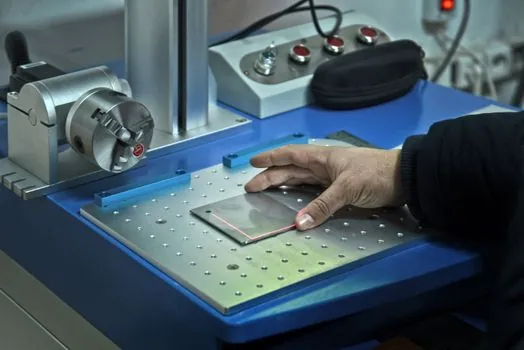
Laser coding creates a permanent mark by focused energy, generally producing a high-contrast, wear-resistant result on compatible materials without consumable ink [S4][S8]. It is the stronger candidate for rigid parts, engraved plates, and high-durability identifiers, but the substrate compatibility and required mark must be tested before committing to a production installation [S4].
Neither method is universally superior. CIJ supports frequent variable-data changes and broad packaging applications, while laser marking suits permanent identification where the marked surface is suitable and contamination from liquid ink is undesirable [S4][S8].
Decision matrix across the main criteria
On substrate range, CIJ leads for flexible packaging and varied packaging materials because it applies ink without contacting the product; laser is more selective because the available response depends on the material and surface condition [S1][S4]. On durability, laser generally holds the advantage because its mark is formed into the surface rather than deposited as liquid ink [S4][S8].
On variable data and changeover, CIJ is the practical choice for production lines that need changing dates, batch numbers, expiry information, and other variable codes. Laser is better suited to fixed or less frequently changed identifiers that require a durable, permanent result [S1][S4]. On cleaning and environmental control, laser avoids liquid ink and associated solvent handling, while CIJ requires a controlled ink and solvent supply [S8].
On capital and operating cost, compare the complete package rather than sticker price: printer hardware, installation, ink or toner-equivalent costs where applicable, solvents, preventive maintenance, consumable changes, line cleaning, operator time, and downtime all belong in the calculation [S4][S8]. Published market scopes vary materially, from USD 5.0 billion for coding and marking systems in 2026 to USD 13.7 billion for the broader industrial printer market, so figures must not be treated as interchangeable [S1][S3].
Where each technology fits best
CIJ is the better fit for high-speed packaging lines requiring non-contact variable codes, especially where products or packaging move continuously and code content changes by lot or production run [S1]. The broader industrial printer market assigns inkjet systems 46.0% technology share for 2026, while packaging and labeling account for 52.0% of applications [S3].
Laser coding is the better fit for permanent component identification, serial numbers, and marks that must withstand handling or later processing [S6][S8]. The available industrial coding portfolio includes Videojet large-character inkjet printers, laser coding systems, thermal-transfer printers, and labeling equipment, confirming that these are complementary product classes rather than substitutes for every application [S6].
Neither technology is a sound default for a process that must be continuously inked under an exacting migration, hygiene, or contamination control without validated materials and procedures. Such applications require product-specific review; the comparison guidance addresses laser and inkjet performance, investment, maintenance, flexibility, print quality, and industrial use [S8].
Ownership, durability, and failure modes
A CIJ installation creates a recurring fluid-management dependency involving ink, solvent or primer, print-nozzle condition, fluid level, and recirculation. A laser installation removes consumable ink from the marking head, but introduces different failure modes involving optics, focusing, marking energy, motion, and surface interaction [S4][S8].
Maintenance strategy must match operating hours rather than calendar convenience. The industrial comparison identifies production completed within the same operating time and reduced operating time as separate decision factors for CIJ and laser coders [S4]. For a line with frequent washdowns or changing substrates, verify nozzle inspection intervals, solvent handling, and cleaning procedures before accepting a CIJ specification.
Laser systems can mark without liquid ink, but an unsuitable surface may reduce mark contrast, produce inconsistent results, or create an unacceptable interaction with the part. CIJ can produce clean codes on flexible packaging, yet code quality remains sensitive to substrate surface, wetting, fluid selection, print distance, and equipment setup [S1][S3].
Office-printer cost-per-page figures are not valid proxies for industrial coding economics. The cited source discusses laser and inkjet office printers rather than coded packaging or component marking [S5]. Industrial buyers should price the coded unit, maintenance labor, consumables, change parts, scrap, and downtime instead.
Market context without false precision

The coding and marking systems market is estimated at USD 5.0 billion in 2026 and forecast at USD 9.0 billion by 2036, a 6.1% compound annual growth rate [S1]. A separate coding and marking equipment forecast starts from USD 7.88 billion in 2026 and reaches USD 12.62 billion by 2034 [S2]. Another coding and marking solutions estimate places the 2026 market at USD 9.15 billion, up from USD 8.62 billion in 2025 [S7].
These values measure different market boundaries and should not be averaged. Fact.MR estimates continuous inkjet at 42.0%, direct sales at 48.0%, printers and coders at 51.0%, flexible packaging at 34.0%, and food and beverages at 38.0% of its 2026 coding and marking systems scope [S1].
For equipment planning, the more useful market signal is the industrial printer forecast of USD 13.7 billion in 2026, USD 26.3 billion in 2036, and 6.7% CAGR, with inkjet at 46.0% and packaging and labeling at 52.0% [S3]. These estimates support continued competition between the technologies, but production economics and substrate testing must determine the model.
Procurement and acceptance criteria
Specify the coder by coded output, not by the broad label “industrial printer.” Define product dimensions, substrate material, surface finish, required code type, character height, contrast, placement, line speed, and frequency of code changes before comparing models [S4][S8].
For CIJ, include fluid compatibility, print distance, nozzle configuration, solvent or primer requirements, flushing procedure, and permissible cleaning exposure in the acceptance test. For laser, include the approved substrate range, mark geometry, contrast requirement, and process conditions affecting the surface. In both cases, run production-representative samples through changeover, start-stop operation, and normal cleaning exposure.
Equipment scope should also identify whether the coder is integrated with a carton erecting machine, a filling machine, or a case packing machine. Placement affects standoff, line speed, guarding, data exchange, and whether a separate coding machine is justified.
Track two decision signals before purchase: the measured defect rate against the required code specification, and the validated maintenance burden per operating hour, including fluid or optics work and line stoppages. Obtain substrate-specific trial results and a complete lifecycle-cost comparison rather than selecting from a market-share ranking [S1][S4].