
ISO 13850 is a type-B2 safety standard that defines the emergency stop function on machinery, while IEC 60947-5-5 is a product standard governing the electrical emergency stop device with mechanical latching that physically implements that function [S1][S3]. The two are complementary, not competing: ISO 13850 tells the integrator what the safety function must do, IEC 60947-5-5 tells the component supplier how the device must behave and be tested.
As of 01 September 2026 the European version EN IEC 60947-5-5:2026 supersedes the 1997 base plus amendments A1:2005, A11:2013 and A2:2017, keeping the same ICS classification 29.130.20 / 29.120.99 and reaffirming the device scope: low-voltage switchgear and controlgear, control circuit devices, electrical emergency stop device with mechanical latching function [S3].
Scope Split: Function vs Physical Device
ISO 13850, currently published as the 2015 edition, sets the design principles for the emergency stop function, including when it must be triggered, how the actuation must behave, what reset logic is required, and the requirement that it remain a complementary protective measure rather than a substitute for safeguarding or inherently safe design [S2][S4]. Clause 4.1.1.1 of ISO 13850 states: the purpose of the emergency stop function is to avert actual or impending emergency situations arising from the behaviour of persons or from an unexpected hazardous event [S4].
IEC 60947-5-5 sits one layer down and constrains the device itself: the actuator, the contact block, the latching mechanism, and the electrical and mechanical tests they must pass at the rated insulation voltage, making/breaking capacities, and environmental conditions declared by the manufacturer [S3][S5]. When a panel builder selects an E-stop pushbutton, IEC 60947-5-5 is the compliance line on the datasheet; when a machine designer specifies the safety function, ISO 13850 is the document that drives the risk assessment and the safety-related control system architecture (typically EN ISO 13849-1, which ISO 13850 references for performance levels) [S4].
Hard Requirements Both Standards Impose on the Actuator
Both standards converge on the same physical rules for the actuator, which is why a compliant device can satisfy both. The mushroom-head button must be red with a yellow background, the latching must be mechanical (so a loss of supply cannot release it), the contacts must be positive-opening (forced opening, not reliant on spring alone), and the reset must be a deliberate, intentional action such as twist, pull, or key release, not a passive release [S5][S7]. ISO 13850 codifies the ergonomic rules and the latching, reset and availability requirements, while IEC 60947-5-5 codifies the electrical and mechanical endurance tests on the device that prove those rules are met [S3][S4].
On availability, ISO 13850 requires the emergency stop function to be available and operable at all times, from every foreseeable operating position, and to take precedence over all other functions in any mode [S4]. The 2026 IEC revision reinforces the same intent at device level by tightening the mechanical-latching test sequence so that a single fault cannot release the latch or close the safety contacts without an explicit reset [S3]. The harmonised standard list under the Machinery Directive (MD Annex I 1.2.4.3) names EN ISO 13850 as the route to presumption of conformity for the emergency stop device requirement, with EN 60947-5-5 used in support for the device characteristics [S8].
Decision Matrix: Which Standard Drives Your Spec
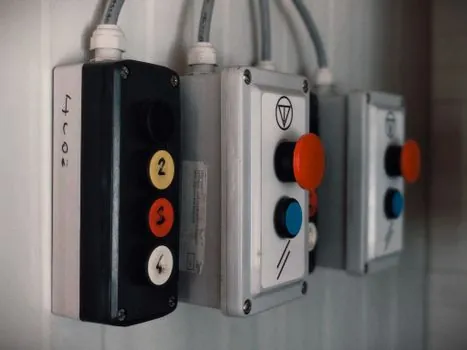
Use the matrix below as the gate when you pick a part number and write the technical file.
Machine designer / system integrator: ISO 13850 governs. You must justify the function's category (0 or 1 stop), the reset behaviour, the actuation force and travel, and the integration into the safety-related control system (PL d / PL e per EN ISO 13849-1, or SIL per IEC 62061) [S4][S6]. Component buyer / panel builder: IEC 60947-5-5 governs. The chosen E-stop must carry a vendor declaration of conformity to (EN) IEC 60947-5-5:2026, with the rated values covering your Ui, Uimp, Ith, and the positive-opening contact symbol on the contact block [S3][S5]. Risk assessor: the two standards cross-reference. ISO 13850 sets the functional target, IEC 60947-5-5 is the means of compliance, and EN ISO 13849-1 (or IEC 61508 / IEC 62061) sets the performance target [S4][S6].
A practical pass/fail check used by notified bodies: the chosen device must show (a) a red actuator on yellow background, (b) mechanical latching, (c) positive-opening contacts marked with the IEC 60417-5150 symbol on the wiring drawing, and (d) a manufacturer test report against the (EN) IEC 60947-5-5 endurance and dielectric sequences [S3][S7]. If any of those four items is missing, the technical file will not support CE marking under the Machinery Directive [S8].
What Changes in the 2026 IEC Revision
EN IEC 60947-5-5:2026, published 01 September 2026 and approved by CENELEC on 2024-10-16, restates the same core scope (low-voltage switchgear and controlgear, control circuit devices and switching elements, electrical emergency stop device with mechanical latching function) but refreshes the test clauses to align with the parent IEC 60947-1 low-voltage switchgear base standard in force in 2026 [S3]. The four documents it supersedes (EN 60947-5-5:1997, A1:2005, A11:2013, A2:2017) are consolidated, which simplifies procurement: one part number, one declaration, one test report instead of base-plus-amendment stacks [S3].
For integrators this matters during 2026-2027 transition projects: existing machines already CE-marked against the 1997 + amendments package remain valid, but new declarations of conformity issued after 01 September 2026 should reference EN IEC 60947-5-5:2026 to avoid a paperwork gap during customer audits [S3]. The harmonised list entry under the Machinery Directive is the trigger that flips this from optional to required for new placements; until that listing updates, ISO 13850 (EN ISO 13850:2015) remains the primary citation in the technical file for the emergency stop function [S8].
Where the Two Standards Get Misread in the Field
Three recurring mistakes show up on failed audits and field retrofits. Mistake 1: treating ISO 13850 as a device standard. It is a function standard. Buying a "13850-compliant button" is a category error; the device's compliance line is IEC 60947-5-5, the function's compliance line is ISO 13850, and the relationship is one of means-to-end [S4][S9]. Mistake 2: using an E-stop as a substitute for safeguarding. ISO 13850 §4.1.1.3 is explicit: the emergency stop function is a complementary protective measure and shall not be applied as a substitute for safeguarding measures or for the inherently safe design measures [S9].
Mistake 3: passive reset. A device that self-resets when the hazard clears (no deliberate operator action) does not meet the latching and reset requirements of either standard; the latch must hold against vibration and supply loss, and reset must require a twist, pull, or key action performed by the operator at the device [S4][S5]. The 2026 IEC revision tightens the verification of that behaviour in the mechanical-latching test sequence, which is the single most-cited test clause during component qualification [S3].
Integration With the Wider Safety Stack
ISO 13850 and IEC 60947-5-5 do not stand alone. The function defined in ISO 13850 is realised by a device built to IEC 60947-5-5, wired into a safety relay or safety controller evaluated to EN ISO 13849-1 (performance level PL a through PL e) or to IEC 62061 / IEC 61508 (SIL 1 through SIL 3), and the overall machine is brought to the Machinery Directive (2006/42/EC) via the EN ISO 13850 harmonised route [S4][S6][S8]. The right-hand side of the design chain is the risk assessment under EN ISO 12100, which decides whether the E-stop function needs to be category 0 (uncontrolled stop by immediate removal of power) or category 1 (controlled stop with power maintained on the actuators until the stop is achieved) [S4].
For designers comparing wider protective-measure choices, the trapped-key vs electrical guard locking selection map covers the complementary interlock side of the same risk picture, where the E-stop is the human-initiated fallback and the interlock is the routine protective measure. For facilities that also need to plan evacuation signalling, the emergency light and emergency stop button encyclopedia pages cover the lighting-side and actuator-side build of the same incident response. The wider emergency stop reference page ties the function, the device, and the rescue workflow together at the system level.
Spec-Writing Checklist for 2026 Projects

For any new machine technical file drafted in 2026, the practical checklist is: (1) cite EN ISO 13850:2015 for the emergency stop function requirements, including category, reset, and availability; (2) specify devices conforming to EN IEC 60947-5-5:2026, with positive-opening contacts and the IEC 60417-5150 symbol on the wiring diagram; (3) target the safety-related control system to EN ISO 13849-1 PL c or higher, or IEC 62061 SIL 2 or higher, justified by the EN ISO 12100 risk assessment; (4) ensure the reset action is a deliberate operator action at the device (twist, pull, or key); (5) verify that the chosen E-stop cannot be used as a substitute for guards or for inherently safe design under ISO 13850 §4.1.1.3 [S3][S4][S8][S9]. The five-item set covers the audit questions a notified body will ask, and any missing item is the one that historically fails the file.
The next trackable signal is the official Machinery Directive harmonised-standard list update that will cite EN IEC 60947-5-5:2026 alongside EN ISO 13850:2015; until that entry appears, the 1997 + amendments package remains a valid reference for in-flight projects [S3][S8]. Watch the CENELEC and OJEU feeds for that listing, and plan to refresh the component declarations of conformity to the 2026 edition as part of the next documentation cycle.