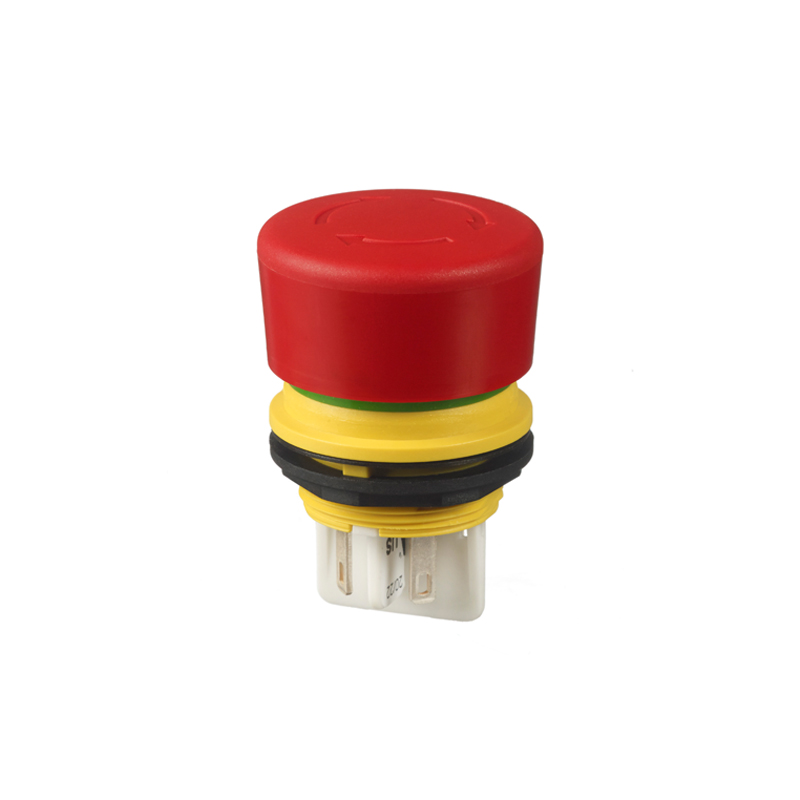
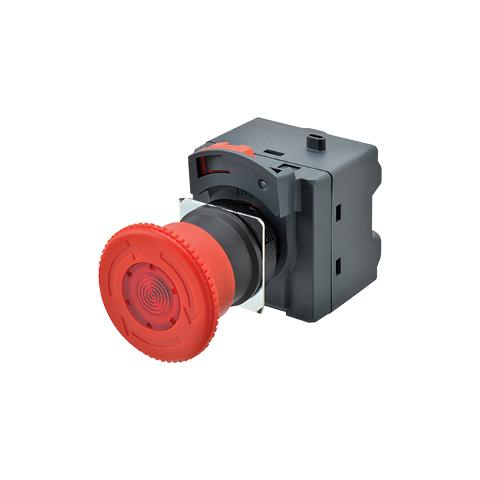
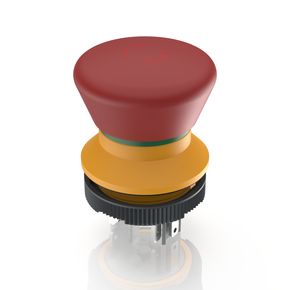
An emergency stop button, commonly called an e-stop, is a manually operated safety device that lets an operator halt a hazardous machine movement immediately and hold it stopped until a deliberate reset. It is the most recognizable component in machine safety: a red mushroom-head actuator on a yellow background, latching when pressed and releasing only by a twist, pull, or key action.
Unlike an ordinary pushbutton, a compliant emergency stop is built around mechanical certainties. Its normally closed contacts open by direct, positive action rather than by a spring, it latches past a point of no return, and it cannot generate the stop command without latching or latch without commanding the stop. These behaviors are defined in ISO 13850, IEC 60947-5-5, and IEC 60204-1, and they are what separate a genuine safety device from a red button that merely looks the part.
Photo: Flygklubben, CC BY-SA 4.0, via Wikimedia Commons
This guide is aimed at industrial purchasing engineers and machine builders. It covers 6 chapters from what an emergency stop is, actuator and station types, contact and reset mechanisms, stop categories and standards, to key spec parameters and selection decisions, with 7 selection FAQs and manufacturer comparisons. All requirements reference the public standards ISO 13850, IEC 60947-5-5, IEC 60947-5-1 Annex K, IEC 60204-1, and NFPA 79.
Chapter 1 / 06
What is an Emergency Stop Button
An emergency stop button is a complementary protective measure that lets a person initiate a stop of a hazardous machine function by a single, deliberate action. The European Machinery Directive treats it under Annex I, clause 1.2.4.3, and the international harmonized standard ISO 13850, Safety of machinery, Emergency stop function, sets out its principles of design. The key word is complementary: an emergency stop does not replace guarding, interlocks, or light curtains. It is the last manual line of defense when those primary safeguards, such as a safety light curtain, have not prevented a developing hazard.
Structurally, a complete emergency stop device has three layers. The first is the actuator, the visible red mushroom head, palm-operated push panel, rope, bar, or foot pedal that the operator drives. The second is the latching mechanism inside the operator, which holds the actuated position mechanically until reset. The third is one or more contact blocks at the rear, whose normally closed contacts open by direct, positive action to break the safety circuit. When the actuator, latch, and contact block are assembled and panel-mounted in a 16, 22, or 30 mm hole, the result is a field-replaceable station.
The design intent is captured in two negative rules drawn directly from ISO 13850 and IEC 60947-5-5. It must not be possible to generate the stop command without the actuator latching in, and it must not be possible to latch the actuator without generating the stop command. These two rules close the loophole where a worn or partially pressed button might appear active without actually breaking the circuit, or stay latched while quietly re-closing its contacts. The mechanism stores energy in a spring to drive both the latch and the contact opening, so the speed at which the button is hit does not change the outcome.
A second principle is that an emergency stop must override all other commands. Pressing it must take priority over the running program, the operator panel, and any automatic sequence, and the machine must not restart by itself when power returns or when the button is released. Resetting the actuator only removes the latch; a separate, deliberate start command is still required to resume operation. This prevents the dangerous case where reaching in to release a button inadvertently restarts the machine.
Historically, the red mushroom on a yellow field became the universal language of machine safety through the convergence of IEC 60204-1, Electrical equipment of machines, in Europe and NFPA 79, the Electrical Standard for Industrial Machinery, in North America. NFPA 79 reserves the red and yellow color combination exclusively for emergency stop applications, which is why no other control on a compliant panel may use that pairing. Today the device spans every industry from packaging lines and machine tools to robot cells, conveyors, presses, and process skids, sold by every major control-component maker and a tier of specialist safety brands.
Chapter 2 / 06
Actuator and Station Types
ISO 13850 recognizes several actuator forms: mushroom-head push buttons easily struck by the palm, pull-cord or pull-wire ropes that span a long machine, bars and handles, and uncovered foot pedals. The mushroom push button dominates discrete control panels, while pull-rope stations protect conveyors and long material-handling lines where a worker may be anywhere along the run. The table below compares the mainstream actuator and station types by where each fits best.
Type
Actuation
Typical Mount
Best Suited To
Mushroom push button
Palm or finger press, latches
16 / 22 / 30 mm hole
Control panels, machine consoles, robot cells
Pull-rope (rope pull)
Pull or rope slack/break
Bracket, in-line tensioned
Conveyors, long lines, bulk handling
Foot pedal (uncovered)
Foot press
Floor stand
Press brakes, sewing, hands-busy stations
Palm / grab switch
Large flat palm strike
Panel or pendant
Gloved operation, fast reach scenarios
Enclosed pre-wired station
Mushroom in housing
Surface mount enclosure
Remote points, walls, retrofit add-ons
Mushroom push buttons carry an extended, rounded head, the mushroom profile required so that a hand sweeping across a panel reliably catches and depresses it. Head diameters of 30, 40, and 60 mm are standard, with larger heads chosen for gloved hands and palm operation. The body may be metal, for harsh duty and impact resistance, or reinforced plastic, which is lighter and corrosion-free. Schneider Harmony XB4 is the metal line and XB5 the plastic line of the same family, a common split across makers.
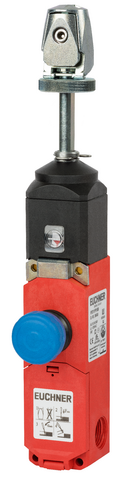
Pull-rope stations replace a single button with a tensioned rope running the length of a conveyor. Pulling the rope anywhere, or the rope going slack from a break, latches the stop. ISO 13850 requires that rope-operated devices stop on both a pull and a rope failure, and that the rope deflection needed to trip stays within defined limits, so the device must monitor rope tension, not just pull force. These stations include a tension indicator and a reset lever, and are specified by maximum span between supports.
Enclosed pre-wired stations place one or more mushroom operators in a sealed surface-mount housing with the contacts already wired to a terminal block. They are the fastest way to add emergency stops at remote points, on walls, or as a retrofit, without cutting into an existing panel. Allen-Bradley 800F enclosed stations and Schneider XALK lines are typical, commonly rated IP66 for indoor industrial use and offered with multiple operators and pilot lights in one box.
Across all forms, two anti-references apply. An emergency stop actuator must never be guarded by a ring or recess that prevents a fast palm strike, and it must never share the red-on-yellow identity with any non-emergency function. The actuator color is red, the immediate background is yellow, and no other control on the machine may reuse that combination.
Chapter 3 / 06
Contact and Reset Mechanisms
The mechanical heart of a compliant emergency stop is how its contacts open and how the actuator latches and resets. Three properties are non-negotiable under IEC 60947-5-5 and ISO 13850: direct opening action, trigger action with a defined point of no return, and self-latching that ties the latch to the contact opening. The table below summarizes the mechanism vocabulary an engineer reads on a datasheet.
Mechanism
What it Means
Why it Matters
Direct opening action
NC contacts forced apart by rigid link, not a spring
A welded contact is physically torn open; fail-safe
Trigger action
Contacts snap open past a point of no return
Prevents slow teasing or partial half-pressed states
Self-latching
Actuator holds the pressed position until reset
Command persists; machine cannot self-restart
Self-monitoring contact block
NC opens if the block detaches or is mis-mounted
Detects a contact block that vibrates loose
Twist / pull / key release
Deliberate manual unlatch action
No accidental reset; key limits who may reset
Direct opening action, defined in IEC 60947-5-1 Annex K, means contact separation is the direct result of a specified movement of the actuator through non-resilient members such as a rigid plunger, not dependent on a return spring. Its symbol is an arrow inside a circle, often marked on the contact block. The practical payoff is that if the normally closed contact welds, continued actuator travel breaks the weld and opens the circuit anyway. This is the single property that most distinguishes a safety contact from an ordinary one.
Trigger action adds a snap mechanism so the contacts cross a point of no return as they open. Energy stored in a spring drives both the latch and the contact opening, independent of how fast the operator presses. This defeats two failure modes named in the standards: contact teasing, where slow movement leaves contacts hovering on the edge of conduction, and blocking, where a half-pressed actuator appears active but has not opened the circuit. Past the trigger point, the device is committed: it latches and the command is generated together.
Self-monitoring contact blocks (SMCB) mechanically clip to the operator so that if the block separates, falls off, or is wrongly installed, its normally closed contact is forced open and the safety circuit reads the stop state. Allen-Bradley 800F-X01S is a self-monitoring 1NC block rated to 10 A and 690 V, and Schneider Harmony XB5 offers a monitoring contact in configurations such as 1NO 2NC. Without self-monitoring, a contact block shaken loose by vibration could silently disconnect the stop, which is exactly the latent failure safety standards aim to eliminate.
Reset is by deliberate manual action only. Twist-to-release rotates the head to unlatch, pull-to-release lifts it, and key-release requires a key so only authorized staff can reset. IEC 60947-5-5 states that for twist-to-reset devices the direction of unlatching must be clearly marked. Crucially, reset must not restart the machine: it only clears the latch and re-arms the safety circuit, after which a separate start command is needed. This is why resetting an e-stop on a robot cell never, by itself, sets the robot moving.
Chapter 4 / 06
Stop Categories and Standards
An emergency stop button is only as good as the circuit behind it, and that circuit is defined by the stop category it implements and the family of standards it must satisfy. IEC 60204-1 defines three stop categories by how power is removed, and ISO 13850 restricts an emergency stop to two of them. The table below sets out the categories and the typical machinery each suits.
Stop Category
How it Stops
Allowed for E-Stop
Typical Use
Category 0
Immediate removal of power to actuators (uncontrolled)
Controlled deceleration, then power removed at standstill
Yes
High-inertia spindles, large drives, robots
Category 2
Controlled stop, power left on actuators
No
Normal operational stops, not emergencies
Category 0 is an uncontrolled stop: power to the actuators is cut immediately, usually by dropping out a contactor or safety relay, and the machine coasts or relies on mechanical or fail-safe braking. It is simple and fail-safe, the natural choice where the machine has low inertia or where coasting is harmless. The drawback is that on a high-inertia drive an instant power cut can prolong the stopping distance because there is no active braking.
Category 1 is a controlled stop: power is kept available so the drive can decelerate under control, then power is removed once standstill is confirmed. It suits high-inertia spindles, large servo drives and induction motors, and robots, where a controlled ramp stops the load faster and with less mechanical shock than a coast. Category 1 needs a timed or motion-monitored safety device to remove power after the stop, which is why it pairs with safe-torque-off drives and a safety PLC or safety controller. Category 2 leaves power on the actuators and is excluded from emergency stop use by ISO 13850, because an emergency function must not depend on the drive staying energized.
The standards stack around the device is layered. ISO 13850 is the core type-B standard for the emergency stop function. IEC 60947-5-5 is the product standard for the electrical control circuit device with the mechanical latching function, and it imports the direct opening action requirement of IEC 60947-5-1 Annex K. IEC 60204-1 governs the electrical equipment of the machine and defines the stop categories and the red-on-yellow identification, mirrored in North America by NFPA 79. The European Machinery Directive Annex I, 1.2.4.3, is the legal hook that makes an emergency stop mandatory on most machinery.
On top of these sit the functional-safety standards that rate the whole stop circuit, not just the button. ISO 13849-1 expresses the result as a Performance Level from PL a to PL e, while IEC 62061 uses a Safety Integrity Level, SIL 1 to SIL 3. A typical machine emergency stop is designed to PL d or PL e, achieved with redundant normally closed contacts feeding a safety relay or safety controller. The button itself is a subsystem in that calculation; choosing a device with two direct-opening contacts and self-monitoring is what makes the higher performance levels attainable.
Chapter 5 / 06
Key Specification Parameters
Reading an emergency stop datasheet means separating the safety-defining parameters from the ordinary electrical ratings. The table below lists the key specification parameters that drive selection, with representative values drawn from mainstream 22 mm safety pushbutton series such as Schneider Harmony XB4 and XB5 and Allen-Bradley Bulletin 800F. Always confirm against the specific part number, since the same operator body ships in many variants.
Parameter
Typical Value or Option
Notes
Mounting hole
16 / 22 / 30 mm
22 mm is the most common panel standard
Mushroom head diameter
30 / 40 / 60 mm
Larger heads for gloved or palm use
Contact configuration
1NC, 2NC, 1NO 2NC
NC contacts are direct-opening
Utilization category
AC-15, DC-13
Inductive control of relays and contactors
Rated insulation voltage
600 to 690 V
Per IEC 60947-5-1
Thermal current Ith
10 A
Open-block thermal rating
Ingress protection
IP65 / IP66 / IP67 / IP69K
IP69K for high-pressure washdown
Operating temperature
-40 to +70 °C
Metal bodies reach the wider range
Mechanical durability
≥ 1 million cycles
Operator life under the stated standard
Mounting hole and head diameter set the panel footprint and the ease of operation. The 22 mm hole is the global default; 16 mm suits compact panels and 30 or 30.5 mm follows the older North American heavy-duty standard. Head diameter of 40 mm is the typical machine-panel choice, while 60 mm heads serve large palm strikes and gloved hands. The actuator must protrude enough to be struck quickly, which is why recessed or ringed mounts are not used on emergency stops.
Contact configuration and utilization category determine both the safety architecture and the electrical load. One normally closed direct-opening contact is the minimum, two are used for redundant PL d or PL e circuits, and an added normally open contact (giving 1NO 2NC) feeds a monitoring input on the safety relay. The relevant utilization categories are AC-15 and DC-13, both for switching electromagnetic loads such as relay and contactor coils. A representative rating set is around 3 A at 240 V AC-15 and a few tenths of an amp at the higher DC-13 voltages, since the device drives control loads, not power loads.
Ingress protection and temperature match the device to its environment. IP65 covers dust and low-pressure water for indoor panels; IP67 adds temporary immersion; IP69K certifies resistance to close-range, high-pressure, high-temperature jet cleaning, essential in food, beverage, and pharmaceutical plants. Schneider Harmony XB4 metal and Allen-Bradley 800F families reach the IP66 to IP69K range. Operating temperature spans from about -40 to +70 degrees C for metal-bodied units, with plastic bodies usually narrower at the cold end.
Mechanical durability is stated as a number of operating cycles, with quality 22 mm operators rated at or above 1 million mechanical operations. Because an emergency stop is, by design, pressed rarely, mechanical life is seldom the limiting factor; electrical durability under the actual switched load and the integrity of the latching mechanism matter more. The parameters that genuinely gate selection are the safety-defining ones: direct opening action, trigger action, self-monitoring, and the contact count needed for the target performance level.
Chapter 6 / 06
Selection Decision Factors
To turn the preceding chapters into a specific part number, follow the decision sequence below. Most emergency stop selection errors come not from a single wrong rating, but from skipping the safety-architecture step and treating the device as an ordinary pushbutton. These eight steps can serve as a fixed RFQ template.
Confirm the safety function and stop category: Decide whether the duty is an emergency stop (ISO 13850, halts movement) or an emergency switching-off (removes power against shock), then choose stop category 0 or 1 per IEC 60204-1. Category 2 is not permitted for an emergency stop.
Set the target performance level: Derive PL a to PL e per ISO 13849-1 or SIL 1 to SIL 3 per IEC 62061 from the machine risk assessment. PL d or PL e usually drives a two-channel circuit with redundant direct-opening contacts.
Choose contact count and self-monitoring: One NC for single channel; 2NC for redundancy; add a monitoring NO (1NO 2NC) for the safety relay. Specify a self-monitoring contact block where a detached block must be detected.
Select actuator form and head: Mushroom for panels, pull-rope for long conveyors, palm or foot for hands-busy stations. Pick 40 mm heads for general use, 60 mm for gloved or palm strikes, always red on yellow.
Pick mounting and reset: 22 mm hole is standard; choose twist, pull, or key release. Use key-release where only authorized staff may reset, and mark the unlatch direction per IEC 60947-5-5.
Match ingress protection and temperature: IP65 indoors, IP67 or IP69K for washdown and outdoor use. Verify both operator and contact block carry the rating, and confirm the temperature range for metal versus plastic bodies.
Verify body material and certifications: Metal for impact and harsh duty, plastic for corrosion and weight. Require the relevant marks: CE, UL, CSA, and CCC for China, plus the ISO 13850 and IEC 60947-5-5 compliance statement on the datasheet.
Plan layout and accessibility: Place stations so any operator reaches one within an unobstructed reach, ensure each is visible and never obscured, and confirm the device overrides all other commands and prevents automatic restart on reset.
One last commonly overlooked dimension is maintainability and consistency across the plant: standardizing on one operator family, keeping spare self-monitoring contact blocks, and ensuring every reset point is documented all shorten repair time and reduce wiring errors during retrofits. Schneider Electric, Allen-Bradley (Rockwell), Siemens, Eaton, ABB, Pilz, Schmersal, EAO, and IDEC all maintain wide e-stop ranges with local stock and certification support, which makes them dependable choices for projects that must pass a machinery safety audit.
FAQ
What is the difference between an emergency stop and an emergency switching-off device?
Both use the same red mushroom actuator, but the safety function differs. An emergency stop arrests hazardous mechanical movement, normally as a stop category 0 or category 1 per IEC 60204-1, and is governed by ISO 13850. An emergency switching-off device removes electrical power to protect against electric shock or arc flash, and is treated as a category 0 disconnection. The hardware can look identical, but the upstream wiring and the risk assessment that justifies the device are different. ISO 13850 permits only stop category 0 and category 1 for an emergency stop; category 2, which leaves power on the actuators, is not allowed.
Why must an emergency stop button use direct opening action?
Direct opening action, defined in IEC 60947-5-1 Annex K, means the normally closed contacts are forced apart by a rigid mechanical link from the actuator, not by a spring. If the contacts weld shut, continued travel of the actuator physically tears them apart, so a single welded contact cannot defeat the stop command. The symbol is an arrow inside a circle. ISO 13850 and IEC 60947-5-5 require this property so the device fails toward the safe state. A button that relies only on a return spring to open its contacts is not a compliant emergency stop device.
What does a self-monitoring contact block do?
A self-monitoring contact block (SMCB) mechanically latches onto the operator so that if the contact block falls off or is incorrectly mounted, its normally closed contact is forced open, driving the safety circuit to the stop state. This guards against the dangerous failure where vibration shakes a snap-on contact block loose while the operator still appears intact. Allen-Bradley 800F-X01S and the monitoring contact on Schneider Harmony XB5 are examples. Self-monitoring blocks are recommended wherever loss of the contact connection would otherwise go undetected, which is most safety-rated installations.
What are stop categories 0, 1, and 2?
IEC 60204-1 defines three stop categories. Category 0 is an uncontrolled stop by immediate removal of power to the actuators, letting the machine coast or brake mechanically. Category 1 is a controlled stop where power is kept available to decelerate the drive, then removed once standstill is reached, which suits high-inertia spindles and large motors. Category 2 is a controlled stop with power left on the actuators. ISO 13850 allows only category 0 and category 1 for an emergency stop function, because category 2 keeps the drive energized and is not considered safe for emergencies.
How many contacts and what reset type should I choose?
For a single-channel circuit, one normally closed direct-opening contact is the minimum. Safety circuits rated to ISO 13849-1 PL d or PL e, or IEC 62061 SIL 2, normally use two normally closed contacts for redundancy, often written 2NC, and may add a normally open monitoring contact for the safety relay, giving 1NO 2NC. Reset is by deliberate manual action: twist-to-release, pull-to-release, or key-release. Key-release suits stations where only authorized staff may reset. The reset action only unlatches the actuator; the machine still requires a separate start command to run.
What IP rating and mounting size do I need?
Standard panel-front stations use a 22 mm mounting hole, the most common size, with 16 mm and 30 mm or 30.5 mm also available. Mushroom heads are typically 30, 40, or 60 mm in diameter; larger heads suit gloved or palm operation. For indoor control panels IP65 is usual. Washdown, outdoor, and food or pharmaceutical lines need IP67 or IP69K, the latter rated for high-pressure high-temperature jet cleaning. Schneider Harmony XB4 metal and Allen-Bradley 800F enclosed stations reach IP66 to IP69K. Verify both the operator and the rear contact block carry the rating, because the contact side is often the weak point.
Which manufacturers and series fit safety-rated e-stop applications?
For machine safety duties requiring direct opening action, self-monitoring contacts, and ISO 13850 certification, the mainstream choices are Schneider Electric Harmony XB4 and XB5, Allen-Bradley Bulletin 800F and 800T, Siemens SIRIUS ACT 3SU1, Eaton RMQ-Titan M22, and ABB Modular and Compact ranges. Specialist safety brands include Pilz PIT es, Schmersal, EAO Series 04 and 84, and IDEC XA and HW series. For enclosed pre-wired stations, Allen-Bradley 800F and Schneider XALK lines ship in IP66 housings. Always confirm the part number carries the e-stop trigger action and direct-opening NC contacts, since the same operator body is also sold as a non-safety pushbutton.
Emergency Stop Button Manufacturers
Source-backed product routes. Open a company dossier for procurement scope and cited evidence.