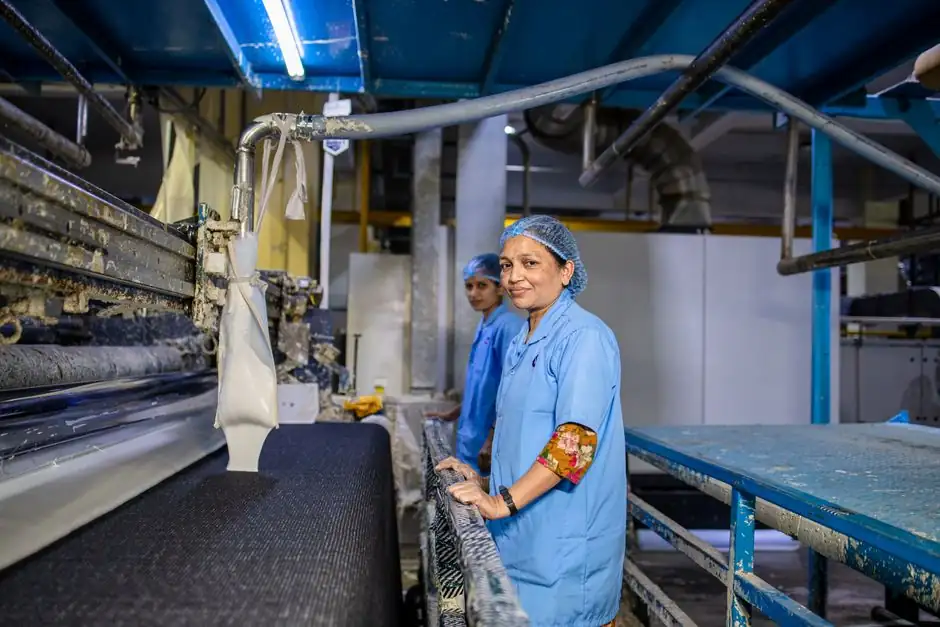
For textile-mill drive trains, jaw couplings sized from the L-series (max torque 12,500 in-lbs / 1,412 Nm, max bore 2.875 in / 73 mm) through the C-series (max torque 37,800 in-lbs / 4,271 Nm, max bore 4.000 in / 102 mm) cover the bulk of carder, draw-frame, and loom motor applications, with elastomer (spider) material chosen against lint, humidity, and ambient heat [S1].
Textile mills run hot, humid, and lint-laden, and they are heavily cyclic: carders stop and restart dozens of times per shift, looms index under shock, and dye-house fans run continuously in saturated air. A jaw coupling's three-piece architecture (two metal hubs plus a compressible elastomer spider) suits that profile because the elastomer damps torsional vibration, tolerates angular and parallel misalignment, and keeps metal-to-metal contact out of the drive train [S1][S4].
Size envelope and torque coverage for mill motors
Across the Lovejoy jaw-coupling family, bore range spans 0.125 in (4.45 mm) to 7.000 in (178 mm) and torque spans 3.5 in-lbs (0.4 Nm) to 170,004 in-lbs (19,209 Nm) over 24 sizes, with standard bores covering AGMA, SAE, and DIN keyway combinations [S1][S3]. For typical textile-motor horsepower (0.5 kW to 75 kW, 4-pole, 1,750 RPM-class induction motors), the L and AL series sit in the working sweet spot.
The L-series maxes out at 12,500 in-lbs (1,412 Nm) torque and 2.875 in (73 mm) bore, the AL-series (aluminum) at 2,268 in-lbs (256 Nm) and 1.875 in (48 mm) bore, and the SS-series (stainless) at 3,708 in-lbs (419 Nm) and 1.875 in (48 mm) bore [S1]. For larger cards, open-end spinning frames, and finishing-range drives pulling above 30 kW, the C-series extends the ceiling to 37,800 in-lbs (4,271 Nm) torque at 4.000 in (102 mm) bore, which keeps the coupling out of the high-stress corner where spider life collapses [S1].
Spider material choice against mill conditions
The elastomer spider is the wear part that decides coupling life in a textile plant, and the four common families (NBR SOX rubber, Urethane, Hytrel, and bronze) trade damping, temperature ceiling, and chemical resistance differently [S1]. NBR SOX (nitrile) is the default for general-purpose drives, urethane carries higher torque per durometer and resists abrasion from airborne lint, Hytrel extends the upper temperature ceiling for hot zones like dye-house exhaust or stent frames, and bronze is specified where the spider must survive temperatures or chemical attack that would destroy any rubber compound [S1][S4].
For carding and spinning floors where ambient is typically 30 to 40 °C with relative humidity of 55 to 75 % and airborne fiber fly, urethane or Hytrel spiders typically outlast NBR by a measurable margin. The fail-safe property is critical on continuous-process lines: when the spider wears through, the bare metal jaws lock together and keep the drive turning, which preserves production on fire-pump, exhaust-fan, and lint-filter drives where a sudden stop is unacceptable [S4]. Inspection rule of thumb: replace the spider before it wears below 75 % of its original thickness, per the Lovejoy catalog safety instructions [S3].
Service factor and shock loading on carders and looms
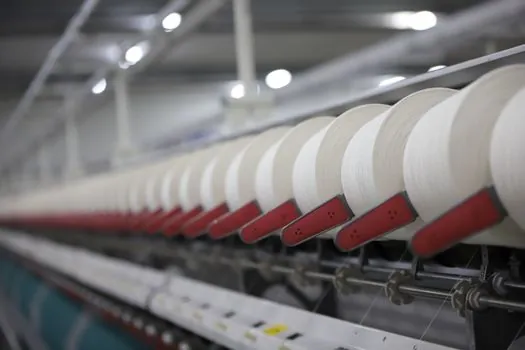
Textile drives are not smooth-torque loads. Carders peak at 2.0 to 2.5 times rated torque on startup and during web doff, and looms index under cyclic shock that can briefly hit 2.5 to 3.0 times rated torque. Service-factor selection therefore drives the size jump: a 15 kW, 1,750 RPM motor with 1.15 service factor from the coupling maker's chart, multiplied by 2.0 for carding shock, lands in a coupling whose catalog torque rating is at least 2.3 times the motor's full-load torque output [S2][S5].
JBJ's jaw-in-shear selection process uses a charted sequence (rated torque, service factor, bore, keyway, then hub material) and explicitly lists four components: two hubs, one elastomer, and one retaining feature, which is the same architecture that Lovejoy, Martin, and KTR publish for their L-series equivalents [S2]. Martin-Flex runs a parallel dual line: one series sized for higher horsepower-per-size, one for interchangeability with legacy installed bases, both sharing the same elastomer inserts [S5]. For a brownfield card room, that interchangeability is often the deciding factor: a drop-in L100/L110 hub avoids line re-alignment.
Misalignment, RPM limits, and environment-specific build
Standard L-series jaw couplings carry a 3,600 RPM limit on the larger LC radially-removable elastomer build, while the SW variant drops to 1,750 RPM because of its open-center geometry [S1]. For high-speed dye-house fans and vacuum extractors above 3,600 RPM, the LC or C type is the correct build, not the SW. Angular misalignment tolerance on jaw couplings is typically 0.5 to 2.0 degrees depending on size, and parallel offset is roughly 0.015 to 0.025 in (0.38 to 0.64 mm), which is more than enough to absorb thermal growth on long motor-gearbox shafts but not enough to substitute for poor foundation alignment [S4][S6].
Material selection pivots on ambient and wash-down exposure. Aluminum AL-series hubs (max torque 2,268 in-lbs / 256 Nm) are passivated and used in dry spinning rooms where weight matters; SS-series (stainless, max torque 3,708 in-lbs / 419 Nm) is the default for bleach rooms, dye-house wet zones, and any area exposed to alkaline or peroxide wash-down; and standard L-series hubs in sintered iron or ductile iron cover the dry, non-corrosive areas [S1]. The comparison lines up neatly for procurement:
- L series: max torque 12,500 in-lbs (1,412 Nm), max bore 2.875 in, sintered iron/steel, general-purpose dry-mill duty.<br>- AL series: max torque 2,268 in-lbs (256 Nm), max bore 1.875 in, aluminum, lightweight / low-inertia loads.<br>- SS series: max torque 3,708 in-lbs (419 Nm), max bore 1.875 in, stainless steel, wash-down and bleach areas.<br>- C series: max torque 37,800 in-lbs (4,271 Nm), max bore 4.000 in, ductile iron/steel, heavy carder and loom drives.
Selection workflow for a mill-floor retrofit
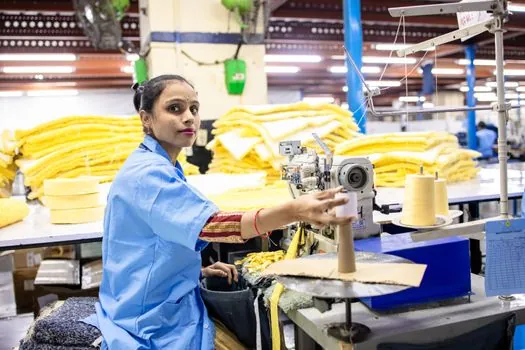
The practical sequence for a textile-mill retrofit is: confirm motor full-load torque (kW × 9,550 / RPM), apply the appropriate service factor (1.5 for uniform load, 2.0 for light shock, 2.5 to 3.0 for carder/loom shock), pick the catalog size whose rated torque at the chosen spider durometer exceeds the multiplied value, then verify bore and keyway fit against motor and gearbox shaft drawings [S2][S3][S5]. The same workflow applies to adjacent process industries, and the criteria carry over almost intact to Jaw Coupling Selection for Pulp and Paper Drives, where humidity, lint-equivalent (paper dust), and cyclic shock profiles are nearly identical to a card room.
Two trackable signals for the next quarter: (1) Lovejoy catalog page last updated 2026-08-17 confirms current bore and torque ratings remain in production with 24-hour stock shipping on most types [S1]; (2) comparative guidance published 2026-04-07 (Rathi Couplings) places jaw couplings against gear and disc alternatives on torque density, misalignment tolerance, speed, and environment, which is the comparison frame procurement engineers should use when justifying a jaw coupling over a disc coupling or gear coupling on a retrofit [S6].
For component-level specifications, see jaw coupling.