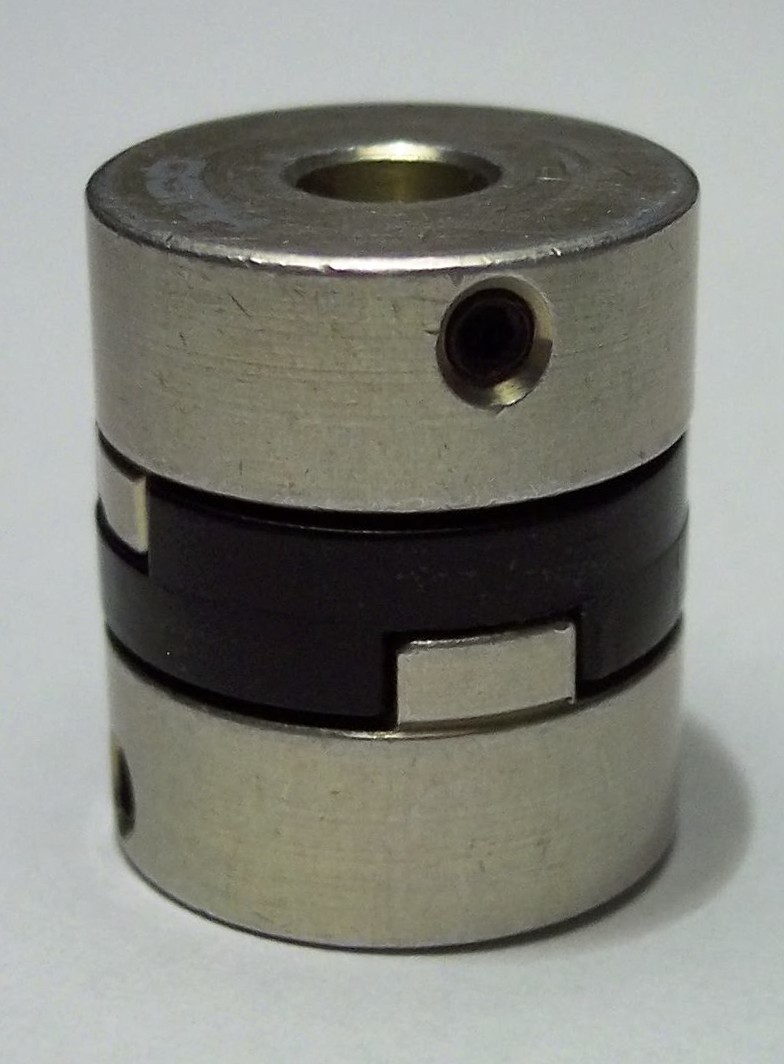
A jaw coupling is a three-piece flexible shaft coupling: two metal hubs whose interlocking jaws drive a single elastomeric insert called a spider, which sits between the jaws and transmits torque while absorbing shock and accommodating shaft misalignment. It is one of the oldest, simplest, and lowest-cost flexible couplings in power transmission, and remains the default connection between an electric motor and a pump, fan, gearbox, or compressor across virtually every industry.
Because the torque path runs through a replaceable rubber or plastic spider, the jaw coupling is also fail-safe: if the spider fails, the metal jaws engage directly and keep the drive turning until a planned shutdown. The spider, not the hub, sets the torque rating, the temperature limit, and the damping behavior, which is why selecting the spider material is the single most important decision in jaw coupling specification.
Photo: Hohum, CC BY-SA 3.0, via Wikimedia Commons
This guide is written for industrial purchasing engineers and design engineers selecting flexible couplings for motor-to-driven-equipment drives. It covers 6 chapters spanning what a jaw coupling is, straight-jaw versus curved-jaw and in-shear types, spider materials, torque and misalignment specifications, spec-sheet decoding, and the selection decision sequence, with 7 selection FAQs and manufacturer references. Torque, misalignment, and material figures are cross-checked against Lovejoy (Timken) and KTR ROTEX catalog data and the selection conventions of DIN 740, ISO 14691, and DIN 69002.
Chapter 1 / 06
What is a Jaw Coupling
A jaw coupling connects two coaxial rotating shafts, transmitting torque from a driver to a driven machine while tolerating the small alignment errors and torsional shocks that exist in every real installation. It is built from exactly three parts: a driving hub, a driven hub, and an elastomeric spider that nests between the jaws of the two hubs. Each hub carries a set of protruding jaws, and the legs of the spider sit in the gaps so that one hub cannot rotate relative to the other without compressing the spider legs. This makes the spider the working element of the coupling, and the metal hubs simply the means of clamping it to the shafts.
Functionally the jaw coupling sits in the family of flexible elastomeric couplings, alongside pin-and-bush, tire, and grid couplings. Its defining trait is that the elastomer is loaded in compression (in the classic straight-jaw form) rather than in bending or shear, and synthetic rubber is far stronger in compression than in shear, which is why such a compact part can carry meaningful torque. The spider also cushions torque ripple from the motor and absorbs vibration, protecting bearings and gears downstream. When the shafts are slightly out of line, the spider deforms to take up the offset rather than transmitting that load straight into the bearings.
The jaw coupling is fail-safe by geometry. Should the spider tear, abrade, or melt, the driving and driven jaws come into direct metal-to-metal contact and continue to transmit torque, so the machine does not coast to an uncontrolled stop. This is a limp-home condition, with no damping and considerable noise and heat, that buys time until a planned spider replacement, not a normal operating state. The fail-safe property is a major reason jaw couplings dominate pumping, ventilation, and conveying duties where an unplanned trip is costly.
The design is genuinely old. The original jaw coupling patent associated with Louis Ricefield was acquired by Lovejoy in 1927, and the L-type three-piece spider coupling has been a power transmission staple ever since, with Lovejoy now part of Timken. The geometry proved so durable that the L-line hub and spider dimensions became a de-facto industry standard, with compatible spiders cross-sourced from many suppliers. In the 1970s and 1980s the curved-jaw refinement, popularized by KTR under the ROTEX name, reshaped the jaw and spider contact surfaces to raise torque density and misalignment capacity, and a backlash-free prestressed version later opened the door to servo and motion-control use.
In application scale, jaw couplings span an enormous range, from miniature couplings carrying well under 1 Nm in encoders, small pumps, and instrument drives, up to large industrial curved-jaw units rated to roughly 35,000 Nm in heavy pump and compressor trains. The same three-piece architecture, scaled by hub size and spider material, covers nearly the entire band. No single coupling type covers every duty, but the jaw coupling covers more of the general-purpose middle than any other, which is exactly why it is so common.
Chapter 2 / 06
Jaw Coupling Types
Although every jaw coupling shares the two-hubs-plus-spider architecture, three structural families differ enough to change torque, misalignment, and price by a wide margin: straight-jaw (compression), curved-jaw, and jaw-in-shear. Choosing the wrong family is the most common selection error, because a buyer fixed on a straight-jaw size may be paying in bearing reaction loads what a small upgrade to a different family would have saved. The table below summarizes the engineering differences.
Type
Spider Loading
Angular Misalign.
Parallel Misalign.
Typical Use
Straight-jaw (L type)
Compression
~1°
0.25 to 0.4 mm
General motor-to-pump drives
Curved-jaw (ROTEX)
Compression, convex contact
~1°
0.2 to 0.5 mm
Higher torque density, quieter
Curved-jaw servo (GS)
Prestressed, backlash-free
~0.9°
small, by size
Servo and motion control
Jaw-in-shear
Shear
~2°
up to 2.4 mm
High misalignment, easy spider swap
Straight-jaw (compression) couplings are the classic Lovejoy L type and its many compatibles. The jaws of both hubs lie in the same plane, and the driving jaws push the driven jaws through the spider legs, loading the elastomer in compression. Because rubber is strongest in compression, this family transmits high torque and tolerates overload well for its size, and it is the lowest-cost flexible coupling on the market. The trade-off is modest misalignment capacity, around 1 degree angular and 0.25 to 0.4 mm (0.010 to 0.015 inch) parallel, and the fact that misalignment generates appreciable reaction loads on the shafts.
Curved-jaw couplings, exemplified by the KTR ROTEX family, machine the jaw flanks and spider teeth so the contact is convex against concave. Spreading the load over a larger, gently curved area lowers peak surface pressure and edge stress, which raises torque density, reduces noise, and improves life under misalignment compared with straight-jaw at the same envelope. ROTEX uses a splined hub bore to spider interface (splines per DIN and SAE conventions) and carries torque from under 1 Nm to about 35,000 Nm across its size range, with a maximum spider torsion angle of 5 degrees.
Backlash-free curved-jaw servo couplings, such as the ROTEX GS series built to DIN 69002, take the curved-jaw idea and preload the convex spider teeth against the concave hub jaws so the assembly is free of rotational backlash under prestress. This makes the coupling torsionally stiff enough for highly dynamic servo drives while still offering some vibration damping, and the spider is offered in several Shore hardnesses to tune stiffness. Note that a prestressed servo coupling does not provide the same fail-safe metal interlock behavior as a standard L type and should not be relied on as fail-safe.
Jaw-in-shear couplings draw the hubs apart so the jaws align axially and the wider spider works in a shear plane instead of compression. Elastomers carry less load in shear than in compression, so a shear coupling transmits less torque for its size, but it tolerates far more misalignment, roughly 2 degrees angular and up to 2.4 mm (0.094 inch) parallel, and the spider is radially removable without moving either machine. That serviceability makes jaw-in-shear attractive where alignment is poor or downtime for spider replacement must be minimized.
Chapter 3 / 06
Spider Materials and Grades
The spider is the heart of a jaw coupling: it alone sets the torque rating, the operating temperature window, the damping, and much of the misalignment capacity. Four spider materials dominate industrial practice, each a different point on the torque-versus-damping-versus-temperature trade-off. NBR is the baseline; urethane and Hytrel trade damping for torque; bronze trades almost everything for extreme temperature. The table compares the four against the NBR reference.
Spider Material
Hardness
Torque vs NBR
Temperature Range
Damping
NBR / nitrile (SOX)
~80 Shore A
1.0x (baseline)
-40 to +100 °C
Best
Urethane
~90 Shore A
~1.5x
-39 to +71 °C
Lower
Hytrel (TPE)
~55 Shore D
~3x
-51 to +121 °C
Low
Bronze (metal)
metal
highest
-40 to +232 °C
None
NBR (nitrile butadiene rubber), often catalogued as SOX, is the standard spider at roughly 80 Shore A hardness. It offers the best vibration damping of the elastomer options, good resistance to oil, hydraulic fluid, and most chemicals, and a usable temperature range of about -40 to +100 degrees Celsius (-40 to +212 degrees Fahrenheit). It defines the baseline (1.0x) torque rating against which the other materials are compared. For the majority of general-purpose motor-to-pump and motor-to-fan drives, NBR is the correct and lowest-cost choice, and its strong damping protects the rest of the drivetrain.
Urethane (polyurethane) spiders are stiffer, around 90 Shore A, and carry roughly 1.5 times the torque of NBR for the same coupling size, with very good chemical and oil resistance and good resistance to ozone and sunlight. The price is reduced damping and a narrower temperature window, about -39 to +71 degrees Celsius (-30 to +160 degrees Fahrenheit). Urethane suits drives that need more torque margin in a fixed envelope but still run within moderate temperatures and benefit from chemical resistance.
Hytrel, a thermoplastic polyester elastomer at about 55 Shore D, is much stiffer again and carries roughly 3 times the torque of NBR, with a wide temperature range of about -51 to +121 degrees Celsius (-60 to +250 degrees Fahrenheit) and excellent resistance to oils and chemicals. The trade-offs are significant: low damping, more transmitted vibration, and an angular misalignment rating cut to roughly half that of the softer materials. Hytrel is the choice when high torque density and high temperature matter more than smoothness, and when alignment is good.
Bronze spiders replace elastomer entirely with a metal element for extreme conditions, handling about -40 to +232 degrees Celsius (-40 to +450 degrees Fahrenheit) and resisting virtually all chemicals. Bronze provides zero damping, requires lubrication, and is speed-limited to roughly 250 RPM regardless of size, which restricts it to slow, hot, chemically aggressive duties where no rubber would survive. For most plants, an elastomer spider with a remote mounting or cooling arrangement is preferable to a bronze element. As a rule, harder spiders mean more torque and less forgiveness; the selection task is matching that balance to the drive.
Chapter 4 / 06
Torque, Misalignment and Standards
Two engineering numbers govern jaw coupling sizing: the torque the coupling must transmit continuously, and the misalignment it must absorb without overloading the shafts. Both are tied to the size code and the spider material, and both are framed by the same selection standards. The table below gives representative nominal torque values for common Lovejoy L-line sizes, contrasting the NBR baseline against the higher-torque Hytrel spider, drawn from published L-type rating data.
Size (Lovejoy L)
Hub OD (approx.)
Nominal Torque, NBR/SOX
Nominal Torque, Hytrel
L075
0.75 in (19 mm)
90 in-lb (10.2 Nm)
227 in-lb (25.6 Nm)
L090
0.90 in (23 mm)
144 in-lb (16.3 Nm)
401 in-lb (45.3 Nm)
L095
0.95 in (24 mm)
194 in-lb (21.9 Nm)
561 in-lb (63.4 Nm)
L099
0.99 in (25 mm)
318 in-lb (35.9 Nm)
792 in-lb (89.5 Nm)
L100
1.00 in (25 mm)
417 in-lb (47.1 Nm)
higher, see catalog
Two patterns are visible in the table. First, the Hytrel spider raises nominal torque to roughly 2.5 to 3 times the NBR figure within the same hub, confirming that the spider, not the hub, sets the rating. Second, the size number tracks the hub outside diameter: in the Lovejoy L and AL series the digits are the nominal hub outside diameter in hundredths of an inch, so L075 is about 0.75 inch (19 mm) and L100 about 1.00 inch. The full L line runs from L035 (about 0.4 Nm, 9 mm bore) to L276 (about 1,412 Nm with a bronze spider, 73 mm bore), with standard elastomer spiders rated to 3,600 RPM and bronze limited to 250 RPM.
Misalignment capacity is the second sizing axis. A standard compression straight-jaw coupling accepts roughly 1 degree of angular misalignment, 0.25 to 0.4 mm (0.010 to 0.015 inch) of parallel offset, and axial float of about 10 percent of the spider thickness, all reduced when a stiffer spider (Hytrel) is fitted. A jaw-in-shear design pushes those numbers to about 2 degrees angular and 2.4 mm (0.094 inch) parallel. The engineer should treat the catalog figure as a maximum, not a target: every degree of real misalignment feeds reaction load into the shafts and bearings and shortens spider life, so good shaft alignment is always worth the effort.
Service factor sizing is the conventional method. Compute the nominal driven torque, then multiply by a service factor that captures load roughness. Uniform loads such as centrifugal pumps and fans on electric motors use a service factor near 1.0; conveyors, mixers, and reciprocating pumps use about 1.5 to 2.0; severe shock loads such as piston compressors, crushers, and presses use 2.0 to 2.5 or more. The product is the design torque, and the chosen size and spider must meet or exceed it.
Several published standards frame this work. DIN 740 (flexible shaft couplings) provides the selection method and the load and shock factors that underlie service-factor tables. ISO 14691 covers general-purpose flexible couplings for mechanical power transmission in the petroleum, petrochemical, and natural gas industries. DIN 69002 governs the backlash-free curved-jaw servo coupling interface used by the ROTEX GS family, while spline bore interfaces follow DIN and SAE conventions. These designations are the right reference points to quote in a specification or RFQ.
Chapter 5 / 06
Key Specification Parameters
A jaw coupling datasheet is short compared with an instrument datasheet, but each line matters. Eight parameters drive the selection decision: nominal and maximum torque, bore range and clamping method, maximum speed, spider material and hardness, misalignment ratings, temperature limit, torsional stiffness, and backlash. Each is explained below in the order a buyer should read them.
Nominal torque and maximum torque. Nominal (rated) torque is the continuous torque the coupling and spider can transmit indefinitely; maximum or peak torque is a short-duration limit for starts and shocks, typically two or more times nominal depending on spider material. Always size against design torque (nominal driven torque times service factor), and confirm the peak rating covers worst-case start and brake events. Remember the rating is per spider material: the same hub with NBR, urethane, or Hytrel reads three different torque lines.
Bore range and clamping. The maximum bore limits which shaft the hub can fit, and the hub style determines how it grips: a set-screw or clearance-fit bore with keyway is standard, while clamping (split) hubs, taper bushings, and spline bores appear on higher-duty or servo versions. Confirm bore, keyway to a recognized standard, and tolerance class before ordering, because the hub must clear the shaft and key without interference.
Maximum speed. Standard elastomer spiders in the L line are rated to about 3,600 RPM; open-center spiders are lower (about 1,750 RPM for NBR, 3,600 for urethane and Hytrel); bronze elements are limited to roughly 250 RPM. High-speed drives may require balanced hubs and a check against the coupling's critical speed.
Spider material, misalignment, and temperature were covered in Chapters 3 and 4; on the datasheet they appear as the spider hardness (for example 80 Shore A NBR), the angular and parallel misalignment limits, the axial float, and the temperature window. The remaining two parameters are the ones servo and dynamic-drive engineers must check:
Torsional stiffness is the torque needed per unit of angular twist of the spider, expressed in Nm per radian or Nm per degree. It sets the natural frequency of the drive and the degree of vibration damping. Softer spiders (NBR) are torsionally soft and damp well; stiffer spiders (Hytrel) and prestressed servo spiders are torsionally stiff for precise positioning.
Backlash is the free rotational play before torque transmits. Standard compression jaw couplings have some backlash and are unsuitable for precision positioning; backlash-free servo couplings (ROTEX GS, DIN 69002) prestress the spider to eliminate it.
Maximum torsion angle caps how far the spider may wind up under peak torque before damage; ROTEX jaw couplings, for example, specify a maximum torsion angle of 5 degrees across all sizes.
Hub material (sintered iron, steel, aluminum, stainless, or ductile iron) affects strength, inertia, and corrosion resistance; the AL prefix in the Lovejoy line denotes an aluminum hub, the SS prefix stainless steel.
Read these eight parameters together rather than fixing on torque alone. A coupling that meets the torque target but has too little misalignment capacity, the wrong temperature window, or unacceptable backlash for a servo loop is the wrong coupling, and the failure will show up as bearing wear or positioning error long after the purchase order closes.
Chapter 6 / 06
Selection Decision Factors
To convert the preceding chapters into a specific part number, work the decision sequence below in order. Most selection mistakes come not from a single wrong value but from deciding the size before the duty is understood. These steps double as a fixed RFQ template for a jaw coupling.
Define the duty and design torque: compute nominal driven torque (T = 9550 x kW / RPM in Nm), then multiply by the service factor for the load character per DIN 740 (about 1.0 uniform, 1.5 to 2.0 moderate shock, 2.0 to 2.5+ for reciprocating compressors and crushers). The result is the continuous design torque the coupling must accept.
Choose the coupling family: straight-jaw for general low-cost drives, curved-jaw (ROTEX) for higher torque density and lower noise, jaw-in-shear for poor alignment or fast spider service, and backlash-free curved-jaw servo (ROTEX GS, DIN 69002) for motion control. The family sets the torque, misalignment, and backlash envelope before any size is chosen.
Select the spider material: NBR for best damping and general use, urethane for about 1.5x torque with chemical resistance, Hytrel for about 3x torque and high temperature at the cost of damping and angular capacity, bronze only for extreme temperature at very low speed. The spider sets the actual torque line you size against.
Pick the size against torque, bore, and speed: choose the size whose catalog nominal torque for the chosen spider meets or exceeds design torque, then confirm both shaft bores fit within the maximum bore, the keyway suits, and the operating speed is within the spider's RPM limit.
Verify misalignment and axial float: compare the installed angular, parallel, and axial misalignment against the rating for the chosen family and spider. If real misalignment approaches the limit, move up a family (to in-shear) or improve alignment rather than relying on the elastomer to absorb it.
Check temperature and environment: confirm ambient and radiated heat sit inside the spider's temperature window, and select hub material (steel, aluminum, stainless) for the corrosion and inertia needs. Add a guard for rotating-part safety.
Confirm dynamic requirements: for servo and high-response drives, check torsional stiffness against the drive's natural frequency and require backlash-free construction; for shock-loaded drives, confirm the peak torque rating and overload margin.
Total cost of ownership: jaw couplings are cheap to buy, so the real cost is downtime for spider replacement. Favor designs with radially removable spiders (jaw-in-shear) where access is poor, stock the correct spider hardness as a spare, and weigh a slightly larger size against the cost of premature spider wear from running near the rating.
One last, frequently overlooked dimension is serviceability and spare availability: whether the spider can be replaced without pulling the hubs or moving the machines, whether the correct spider hardness is held in local stock, and whether the maker's L-line or ROTEX geometry is widely cross-sourced. Because the Lovejoy L-line spider is an open de-facto standard and the ROTEX spider is a defined catalog part, both are easy to source globally, which is a genuine advantage for plant maintenance over a year of operation. Major suppliers including Lovejoy (Timken), TB Wood's (Regal Rexnord), KTR Systems, SKF, Ruland, and R+W maintain catalog and spare-part availability across regions.
FAQ
What is the difference between a jaw coupling and a curved-jaw coupling?
A standard straight-jaw coupling (the classic Lovejoy L type) uses hubs with straight, parallel jaws that compress a multi-leg spider between them. A curved-jaw coupling (the KTR ROTEX family) shapes the jaw flanks and the spider teeth so contact is convex against concave, which spreads surface pressure over a larger area and reduces edge loading. The practical results: curved-jaw couplings carry more torque per envelope, run quieter, and tolerate more misalignment than straight-jaw at the same size, while straight-jaw couplings remain the lower-cost choice for general industrial drives. Both are three-piece, fail-safe, and use interchangeable spider hardnesses.
What spider material should I choose: NBR, urethane, or Hytrel?
NBR (nitrile, around 80 Shore A) is the default: best vibration damping, oil resistance, and a temperature range of -40 to +100 degrees Celsius, rated at the baseline torque. Urethane (around 90 Shore A) carries about 1.5 times the NBR torque with good chemical and oil resistance, but damps less and is limited to roughly -39 to +71 degrees Celsius. Hytrel (a thermoplastic polyester elastomer, around 55 Shore D) carries about 3 times the NBR torque and runs from -51 to +121 degrees Celsius, but it is stiff, transmits more vibration, and cuts the angular misalignment rating roughly in half. Bronze inserts handle -40 to +232 degrees Celsius with zero damping but are limited to about 250 RPM.
Is a jaw coupling fail-safe if the spider breaks?
Yes, with a caveat. A straight-jaw coupling is fail-safe: if the elastomer spider tears or melts, the metal jaws of the two hubs interlock and continue to transmit torque mechanically, so the machine keeps running rather than coasting to an uncontrolled stop. This bridges the gap until a planned shutdown. The caveat is that metal-on-metal contact has no damping and generates noise, heat, and shock, so it is a limp-home condition, not a normal operating mode. Replace the spider promptly. Backlash-free servo couplings prestressed under load do not behave the same way and should be treated as non-fail-safe for control purposes.
How do I size a jaw coupling using the service factor?
Calculate the nominal driven torque (T = 9550 x kW / RPM in Nm), then multiply by a service factor that reflects the load character per DIN 740 or the maker catalog. A uniform load such as a centrifugal pump or fan on an electric motor uses a service factor of about 1.0; moderate shock duties such as conveyors or mixers use 1.5 to 2.0; severe reciprocating loads such as piston compressors, crushers, and crank presses use 2.0 to 2.5 or higher. The result is the design torque the coupling must accept continuously. Choose a size whose catalog nominal torque (for the chosen spider) meets or exceeds it, then verify maximum bore, maximum speed, and ambient temperature.
How much misalignment can a jaw coupling tolerate?
For a standard compression straight-jaw coupling, expect roughly 1 degree of angular misalignment, about 0.25 to 0.4 mm (0.010 to 0.015 inch) of parallel offset, and axial float limited to about 10 percent of the spider thickness, all varying with spider material (stiffer Hytrel allows less). A jaw-in-shear design is far more forgiving, raising angular capacity to about 2 degrees and parallel offset to roughly 2.4 mm (0.094 inch). Misalignment is not free: a misaligned jaw coupling imposes reaction loads on the connected shafts and bearings and shortens spider life, so always align to the tightest practical tolerance and treat the catalog figure as an emergency limit, not a target.
What does the number in a Lovejoy L-size (L075, L100) mean?
In the Lovejoy L and AL series the numeric portion encodes the nominal hub outside diameter in hundredths of an inch: an L075 hub is about 0.75 inch (19 mm) in outside diameter, an L100 is about 1.00 inch, an L150 about 1.50 inch, and so on up to L276. Larger numbers mean larger envelope, larger maximum bore, and higher torque. The AL prefix denotes an aluminum hub of the same spider geometry; the L prefix is sintered iron or steel. Because the number is a diameter code and not a torque code, always read the torque from the catalog for the specific size and spider, never infer it from the number alone.
Are jaw couplings suitable for servo and motion-control applications?
Standard compression jaw couplings have backlash and are not ideal for precision positioning. For servo and motion control there is a dedicated variant: the backlash-free curved-jaw servo coupling, such as the KTR ROTEX GS family built to DIN 69002. It preloads convex spider teeth against concave hub jaws so the system is free of backlash under prestress while staying torsionally stiff, giving accurate positioning with some vibration damping. These spiders come in several Shore hardnesses (for example 92 Shore A, 98 Shore A, and 64 Shore D) so torsional stiffness can be tuned to the drive. For zero-backlash high-stiffness duty without elastomer, bellows or disc couplings are alternatives. Major makers include Lovejoy (Timken) for the straight-jaw L-line, TB Wood's, and KTR Systems for the curved-jaw ROTEX family, with SKF, Ruland, and R+W also offering jaw and spider couplings.