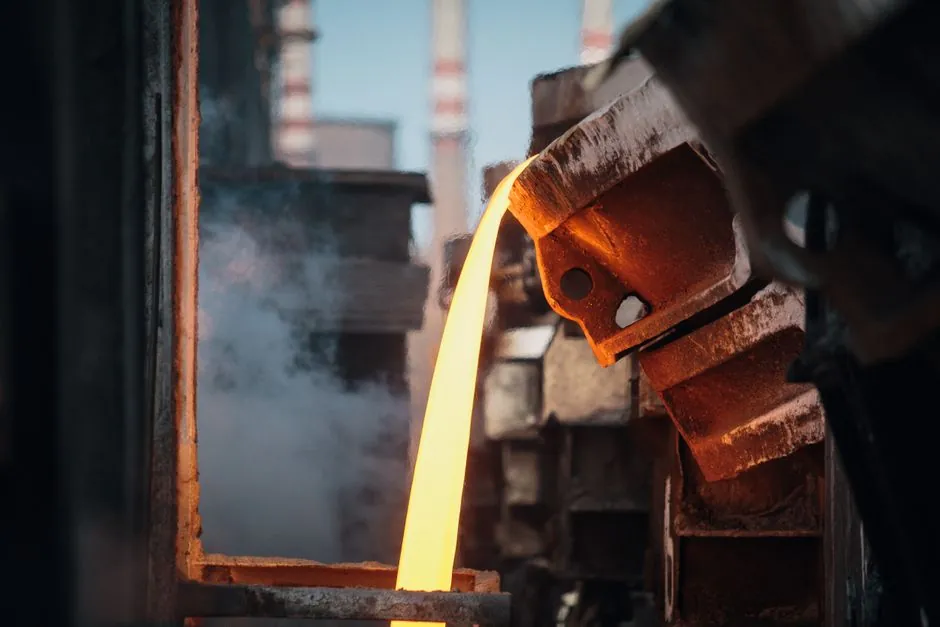
Laser cut-edge hardening on alloy steel sheet is governed by martensite formation inside a narrow heat-affected zone (HAZ), typically 0.05–0.30 mm deep on thin gauge, when carbon content is high enough and the cut cools through the austenite-to-martensite range [S4][S5]. Mild steel (AISI 1018/1020) lacks sufficient carbon to harden meaningfully, while AISI 1045, 4140, 4340, and tool-steel grades show measurable HRC jumps right at the kerf wall [S1][S2].
For sheet metal fabricators and sourcing engineers, the practical question is not "does laser cutting harden the edge" (it does, predictably) but how to specify cutting parameters, assist gas, and post-cut tempering so the HAZ stays inside the tolerance stack rather than cracking the part in service [S4][S5][S7].
What actually happens at the kerf wall: martensite, not "mystery hardening"
The cut-edge hardness bump is a phase transformation, not work hardening. The laser beam pushes a thin layer of steel above the austenitizing temperature (typically 723–900°C depending on carbon and alloy content), then the surrounding cold bulk substrate quenches it as the beam moves on; if carbon is available, that layer transforms to martensite, a hard and brittle BCT phase [S4]. On carbon steel this is exactly the same metallurgical mechanism used in induction or flame hardening, just uncontrolled in depth and temper [S4][S6].
Hardness typically rises from a base of ~85–95 HRB (mild steel) or ~20–25 HRC (pre-hardened alloy) to 50–62 HRC at the immediate cut wall on medium-carbon and alloy grades, then falls off within a fraction of a millimetre [S2][S4]. The brittleness that comes with that hardness (untempered martensite, possible hydrogen pickup from moisture in assist gas) is the real failure mode, not the hardness itself [S5].
Which alloy steels are affected and which are not
Material response is binary once you separate carbon potential from thermal mass. AISI 1008/1010/1018/1020 mild steel is widely reported to show no meaningful hardening from laser cutting, because the carbon level is too low to push the as-quenched structure into martensite [S1][S2]. By contrast, AISI 1045, 4140, 4340, 52100, D2, and A2 tool steels reliably develop a hard edge layer, and that layer will chip cutting tools if a subsequent milling pass is taken without depth adjustment [S2][S4].
Stainless steels (304, 316) sit in the middle: they form some martensite when austenitic, but the bigger problem is chromium carbide precipitation and sensitization along the HAZ, which knocks corrosion resistance down rather than hardness up [S4][S5]. Aluminum alloys generally do not harden at the cut edge because high thermal conductivity drains heat before the substrate can self-quench; titanium can form a hard brittle oxide skin if oxygen is used as assist gas [S4].
How deep the HAZ actually goes on sheet stock
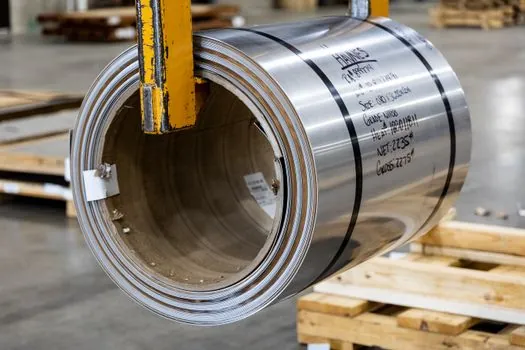
For 1–6 mm alloy steel sheet cut on a fiber laser, measured HAZ depth generally falls in the 0.05–0.30 mm range, with thinner gauge and faster cut speeds landing near the low end [S3][S4][S5]. Bursi et al. (2017) report that, compared with plasma and oxy-fuel, fiber laser cutting produces a smaller kerf and a tighter thermal footprint, which directly limits HAZ extent [S3]. The SendCutSend guidance aligns: faster cutting speed equals less time for heat to conduct sideways into the parent metal, so dwell time (seconds per millimetre of cut) is the variable to control, not raw laser power alone [S5].
For comparison, oxy-fuel routinely produces HAZ measured in millimetres, plasma in tenths of a millimetre, and waterjet in effectively zero thermal HAZ because no heat is applied [S5]. That ordering, oxy-fuel > plasma > laser > waterjet, is consistent across the published literature and is a useful starting point when a drawing specifies "no HAZ" on a part that is fundamentally a thermal-cut process.
Assist gas, speed, and parameter control: the actual levers
The two highest-leverage controls are assist gas chemistry and travel speed. Nitrogen assist on alloy and stainless steel avoids the exothermic oxidation reaction that oxygen assist creates, which both reduces total heat input and prevents oxide build-up along the kerf; SendCutSend and JLC CNC both recommend nitrogen as the default for any cut where downstream HAZ matters [S5][S7]. Higher travel speed shortens the time the cut edge sits above the transformation temperature, shrinking the HAZ [S4][S5].
For shops running fiber lasers, the practical parameter set looks like: 2–6 kW fiber source, nitrogen at 10–20 bar, focal position roughly on the sheet mid-thickness for thin gauge, and travel speed selected to keep dross and HAZ in spec rather than maximised for throughput. Note that laser power and speed are coupled: doubling power without re-tuning speed usually grows the HAZ rather than shrinking it [S4].
Comparison: cutting processes by HAZ, edge quality, and post-cut cost
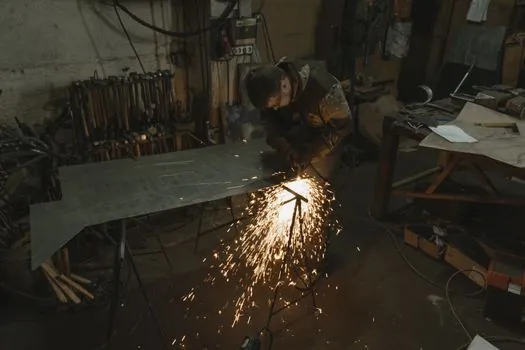
When a part is specified with "no martensitic edge" or "weld-ready edge," the choice of process is as important as the choice of parameters. The table below lines the four common sheet-steel cutting methods against three engineering criteria that show up on real drawings. [S4]
Waterjet: zero thermal HAZ, no martensite risk, but slower cut on thin gauge, slight taper on thick plate, and garnet embedment risk on stainless. Laser (fiber, N2 assist): minimal HAZ (0.05–0.30 mm), clean kerf, fast on 1–6 mm sheet, but martensite risk on medium/high-carbon alloy steel. Plasma: moderate HAZ (0.3–1.0 mm), faster than laser on >10 mm, but rougher edge and more dross. Oxy-fuel: largest HAZ (1.0–3.0 mm+), cheapest on thick plate, and unacceptable for any part with a tight hardness or flatness spec [S5].
For alloy steel sheet in the 1–6 mm range, fiber laser with nitrogen assist is the dominant process for buyers who need tight dimensional and metallurgical control at scale; waterjet is the fallback when HAZ must be zero and throughput can be relaxed [S5].
Post-cut processing: tempering, edge machining, and inspection
Untempered martensite at the cut edge is the most common cause of cracking during downstream bending, rolling, or welding. Two routes are standard: a low-temperature temper at 150–200°C for 1 hour to convert brittle martensite to tempered martensite while keeping most of the hardness, or a full sub-critical anneal at 550–650°C if downstream forming is severe [S4][S5]. Shops that laser-cut 4140 or 4340 and then send the part to a press brake without tempering frequently see edge cracks within 24 hours.
Where the hardened layer interferes with a subsequent machining op, two options apply. First, leave 0.20–0.50 mm on the cut face and face-mill the edge clean; the cost is a secondary operation but the result is a known, uniform hardness for the next pass. Second, adjust the second-op depth-of-cut upward to get below the HAZ, which is the cheaper route but only viable if the HAZ is shallower than the print tolerance [S2]. For QA, microhardness traverses (HV0.1) across the cut edge, or simple file-testing against a calibrated HRC sample, are the field-level checks; formal labs use Vickers or Knoop at 100–500 g load [S4].
When to accept the hardening, when to engineer around it
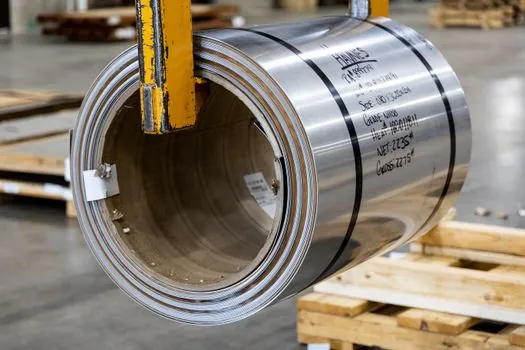
Accept the hard edge when the part is a wear surface, a cutting edge, or a bushing seat, where higher surface hardness is a feature, not a bug. The same martensitic layer that wrecks a bending die is exactly what a wear plate or a shear blade needs, and laser cut-edge hardening on those parts is effectively free heat treatment [S4][S6].
Engineer around it when the part will be welded, bent, deep-drawn, or fatigue-loaded. In those cases, specify N2 assist, raise travel speed, and add a post-cut temper; for highly critical parts, route to waterjet or add a post-cut milling pass. Drawing notes such as "no HAZ on bent edge" or "laser cut edges to be tempered 180°C / 1 hr" are the cleanest way to push this conversation upstream so it is settled at PO time, not at incoming inspection [S4][S5][S7].
Sourcing and standards notes
No single ISO or ASTM standard is dedicated to laser cut-edge HAZ on alloy steel sheet, so the relevant control is usually bolted on through the part drawing and the supplier's process qualification. Common practice is to reference ISO 9013 (thermal cutting classification) for cut quality and dimensional tolerance, and to require a parameter sheet (laser type, power, assist gas, speed) with the first-article submission, so the HAZ behaviour is reproducible batch-to-batch [S5][S7]. For carbon-control reasons, ask for the actual material cert (mill heat number with C, Mn, Cr, Mo values) rather than a generic "AISI 4140" callout, because the hardenability shift between 4140 and 4140H is enough to change the as-cut edge hardness band.
Trackable signals for the next 6 months: tighter nitrogen-assist process windows on 1–3 mm 4140/4340 sheet as aerospace Tier-2 suppliers standardise on laser-plus-temper sequences; more shops publishing HAZ depth data per ISO 9013 zone on first-article reports; and rising use of in-line hardness mapping (eddy-current or microhardness traverse) on cut edges for fatigue-critical parts. For adjacent reading on process selection and measurement on the shop floor, see the write-up on ISO 16331-1 for laser distance meters and the decade resistance box long-term stability note for related QA instrumentation context; background on the HAZ-vs-process trade-off is also covered in our laser level and laser screed reference pages, which cover thermal-load trade-offs in adjacent laser-based processes.
Spec-level background on the components involved: laser marker.