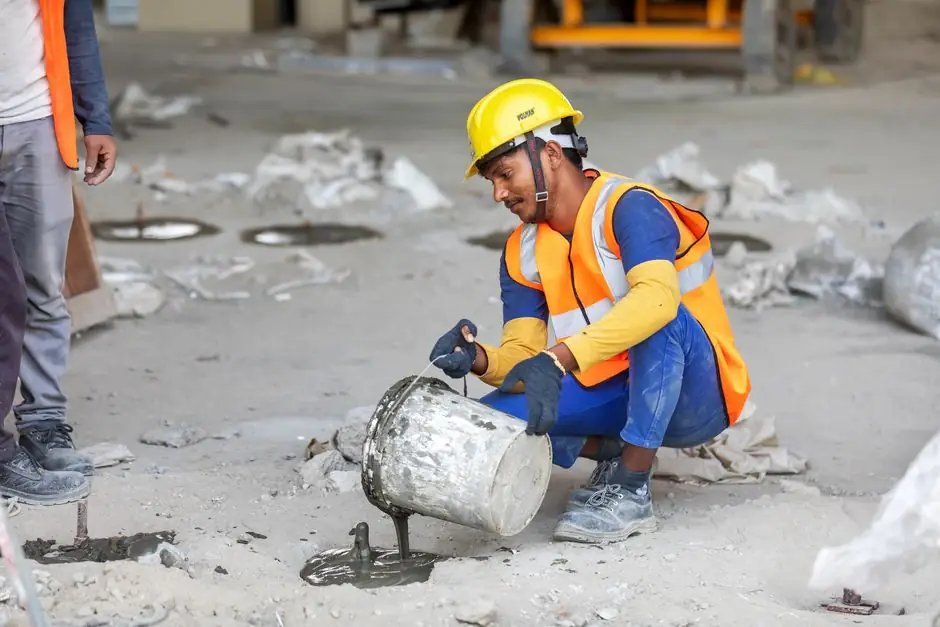
A laser screed is a self-leveling, laser-guided machine that strikes off fresh concrete to a controlled elevation, hitting F-number floor tolerances (FF for flatness, FL for levelness) that hand screeding cannot match on large slabs [S1].
Walk-behind units in the YGJX31-34 line run 0-36 to 0-65 m/min with a 2,500 mm screed head, 500 N exciting force at 50 Hz, and 295-410 kg operating weight, covering 2,000-5,000 m² per day at roughly 3-5x manual output [S3].
What a Laser Screed Actually Does on the Slab
Laser screeding uses a rotating laser transmitter, a receiver on the machine head, and a hydraulic or electric actuator to maintain the screed plane within ±2-3 mm of design elevation across the pour [S3]. Liaison Concrete crews in Northern California routinely deliver FF35/FL25 and can push to super-flat FF50+ when mix design, placement rate, and post-pour laser scanning are controlled [S1].
The head both strikes off and consolidates: vibration at 50 Hz with 500 N exciting force settles aggregate, releases trapped air, and pushes concrete into low spots, which is why a laser screed replaces a separate vibrating screed pass on most industrial pours [S3][S4]. For typical workflows, the laser screed sits between concrete placement and power troweling, with power trowel diameter and blade count chosen afterward to close the surface.
Walk-Behind vs Ride-On vs Handheld Vibrating Screed
Walk-behind laser screeds (YGJX31-34 class) are single-operator machines on a 295-410 kg chassis, with stepless hydraulic or handgrip drive, microcomputer laser scan, and a 2,500 mm self-leveling head [S3]. Suggested working speed is 5 m/min, with top travel speeds of 36-65 m/min for repositioning between bays [S3].
Ride-on laser screeds (Somero, Ligchine, Copperhead, and equivalent) carry the operator on the machine, extend boom reach to 6-7 m, and target 2,000-5,000 m²/day on large warehouse pours where slab panels exceed the practical walking distance for a walk-behind [S3]. They are the default for AGV floors, high-bay racking, and e-commerce fulfillment slabs, all of which appear on Liaison's project list as FF/FL-critical applications [S1].
Handheld vibrating screeds like the Magic Screed are a different category: a single-operator strike-off tool with extruded aluminum blades from 4 to 16 ft, a Honda GX35 gas engine or CAS Li-HD battery option, 7,500 RPM vibration, and 6 in (15 cm) consolidation depth [S5]. Magic Screed markets 4x the area coverage of conventional hand methods, 20,000 ft² in 7 hours vs 5,000 ft² in 10 hours [S5]. This is a finishing-pass tool, not a laser-guided elevation control, so it does not deliver F-numbers on its own and pairs with a laser level for height reference.
FF/FL Specs, Pour Size, and Application Fit
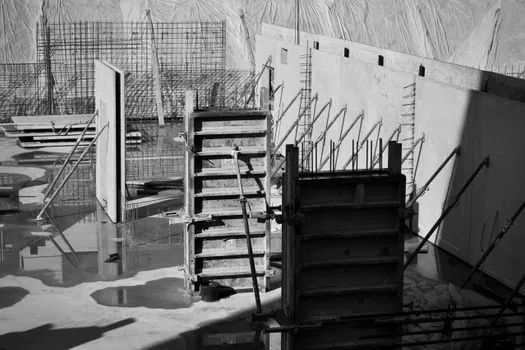
FF/FL numbers follow ACI 117, with FF35/FL25 the typical warehouse floor and FF50+/FL50+ required for AGV paths, narrow-aisse racking, and automated material handling [S1]. A floor that misses FF/FL causes forklift instability, rack misalignment, and vibration that shortens equipment life, and remediation by grinding is expensive and disruptive after the slab cures [S1].
Typical fit matrix: ride-on laser screed for slabs over 1,500 m², walk-behind for 300-1,500 m² pours, vibrating handheld screed for patches, driveways, and small commercial floors under ~500 m², and truss screeds on rails for long narrow strips where boom reach is overkill [S3][S4]. Liaison's typical project list, warehouses, distribution centers, cold storage, manufacturing, AGV facilities, and slabs-on-grade, maps to ride-on or large walk-behind machines with on-site F-number verification by dipstick profiler [S1].
Power, Engine, and Drive Configuration
Walk-behind laser screeds in current production run on either a Honda GX390 generator set at 13 hp / 3,600 rpm or an electric-drive 2.0 kW motor, with fuel tanks of 6.5-14.5 L and stepless hydraulic running devices for forward/reverse control [S3]. Suggested working speed stays at 5 m/min across all four YG models; the wider speed range (0-65 m/min on YGJX33) only matters for fast travel between pour sections, not for strike-off quality [S3].
Indoor and CO₂-restricted sites are pushing battery and electric options. Magic Screed's e-Screed uses a Cordless Alliance System (CAS) Li-HD battery pack with the same blade platform as the gas Honda GX35 unit, marketed for indoor slabs, occupied buildings, and sites with emission limits [S5]. The trade-off is runtime per charge vs unlimited gas runtime, which matters on pours above roughly 1,000 m² where a battery swap mid-shift kills productivity.
Mix Design, Subgrade, and What the Machine Cannot Fix

A laser screed controls the elevation plane; it does not fix a bad subgrade, a wrong slump, or a delayed delivery. Liaison crews in Northern California time placements against coastal-cool vs Central Valley-hot conditions, select mix designs for the pour window, and apply evaporation retarders to keep the surface workable until the head passes [S1].
Subgrade must be uniformly compacted before the truck arrives, since the screed head rides a fixed laser plane and will mirror any subgrade heave as a corresponding high spot in the slab [S1][S4]. Concrete slump, aggregate size, and bleed rate also constrain what flatness the head can hold, and the vibrating screed process (spread, vibrate, strike off, check, finish) assumes the placer has the concrete roughly distributed before the head arrives [S4]. On super-flat work, FF50+ is described by contractors as achievable but conditional on mix, placement rate, and post-pour laser grinding [S1].
Two-Wheel vs Four-Wheel Walk-Behind Frames
Two-wheel walk-behind laser screeds are a lighter sub-category aimed at smaller slabs, residential garages, and interior floors where a 365-410 kg four-wheel machine is too heavy or too wide to maneuver [S3][S6]. They typically use a single axle with the screed head out front, handgrip steering, and a simplified laser receiver mount, trading some production rate for portability through standard door openings and around formwork [S6].
For pours above ~800 m², four-wheel hydraulic walk-behinds and ride-on units outproduce two-wheelers because the wider stance resists head deflection under vibration, and the operator can hold a straighter travel line at 5 m/min working speed [S3]. The selection rule is straightforward: two-wheel for access-limited or sub-500 m² work, four-wheel walk-behind for 500-1,500 m² interior slabs, ride-on for anything larger or where FF/FL above FF35/FL25 is specified.
Selection Checklist and What to Verify Before Bid

Before specifying a laser screed, lock down: required FF/FL (FF35/FL25 vs FF50+), single-pour area, joint layout, mix design and slump, subgrade condition, indoor vs outdoor (emission/CO₂ limits), power source availability, and F-number verification method (dipstick profiler or laser scanning) [S1][S3][S4]. Pour sequence, plant output, and crew size together set the maximum single-pour area; the machine has to finish each bay before the concrete's working window closes [S1].
Two trackable signals for late-2026 procurement: World of Concrete 2027 (Las Vegas, January 19-21, 2027) where Magic Screed exhibits in booth C-3255, and the continued rollout of battery-powered screed platforms (CAS Li-HD and equivalents) for indoor and emission-controlled slabs [S5]. Buyers comparing ride-on brands should request on-site pour references at the same FF/FL tier they are specifying, since published machine capability and field-delivered F-numbers differ when mix and crew are not controlled [S1].
The underlying component specifications are covered under aerial work platform.