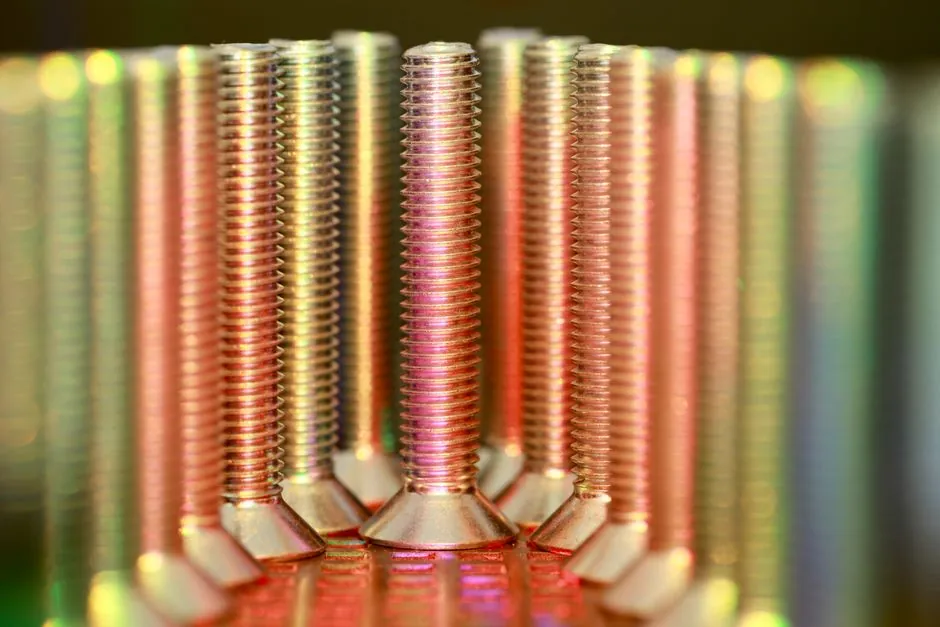
Cement plants specify lead screws at 16–63 mm nominal diameter with 5–20 mm lead, 5–50 kN dynamic and 10–100 kN static load ratings, ISO 3408 travel grades C3–C7, and backlash under 0.05 mm [S4]. Operating envelope runs -20 to 80 °C with grease as default lubricant and GCr15 high-carbon chromium bearing steel to GB/T 18254 as the reference shaft material [S4].
Cement applications differ from clean motion-control duties because airborne clinker dust, ambient temperatures near preheater towers, vibration from crushers, and intermittent shock loads (gate dampers, kiln hoods, cooler discharge) all attack a plain sliding-thread pair faster than a rolling-element pair. The reference parameters above are the baseline; selection is about which of those numbers you tighten, and which components you add around the screw to keep it inside the envelope.
Why a Plain Lead Screw, Not a Ball Screw, in Most Cement Positions
Ball screws achieve 90%+ mechanical efficiency because recirculating balls roll between nut and shaft, while sliding lead screws typically sit at 20–40% efficiency, a tradeoff that is acceptable in cement damper and gate actuators where self-locking under load is the priority [S4]. Ball screws also need positive sealing against contamination: a single grain of clinker dust ingested into the ball track accelerates brinelling and causes fatigue spalling long before the calculated L10 life is reached. For dust-exposed positions, an ACME or stub-ACME lead screw with a polymer nut, dry-film lubrication, and an IP65 bellows is the more robust answer.
Use a ball screw only when the duty is dust-segregated (enclosed damper cabinet, positive-pressure room) and the stroke is short (under ~500 mm), so critical speed and column buckling are non-issues. lead screw variants are preferred wherever self-locking, low noise, low maintenance, and washdown tolerance are required, while ball screw variants win on efficiency and positioning accuracy when contamination is controlled [S3].
Spec Gates That Drive Selection in a Cement Plant
Static load rating, not dynamic, is the binding gate for vertical lift and damper hold duties: 10–100 kN per ISO 3408 covers the bulk of damper, divider, and cooler-thrust positions, with the higher end reserved for kiln hood actuators [S4]. Dynamic load rating of 5–50 kN is the basis for L10 fatigue life and should be checked against the expected cycle count per shift; one shift at 10 cycles/min for five years lands in the 100-million-cycle range, where ISO 3408 fatigue curves are the right reference.
Lead choice trades linear speed against drive torque and self-locking. Small/medium-pitch products are commonly 5 mm and 10 mm, while large-pitch products run 16, 20, 25, 32, and 40 mm; higher lead gives faster linear travel per revolution but reduces the back-driving margin [S2]. For gate actuators that must hold position under material head without a brake, 5–10 mm lead is the safe band; for fast traverse on packaging or palletising auxiliaries in the cement bagging hall, 20–40 mm is appropriate. Travel accuracy grade C3 suits high-precision kiln-alignment jigs, C5–C7 is the cement-plant general-purpose band, and anything tighter than C3 is rarely justified outside metrology [S4].
Materials, Lubrication, and Sealing for a Dusty, Warm Plant
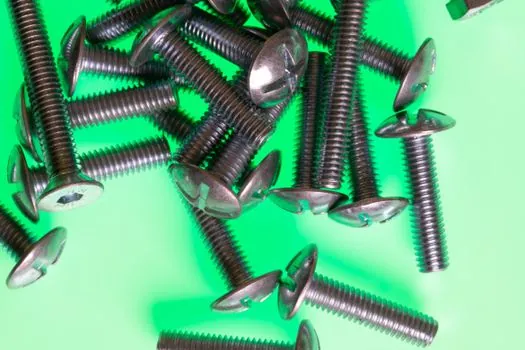
Standard shaft material is GCr15 high-carbon chromium bearing steel to GB/T 18254, with stainless steel as the alternate for corrosive or high-humidity positions such as cement mill water spray zones [S4]. Grease is the default lubricant because it stays put on a vertical shaft; oil-mist is reserved for high-speed continuous-duty actuators where a centralised lube system already exists. Once ambient exceeds ~70 °C, standard greases thin out and relubrication intervals halve; specify high-temperature synthetic grease (e.g. PAO base, dropping point above 250 °C) and shorten the relube cycle to 1,000 hours or quarterly, whichever is shorter.
Sealing is the single biggest maintenance lever. Bellows (rubber or fabric) protect the screw from direct dust and water ingress, with IP65 the practical minimum for outdoor cement-plant service and IP66 for positions exposed to water spray from mill cooling or wash-down. Anti-backlash nut designs use a Constant Force split-nut geometry that holds the flanks in contact under reversing load, which is the right answer for oscillating dampers even though it raises breakaway torque.
Thread Forms, Standards, and NEMA-Size Mapping
ACME and stub-ACME threads dominate because they are cut or rolled easily in GCr15 and accept a polymer or bronze nut; metric trapezoidal threads per DIN 103 are the European standard for the same duty. Ball screws follow ISO 3408 for dimensional and load-rating definitions, with precision grade codes C0 through C10; C10 corresponds to ±0.20/300 mm cumulative lead error and C3 is roughly ±0.012 mm over the same length [S4][S7].
When the actuator is a NEMA-frame stepper or servo, frame size dictates screw diameter: NEMA 8 takes 3/16 in, 1/4 in, or 6 mm screws; NEMA 11 takes the same plus 6 mm; NEMA 14 extends to 10 mm; larger NEMA 23/34 frames support up to 16 mm or 5/8 in screws, which is the cross-over point to the 16–63 mm ISO 3408 band [S3]. Misalignment at the coupling is the most common cause of premature screw failure, so a flexible coupling or a direct-mount bearing block with a compliance spec is part of the screw selection, not an accessory.
Selection Comparison: Lead Screw vs Ball Screw for Cement Service
Across four decision criteria the choice falls out clearly. On efficiency, a ball screw delivers 90%+ versus 20–40% for a sliding lead screw. On self-locking under load, a sliding lead screw holds position without a brake, while a ball screw back-drives unless a fail-safe brake is added. On dust tolerance, the lead screw is robust with IP65 bellows and dry-film lube; the ball screw is sensitive and needs a positive-pressure enclosure. [S4]
For cement applications, the rule of thumb: sliding lead screw for dampers, gates, valves, and vertical hold; ball screw only for enclosed, dust-free, high-cycle positioning. Comparable envelope data is catalogued for screw conveyor drives and special cement handling, but those are rotating-flight components and do not interchange with a linear lead-screw actuator.
Failure Modes, Inspection Signals, and Sourcing Discipline
Backlash growth above the 0.05 mm gate, audible clicking on reversal, and visible scoring on the screw flanks are the three early warning signs of nut wear [S4]. Exceeding the static load rating causes permanent deformation (brinelling on the nut crest or screw root); exceeding the 3,000–6,000 rpm maximum rotational speed risks whip and bearing failure; and sustained operation above 80 °C degrades grease and accelerates fatigue. Any of these is a replacement trigger, not a relube trigger.
For sourcing, ISO 3408 and GB/T 18254 are the two standards that actually govern the part; treat any vendor datasheet that omits the ISO 3408 accuracy grade or the GB/T 18254 material callout as a red flag and request the mill certificate before issuing a PO. Confirm dimensions against the specific model, not the brochure, and qualify two suppliers per critical position to avoid single-source exposure on a kiln-shutdown-critical actuator.
Cross-referencing similar spec-driven applications helps when the line is new: linear actuator selection for material handling maps the same load/stroke/IP decision tree for conveyors, and linear actuator selection for pulp and paper covers a similar dusty, warm envelope for paper mill service.