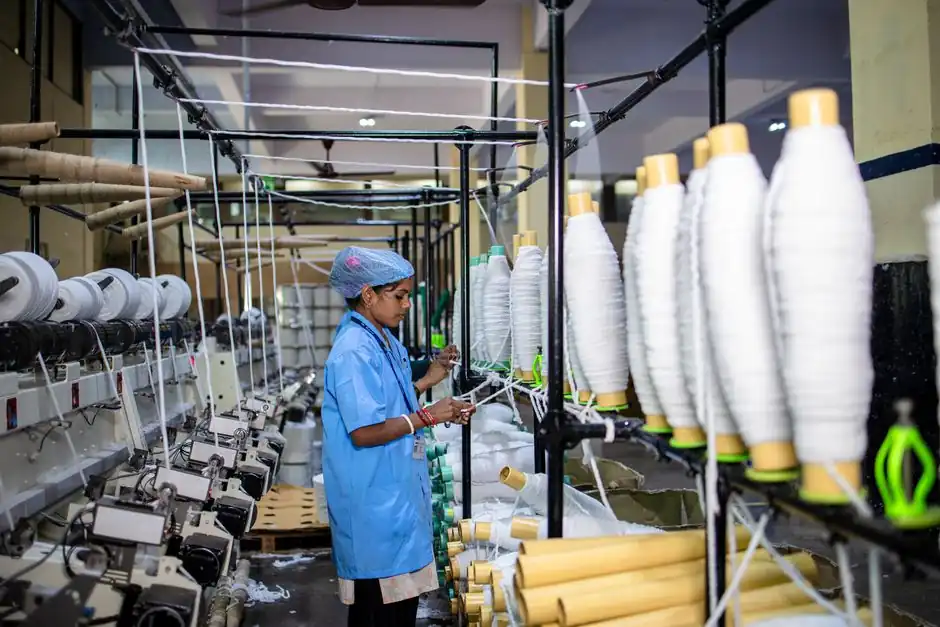
Textile mill linear motion applications most often fall in the 1,000 N to 6,000 N force window, matching the standard 12 V DC and 24 V DC industrial actuator classes that cover roughly 225 lb to 1,300 lb of thrust at full load [S3][S4].
Mill environments combine airborne lint, humidity, and occasional water splash from wash-down or steam, so an IP65 or higher rating on the actuator housing is a practical baseline rather than an upgrade [S5]. A complete actuator assembly for an OEM machine typically includes the housing, drive motor, rotary-to-linear mechanism, a linear guide for the moving carriage, and limit or position feedback [S8].
Force and Load Calculation for Loom and Tenter Duties
Force selection starts with the static plus dynamic load multiplied by a safety factor of 1.5 to 2.0, the range most OEM guidance converges on for industrial electric linear actuators [S2][S5]. A 500 kg roll lift converts to 4,905 N at 1 g, then 7,358 N with a 1.5 safety factor, so a 8,000 N rated actuator is the minimum sensible pick for that duty [S2]. Stepper-driven variants add a further 20% to 30% axial thrust margin to avoid heat soak at continuous duty [S10]. On a loom or knitting machine the required force is rarely the bottleneck; the typical cam, selector, and yarn-tensioner actuators sit in the 1,000 N to 3,000 N band, while tenter frame rail clamping and let-off roll positioning push the requirement into the 4,000 N to 6,000 N range [S3][S4].
Stroke Length, Speed, and the Speed-Force Trade-off
Industrial linear actuators are commonly offered with strokes from 10 mm to 2,000 mm, with mid-range values such as 50 mm, 100 mm, 300 mm, 770 mm, 1,250 mm, and 1,850 mm available as custom options inside that envelope [S4]. A 50 mm stroke unit, for example, can be re-limited in the field to any shorter working length, such as 20 mm to 40 mm, by sliding the external magnetic switches along the tube [S4]. No-load speed for the same actuator family is offered in discrete bands of 3.5, 5, 7, 9, 14, 18, 28, and 38 mm/s, with the slowest 3.5 mm/s point delivering the full 6,000 N / 600 kg / 1,300 lb rating [S4]. Mill planners should expect an inverse relationship between speed and force: any doubling of speed from a screw-driven unit roughly halves available thrust at the rod [S2][S4]. For high-cycle tenter or stenter rail indexing, belt-driven actuators are usually faster but lower in thrust than screw-driven units of the same frame size [S5][S8].
Voltage, Control, and Feedback Architecture
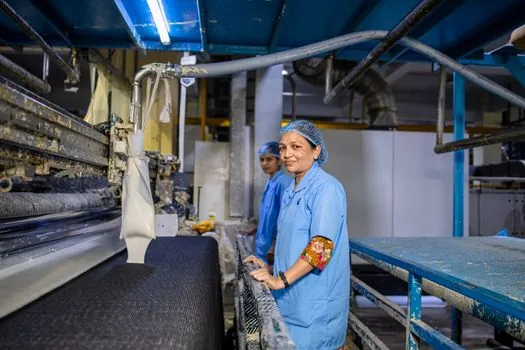
12 V DC actuators remain common in B2B and OEM builds because 12 V DC is a stock rail in many control panels and battery-backed systems, polarity reversal gives simple extend/retract control, and the architecture drops into microcontrollers via standard motor drivers [S3]. 24 V DC is the more frequently specified rail on industrial equipment, including 24 V variants of the 6,000 N class actuators used in mill retrofit projects [S4]. Two-position applications only need built-in limit switches and a DPDT switch or relay; PLC- or motion-controlled loops add home sensors and either potentiometer, Hall-effect, or encoder feedback on the carriage or rod [S5][S8]. Forced commutation via a brushless DC motor, or open-loop stepper control, is the right call where the actuator must hold position without continuous current, an important point for energy cost on 24/7 mills [S8][S10].
Comparison of Common Drive Types for Mill Service
Screw-driven (lead, ball, roller) actuators, belt-driven actuators, and linear-motor-driven stages cover most of what a textile OEM will compare. Against four practical criteria, the picture is: (1) Maximum thrust, screw-driven wins at 6,000 N and above in the same frame, belt-driven trails; (2) Maximum speed and stroke length, belt-driven typically offers the longest travel and highest mm/s, screw-driven is the slowest; (3) Positioning accuracy and repeatability, ball-screw and roller-screw units are the benchmark, lead screws sit a step behind, belt-driven is the weakest; (4) Maintenance exposure to lint, enclosed screw units with IP65 seals are easier to keep clean than open belt-and-pulley designs [S4][S5][S8][S10]. Mills with heavy lint load and limited cleaning windows therefore tend to drift toward enclosed ball-screw or lead-screw 24 V DC actuators on a linear motion rail, not toward belt stages.
IP Rating, Duty Cycle, and Environment
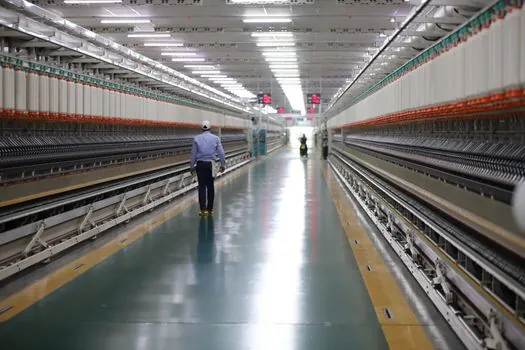
Lint ingress, humidity around dye-house and finishing areas, and intermittent water spray mean the housing seal is as critical as the thrust number. IP65 is the practical minimum for most loom and knitting-floor locations, and IP66 or IP67 becomes worth the cost premium in wet-finish zones [S5]. Built-in limit switches and a maintenance-free design, both standard on the 6,000 N / 50 mm industrial class, remove two of the most common service items on a mill floor [S4]. Duty cycle should be checked against the mill's shift pattern: continuous-duty machinery such as carding and spinning lines wants a rating that supports the full shift without thermal cut-out, and stepper-driven actuators in particular need the 20% to 30% thrust margin to stay cool [S10]. Where the actuator drives a moving carriage rather than an extending rod, the linear bearing choice and its lubrication interval become the real long-term cost driver, not the actuator itself.
Limits, Failure Modes, and Sourcing Signals
Common failure causes reported across industrial selection guides are undersized force, side-load on the extending rod, inadequate sealing, and over-driven duty cycle [S5][S6]. The most expensive mistake on a mill retrofit is matching actuator thrust to the moving load without including friction and binding in the calculation, then derating the safety factor below 1.5. Two trackable signals to watch over the next buying cycle are brushless DC 24 V modules offered with IP67 as standard, and a wider set of 770 mm to 1,850 mm custom-stroke 6,000 N actuators from Chinese OEM lines, both already visible in 2026 supplier catalogues [S4]. For packaging-adjacent mill lines, a useful parallel spec walk-through is the linear actuator selection map for packaging lines, which applies the same force / stroke / IP logic to cartoning and case-packing cells.