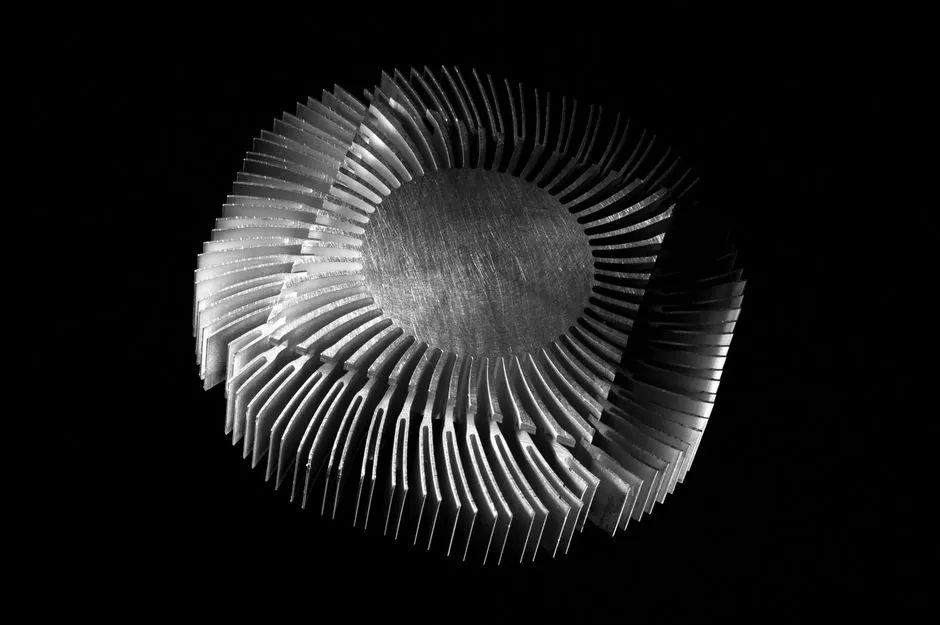
Low pressure die casting uses regulated low air pressure (0.20-1.00 bar) to drive molten metal from a sealed furnace through a riser tube into a horizontal-split die, with pressure held through solidification to feed shrinkage [S7].
The hardware manufacturing segment spans alloy automotive wheels, motor housings, wind-turbine hubs, and structural brackets, where LPDC competes with high-pressure die casting and gravity die casting; choice depends on part size, alloy, and required metallurgical integrity rather than cycle time.
Process Envelope: Pressure, Temperature, and Alloy Windows
LPDC operates in a narrow 0.20-1.00 bar pressure window, an order of magnitude below high-pressure cold-chamber systems, which is why fill velocity stays low and gas entrainment drops [S7]. The technique is paired almost exclusively with aluminum die casting alloys and magnesium, where controlled laminar fill preserves mechanical properties.
For aluminum hardware, He Xin's operating spec sets metal fluid temperature at 995-1010°C, idle furnace hold at 950°C, and die preheat at 110-120°C during production [S1]. Graphite cooling water is held at 30-60°C, with the water level kept 10-15 mm above the immersed back face of the mold [S1]. These four windows (metal, die, graphite, furnace) must hold simultaneously, and a 10°C thermocouple drift between two probes is the documented abort threshold during startup [S1].
Alloy Chemistry Limits for Hardware-Grade Castings
Hardware-grade aluminum LPDC requires tight control of Fe and Sn, each capped below 0.21% (0.21 TP3T) to avoid hard spots and die soldering, while a minimum 0.61% Al purity floor applies to the bath to keep inclusions low [S1]. When copper ingot is added without prior grain treatment, boron is introduced to refine structure, reduce shrinkage porosity, and lower crack risk [S1].
The 0.21% Fe+Sn ceiling is a recurring spec point because iron in particular forms intermetallic phases that act as crack initiators in cyclically loaded hardware such as wheel spokes and suspension knuckles. Foundries running automotive structural parts typically pair this chemistry window with a ceramic die coating sprayed onto cast iron or steel dies, which lets the horizontally split upper die retain the casting while ejectors fire on opening [S8]. For magnesium die casting machine cells, the same low-pressure envelope applies, but melt temperature drops roughly 200°C and shielding gas coverage replaces the air-atmosphere concerns that drive the Fe+Sn cap.
Machine Configuration: Automatic vs Manual, Horizontal vs Vertical
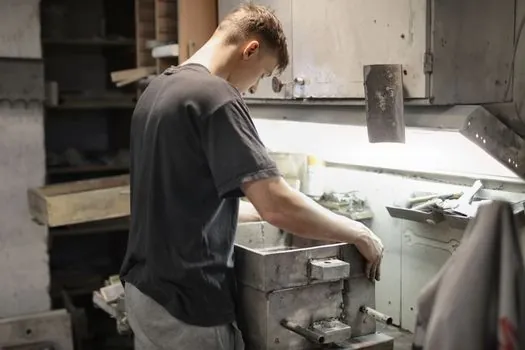
Among LPDC machine types shipped globally, automatic cells account for 56.1% of demand and horizontal configurations hold 62.3%, per Fact.MR's 2025-2035 forecast, with the automotive end-use at 52.6% [S3]. The horizontal bias reflects die layout for wheels and large structural nodes, where a vertical stack would complicate riser-tube routing and ejector placement.
For hardware foundries choosing between an automatic and a manual LPDC, the decision rule is throughput and repeatability: automatic cells are preferred when lot sizes exceed roughly 5,000 castings per SKU, because the closed-loop pressure, graphite dosing, and lift-tube preheat cycles then pay back the higher capex. Manual cells remain common in job shops producing <500 castings per run, where flexibility outweighs cycle time. Across both, the vacuum die casting machine variant extends the same low-pressure envelope by evacuating the die cavity before fill, trading additional cycle seconds for porosity levels below 1% in structural nodes.
Selection Criteria: Tonnage, Platen, and Plumbed Services
Platen size and shot weight, not clamping tonnage, are the binding constraints on LPDC cells, because pressure is supplied by the furnace gas, not the machine's hydraulic clamp. Typical platen windows start near 600x600 mm for small brackets and scale past 1,200x1,200 mm for automotive wheels, with shot weight commonly 8-30 kg of aluminum per cycle [S2].
Plumbed services are the second-tier gate: cooling water (treated, 30-60°C), compressed air at 6-8 bar for the pressurization circuit, natural gas or electric heating rings for the furnace and riser tube, and hydraulic power at 160-210 bar for die close and ejection. Buyers should verify that the riser tube material is rated for the chosen alloy's melt temperature (steel tubes for aluminum, low-carbon steel with ceramic liner for magnesium), and that the die-coat spray booth and dust extraction are integrated into the cell footprint. The low-pressure die casting machine reference page covers the same envelope in a process-engineering context.
Comparison: LPDC vs HPDC vs Gravity for Hardware Parts

Three die-casting routes compete for hardware parts; the table below lines them up against four decision criteria most buyers actually use. [S2]
On cycle time, HPDC leads at 60-180 s, gravity die casting trails at 300-900 s, and LPDC sits in the 180-360 s band, which is the price paid for riser-tube fill and pressure-maintained solidification. On porosity in 6-12 mm wall sections, LPDC and gravity both reach below 1% void content under steady-state operation, while HPDC typically lands at 1-3% unless vacuum-assist is added. On tool life, cast-iron gravity dies exceed 100,000 shots, LPDC steel dies with ceramic coating track 60,000-100,000, and HPDC H13 tool steel dies run 150,000+ when properly heat-treated. On alloy flexibility, all three handle aluminum; LPDC and vacuum die casting machine cells are the only realistic routes for magnesium hardware above 5 kg shot weight.
Application Fit and Limitations for Hardware
LPDC is the dominant route for aluminum automotive wheels, engine blocks, motor housings, and large structural nodes, and is also used for wind-turbine hubs and power-generation castings where low porosity drives fatigue life [S4]. The 2025-2035 market forecast pegs the global LPDC machine market at USD 2.25 billion in 2025, expanding to USD 4.03 billion by 2035 at a 6.0% CAGR, with Asia Pacific, North America, and Europe named as the three growth regions [S3].
Limitations are concrete: cycle time is roughly 2-4x slower than HPDC, so LPDC loses on per-part cost when wall sections drop below 3 mm or when lot sizes fall under a few thousand parts. Riser-tube maintenance, with the documented 30-minute cleaning cadence and steel-brush internal sweep, becomes the dominant downtime line in older cells [S1]. Buyers comparing LPDC with squeeze casting machine picks for telecom enclosures will notice that squeeze casting trades the LPDC riser tube for direct punch injection, gaining strength but losing the gentle laminar fill that LPDC uses for very large thin-wall automotive nodes.
Maintenance Cadence and Operator-Side Specs
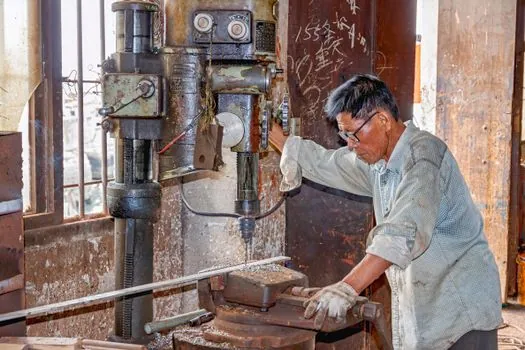
Day-to-day LPDC operation is governed by fixed intervals, not condition-based triggers, so spec sheets should fix these into the SOP. The lift tube is visually inspected for cracks at every shift, cleaned every 30 minutes during production, and preheated to an orange heat before molten metal is admitted [S1].
The die is sand-blasted every ~30 cycles, with the interval shortened when visible dirt accumulates, and graphite concentration is checked by centrifuge rather than by visual estimate [S1]. The mold-cavity inner faces and sprue are swept with a steel brush on demand, while castings are inspected for defects continuously, not at end-of-shift, because the riser-tube fill mode fails fast when the tube or the metal chemistry drifts. Operators are required to wear coveralls, safety shoes, gloves, and safety glasses during startup and production, which is the documented PPE floor in the operating specification [S1].
Trackable signals for buyers evaluating a 2026 LPDC cell quote: confirm the thermocouple pair holds within 10°C at idle (950°C setpoint), confirm the riser tube ships pre-coated and pre-dried, and confirm the die-coat spray system is on the same skid as the machine, not a shared central booth that becomes a bottleneck at three-shift operation. Foundries scaling LPDC for hardware should also pre-qualify a second riser-tube supplier, since tube lead time is a recurring constraint that gates new alloy changeovers.