
Standard manual pallet jack forks span 36 to 48 in (914 to 1219 mm) in length, with a 27 in overall fork spread and a lowered fork height of about 3 to 3.5 in for normal GMA 48x40 in pallet duty [S1][S2].
Low-profile manual variants cut that lowered fork height down to roughly 1.5 to 2 in so the forks can slide into skids and bottom-board pallets that a standard jack cannot enter, trading a smaller wheel base and reduced pump stroke for that clearance [S6][S7]. The fork-length envelope does not change between the two; what changes is how close to the floor the fork heel sits when fully lowered.
Standard Fork Geometry for GMA 48x40 in Pallets
For a standard 48x40 in GMA pallet, the working geometry is 27 in wide across the forks, 48 in fork length, and a 3.25 in lowered fork height, with load capacity classes running 2200 to 5500 lb (about 1000 to 2500 kg) [S2][S5]. Fork length is the most commonly cited "size" because too short a fork will pry the rear bottom board off a GMA pallet, a failure mode that destroys CHEP-style pooled pallets and is a real cost item in any plant sharing a blue pallet pool [S5].
Most operations should follow the "shortest fork that fully supports the load" rule: 48 in forks for full 48x40 in GMA footprints, 42 in forks where the load is consistently shorter, and 36 in forks for tight staging lanes or half-pallet work [S4]. Metric equivalents land at 1150 mm and 1220 mm as the two dominant standard lengths, both sized to the 1200 mm pallet side of a Euro-style or GMA-spec block pallet [S3]. When the load regularly overhangs the pallet edge, longer forks (54 to 60 in) stabilize the projection, at the cost of a longer turning radius in narrow aisles [S4].
Low-Profile Fork Geometry and Clearance Window
Low-profile manual pallet jacks lower the minimum fork entry height to about 1.5 to 2 in, compared to the 3 to 3.5 in minimum on standard jacks, which is the entire reason this variant exists [S6][S7]. The trade is mechanical: a smaller-diameter load wheel and a shorter hydraulic lift, so the typical raised height caps out near 5.25 in versus 7 to 8 in on a standard manual jack, and load capacity usually tops out at the 4400 to 5500 lb class [S6].
Specify low-profile only when the receiving pallets or skids sit below 3 in bottom clearance, which is common with display pallets, injection-molded nestable pallets, and certain plastic pallet SKUs that run thin bottom decks. For the more common GMA 48x40 in wood pallet, a standard jack remains the correct pick; reaching for low-profile when clearance is not the limiter just gives up lift height for no benefit. If your facility runs an even mix of clearance levels, a common workaround is a fleet split: standard jacks for receiving and production, low-profile for shipping-dock work where the skids are ground-hugging [S7].
Fork Length, Fork Width, and Spacing: Three Numbers, Not One

Fork length is only one of three sizing parameters; the other two are individual fork width (typically 6 to 7 in) and the inner-to-inner fork spacing (about 15 in on a 27 in overall spread) [S1][S4]. All three must match the pallet opening, not just the pallet face, which is why Euro-pallet (1200x800 mm) handling requires the narrower inner spacing rather than the wider GMA setting [S5].
The practical matching rule is: forks should extend through the pallet far enough to support the loaded footprint, fork width should be no wider than the pallet stringer or block opening it enters, and the overall spread should clear the narrowest aisle turn you will route the load through [S4]. A 48 in fork on a 40 in deep pallet is correct; the same 48 in fork on a 36 in deep pallet is wasted length that hits racking before the load is set down. The same principle drives the choice between a manual pallet jack and a powered pallet stacker when fork reach, not just fork length, is the constraint.
Standard vs Low-Profile: Criteria Comparison
On the four criteria that drive a buy decision, standard and low-profile forks line up as follows, with all values taken from OEM spec sheets and distributor guides: [S2]
Lowered fork height: standard 3 to 3.5 in, low-profile 1.5 to 2 in. Raised fork height: standard 7 to 8 in, low-profile about 5.25 in. Fork length envelope: both 36 to 48 in (1150 to 1220 mm) standard, with 24 in short options on manual jacks for specialized half-pallet work [S2][S4][S6]. Load capacity: standard up to 5500 lb, low-profile typically 4400 to 5500 lb, so low-profile does not automatically mean lower capacity, only shorter lift [S2][S6].
For most GMA 48x40 in wood-pallet operations, standard forks remain the right pick. For ground-hugging skids, display pallets, or plastic pallet SKUs under 3 in bottom clearance, low-profile forks are the correct pick. If your operation also needs higher lift, scale integration, or electric drive, step up to a pallet stacker or electric pallet truck rather than over-spec'ing a manual jack with low-profile forks.
Use Cases, Misuse, and Sourcing Constraints
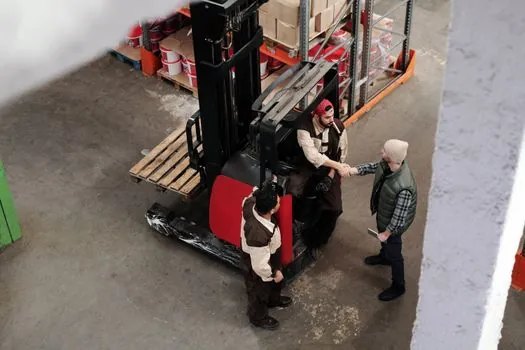
Standard-length forks (36 to 48 in) are the correct pick for any operation handling GMA 48x40 in wood pallets, Euro 1200x800 mm block pallets at the 1220 mm fork-length setting, or any half-pallet work where 36 in forks will fully support the load footprint [S3][S4]. Low-profile forks are the correct pick for display pallets at retail back rooms, ground-hugging machine skids in stamping cells, and any application where the receiving pallet has a sub-3 in bottom opening [S6][S7].
Common misuse includes running a 27 in-wide standard fork spread against a Euro 1200x800 mm pallet, which will not seat the forks inside the stringer or block openings and will bind on entry [S5]. It also includes specifying low-profile forks on a standard GMA workflow just to chase 1.5 in of extra clearance, which costs lift height and pump stroke for no operational gain [S7]. When the real constraint is reach into a deep rack or pallet stack, fork length alone will not solve it; the right answer is a pallet stacker or a pallet rack re-layout, not a longer manual jack fork. Related pump-side trade-offs that interact with fork length are covered in Quick-Lift vs Standard Pump on Manual Pallet Jacks, and if your workflow needs on-the-fly weighing, the fork-length impact is different again; see Pallet Jack Scale vs Standard Manual Pallet Jack: 2026 Spec Comparison for that decision.
Trackable signals to watch through 2026: OEM publish of sub-2 in lowered-height low-profile models with 5500 lb ratings, and wider distribution of 1220 mm metric-spec forks at North American GMA distributors as Euro pallet pooling expands. If either appears in a major distributor catalog before the next spec-sheet refresh, the standard-vs-low-profile split point in this article will shift.