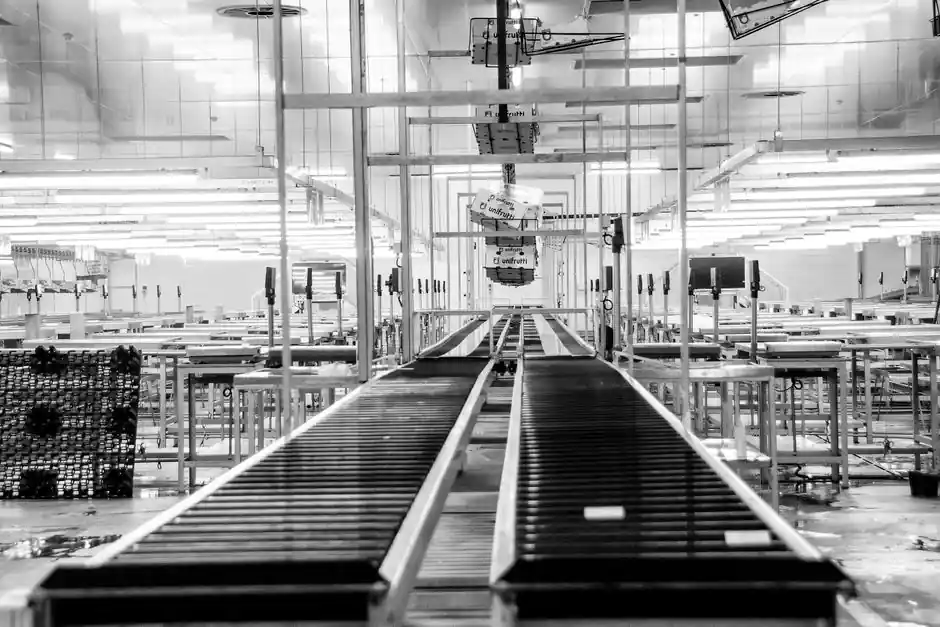
Hand-pushed overhead conveyors stay practical up to roughly 50 lbs per carrier for a single operator on flat, level enclosed track; once sustained loads cross 250 lbs per carrier or track linear ratings exceed 273-471 lbs/ft, the line crosses into the power-assist, motorized, or power and free overhead conveyor range [S3][S6].
The decision is not a single weight number but a bundle of three constraints: per-carrier payload, per-foot track rating at a given support spacing, and the drive-pull ceiling of the chain or trolley. The boundaries between hand-push, motorized, and power-and-free are defined by manufacturer ratings rather than a single OSHA or ISO threshold [S2][S3].
Where Hand-Push Stops Working: Per-Carrier Payload
Unibilt enclosed track hand-push systems are commonly rated to 250 lbs (115 kg) per individual load, which is the practical ceiling for a single operator moving a carrier through curves and switches without mechanical help [S3]. Below that number, a friction-fit trolley on a 3 in, 4 in, or 6 in high-carbon I-beam can still be moved by one person if the track is level and the curves are generous.
Once individual carrier loads climb past 250 lbs, manufacturers recommend either a motorized loop or, where accumulation and routing flexibility are needed, a power and free overhead conveyor with separate load and drive tracks. On Pacline's S-310 system the per-carrier capacity is 400 lbs on the power track and 800 lbs on the free track; on the S-320 it steps to 800 lbs and 1,600 lbs respectively, which is well outside any manual operating window [S2].
Track Linear Rating: lbs per Foot, Not Just lbs per Load
The more binding limit is usually linear, not per-load. Unibilt enclosed track is rated at 471 lbs/ft when supported on 5 ft centers, and drops to 273 lbs/ft when the support span is widened to 10 ft centers [S3]. That 471 lbs/ft figure, multiplied over a 10 ft carrier, gives 4,710 lbs of total suspended load on the loop before track deflection and chain wear become a problem.
I-beam hand-push systems impose a different ceiling. The I-beam track generally limits the trolley loading capacity, and design guides flag that hand-push I-beam with multiple trolleys is workable only when the lift load stays near the 225 lbs reference used in the planning worksheet, not the 1,200 lbs selection column reserved for motorized carriers [S6]. The point at which manual effort stops scaling linearly is therefore a function of trolley count, beam size, and curve radius, not just weight.
Drive-Pull and Chain Breaking Load: The Hidden Ceiling
Even with no operator on the track, the chain and drive impose hard limits. The Pacline S-310 chain breaking load is 5,000 lbs with a maximum drive pull of 600 lbs and a maximum chain length of 1,000 ft per drive at 2.5% friction coefficient; the S-320 steps that to 15,000 lbs breaking load, 2,000 lbs drive pull, and the same 1,000 ft per drive [S2]. Hand-push obviously cannot generate 600-2,000 lbs of horizontal pull through a single drive station.
Maximum drive speed also signals the operating regime: 60 FPM for S-310 and 33 FPM for S-320, with variable-speed controllers letting the line run as slow as 1 FPM for accumulation zones [S2][S4]. Curves reinforce the boundary, with minimum horizontal radii of 24 in (S-310) and 40 in (S-320) and vertical curve radii of 24 in and 48 in respectively [S2]. A manual operator pushing 250 lbs through a 24 in horizontal curve is the upper limit of what a hand-push layout can sustain over a shift.
Decision Matrix: Hand-Push vs Motorized vs Power and Free
Three criteria separate the options cleanly. Per-carrier payload: hand-push under 50 lbs sustained (250 lbs absolute upper bound), motorized monorail 400-800 lbs, power-and-free up to 1,600 lbs per free-track carrier [S3][S2]. Track linear load: hand-push under 50 lbs/ft in practice, enclosed track rated 273-471 lbs/ft by support span, power-and-free sized from the 5,000-15,000 lbs chain breaking load [S3][S2].
Routing and accumulation needs tip the third criterion. Hand-push covers straight runs and gentle curves only; motorized monorail covers continuous loop accumulation at 1-60 FPM; power-and-free adds switching, storage spurs, and inverted (floor-level) operation for paint finishing where dust and oil must be kept off the product [S2][S3][S4]. For comparison with floor-level alternatives, the manual pallet jack range covers roughly 5,000-5,500 lbs per jack but stays ground-bound, while overhead lifts free the floor but inherit the track linear limits above.
When Manual Works, and When It Quietly Fails
Manual overhead conveyors are the right tool for garment storage, light assembly, paint-line carriers under 250 lbs, and any application where variable speed between 1 FPM and 60 FPM is not needed because the line is operator-paced [S3][S4]. They are also the lowest-cost entry, since adding a drive station, motor, and controls to an enclosed-track loop roughly doubles the installed cost relative to a hand-push layout of the same length.
The failure mode is gradual, not catastrophic: operators lean harder, chain wear accelerates past the 2.5% friction coefficient baseline, drive pull climbs toward the 600 lbs S-310 limit, and energy use on supposedly motorized lines creeps up before anyone notices a maintenance issue. For heavier processes where loads or accumulation need to be weighed in motion, the weighing instrument is commonly a load cell on the carrier or a limit switch at the dispatch station, both of which assume the conveyor itself is already motorized.
Safety Boundary and Next Trigger Point
Lockout/tagout is non-negotiable before any manual adjustment on a powered overhead conveyor, regardless of whether the line is rated hand-push or fully motorized [S5]. The realistic trigger to specify power-assist is when any one of three numbers is exceeded: 250 lbs per carrier on enclosed track, 471 lbs/ft at 5 ft support centers, or 50 lbs sustained push force on a level hand-push loop.
For operations that want to stay overhead but cannot justify a full power-and-free system, the in-between step is a gravity-assisted manual conveyor with controlled slope, sized off trolley rolling resistance rather than drive pull. Two signals to watch going into Q4 2026: enclosed-track manufacturer extensions of the 250 lbs hand-push rating toward 300-350 lbs per carrier, and more standard offerings of inverted (floor-level) enclosed track that reuse the same chain ratings in a paint-friendly orientation [S3][S4].
See also our earlier report, Spacer Length Sets the Parallel Offset Budget on a Double Disc Coupling.