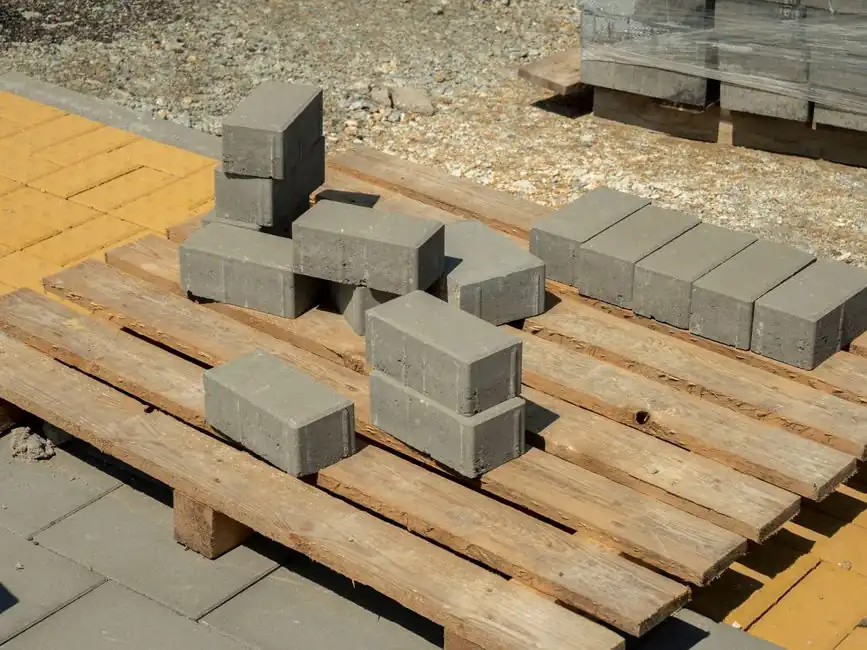
A 5,000 lb class manual pallet jack typically carries two small load wheels under the fork tips and two larger steer wheels at the tiller, and choosing between polyurethane and nylon for those four contact patches is the single largest determinant of floor noise, floor marking, rolling effort, and wheel life on that truck [S1][S4].
Polyurethane is a cast elastomer in the 75–95 Shore A range for most pallet jack treads, while the competing option is solid cast nylon 6 or nylon 6/6, typically running 80–85 Shore D, which is roughly 30 hardness points harder on the same scale [S2][S3]. That hardness gap, not the colour or the price, drives almost every operational difference in service.
Decision matrix: floor condition, load, noise, chemistry
Polyurethane tread scores higher on floor protection (non-marking on sealed concrete, epoxy, tile, and VCT) and on noise, with multiple dealer sources describing it as markedly quieter than nylon in retail and light-industrial aisles [S2][S4][S5][S6]. Nylon scores higher on load capacity and impact survival: it tolerates cold-store floors, debris-strewn dock plates, and outdoor pavers that would chunk a polyurethane tread, and it resists water, most hydraulic fluids, and many solvents that swell or degrade polyurethane [S2][S3][S4][S7][S8].
Across nine published comparisons, the ranking is consistent: polyurethane = smoother, quieter, floor-safe, slightly lower load rating; nylon = harder, louder, more chemically resistant, longer service life on rough ground [S1][S2][S3][S4][S5][S6][S7][S8][S9]. One manufacturer source quantifies the polyurethane weakness bluntly, noting that polyurethane wheels are "easily damaged when they run over debris and small items" and are not corrosion resistant, while nylon is rated excellent for both abrasion and chemical exposure [S2][S9].
Where each material is the right call
Specify polyurethane when the operating envelope is a clean, smooth, indoor floor and the operator or customer will notice noise or scuffs: retail back rooms, grocery aisles, hospitals, finished-goods warehouses on epoxy, and pharma or electronics assembly [S1][S4][S5][S6]. A September 2026 product comparison likewise positions polyurethane wheels as the choice when "quiet and protect epoxy floors" is the priority [S7].
Specify nylon when the truck will see cold stores (nylon retains stiffness and impact resistance below 0 °C where polyurethane becomes glassy and chips), outdoor or semi-trailer docks, plants with metal shavings or pallet debris on the floor, or chemical exposure to oils, fuels, and many solvents [S2][S3][S4][S8][S9]. For mixed fleets running both retail and yard, several dealers recommend keeping two trucks: a polyurethane-wheel unit for the customer-facing area, a nylon-wheel unit for the dock and yard [S4].
Load, rolling effort, and wear data you can plan around
Nylon's higher hardness translates into roughly 10–20% lower rolling resistance on smooth, hard floors because the tread deforms less, so under the same 5,000 lb load a nylon-wheeled jack is normally easier to pull than a polyurethane-wheeled one of the same build [S2][S3]. That advantage reverses on cracked, debris-strewn, or wet concrete, where polyurethane's higher friction and damping keep the load under control and the operator from having to fight a bouncing truck [S1][S2].
Wheel life is environment-bound rather than material-bound. On a clean epoxy floor a polyurethane load wheel commonly reaches 12–24 months of single-shift service, while on a rough dock with regular debris impact the same wheel can fail in weeks from chunking and flat-spotting; a nylon wheel on that dock will typically outlast polyurethane by 2–4x, but the same nylon wheel on a polished retail floor will leave scuffs and run louder without giving any extra hours of life [S4][S5][S6][S9]. Urethane pricing runs higher than nylon up front, but total cost of ownership usually tracks the floor condition, not the unit price, because the replacement labour and downtime dominate [S2][S7].
What the comparison tables actually say
Side-by-side summaries published by dealers since 2021 line up cleanly: durability is rated "high" for both, nylon is "excellent" on chemical resistance versus "moderate" for polyurethane, noise and vibration are "less" with polyurethane and "more" with nylon, traction is "excellent" for polyurethane and "moderate" for nylon on smooth floors, and floor protection is "excellent" for polyurethane versus "average" for nylon, with nylon priced lower up front and polyurethane higher [S2][S4]. Read together, the tables describe a 2-axis problem: smooth/customer-facing floors favour polyurethane, rough/industrial floors favour nylon, and there is no single winner across both axes [S1][S2][S3][S4][S5][S6].
For mixed-duty fleets, a practical rule from the field is to standardise polyurethane on steer wheels (where noise and floor marking concentrate) and keep nylon as an option on load wheels (where impact and debris concentrate) only when the truck lives on a dock; a one-material truck matched to the dominant floor type is simpler and cheaper than mixing per axle [S4][S7]. For deeper cost modelling of the polyurethane supply chain behind those wheels, a 2026 capex breakdown of where the money actually goes in elastomer plants is worth a read.
Limits, failure modes, and what to check before you swap
Polyurethane failures are dominated by mechanical damage (chunking from debris, flat-spotting from static loads in storage, hydrolysis in warm humid wash-down areas) and chemical attack from solvents, concentrated acids, and some hydraulic fluids; the wheels rarely wear out, they are destroyed [S3][S7][S9]. Nylon failures are dominated by floor marking, operator complaints about noise and ride harshness, and brittle fracture under sharp impact at sub-zero temperatures, and the wheels are usually replaced for reasons other than wear [S2][S4][S8].
Before changing a fleet over, check three things: confirm the hub bore, hub length, and bearing size match between polyurethane and nylon offerings for your jack model (a 2-inch poly wheel is not a drop-in for a 2-inch nylon wheel if the hub length or bore differs); confirm the rated load per wheel is at least one-quarter of the truck capacity so a 5,500 lb jack is covered by four wheels rated for 1,375 lb each; and confirm the floor finish warranty, because some sealed-concrete and epoxy specs explicitly exclude hard polyamide or metal wheels [S3][S4][S5]. If your application is sizing forks rather than wheels, the companion piece on manual pallet jack fork length vs low-profile forks covers the matching decision on the other end of the truck.
Trackable signals for the next decision cycle: whether your dealer or OEM has shifted the standard steer-wheel compound from polyurethane to a thermoplastic polyurethane (TPU) blend (quieter, longer-lasting, higher cost), and whether cold-store operators in your region are specifying glass-filled nylon over standard cast nylon to cut brittle-fracture events below -20 °C [S3][S7][S9].