
A handheld marble cutter removes stone through abrasive grinding, not sawing: a universal or brush motor spins a diamond-segmented circular blade at no-load speeds of 12,000 RPM or above, and each exposed diamond crystal on the rim micro-fractures the workpiece on contact [S2].
Typical handheld ratings cluster around a 110-125 mm blade diameter, 1,200-1,800 W input power, and 2.5-3.5 kg total mass, with a mains supply of 220-240 V at 50-60 Hz; a representative 1350 W, 12500 r/min, 110 mm model is documented by a major power-tools OEM [S2][S4].
Core components: motor, spindle, baseplate, diamond blade
Five parts define every handheld marble cutter: a motor housing, a spindle-mounted cutting blade, a top handle, a metal or polymer baseplate, and (on better models) a water feed or dust port [S2]. The baseplate acts as both a depth-of-cut reference and a stable skid that holds the blade perpendicular to the workpiece, while the handle absorbs torque reaction so the operator can keep the cut straight [S2].
The blade is a steel core with a sintered diamond rim; the diamond grit size and bond hardness are matched to the target material (hard bond for soft stone, soft bond for hard granite) to keep the segments self-sharpening rather than glazing over [S3]. Spindle bearings are grease-packed ball bearings sized for sustained 10,000+ RPM radial load, which is the real wear item on a contractor-grade tool [S2].
Working principle step-by-step, from switch-off to chip
Cutting begins with preparation: the operator selects a blade whose diameter and bore match the arbor, fits it, and sets depth-of-cut against the baseplate so no more than the diamond segment is exposed [S3]. The motor is then started; the blade must reach full no-load speed before the rim touches the stone, because feeding into the cut under speed starves the diamonds and burns the bond [S2].
Once the rim engages, three things happen at once: (1) the leading diamonds impact the stone and microfracture it; (2) the steel-bond matrix erodes just fast enough to expose a fresh layer of grit; (3) water or air flushes the swarf out of the kerf so the segments do not ride on a pad of debris [S3]. On a 110 mm blade this leaves a kerf roughly 2.0-2.5 mm wide, and the stone is removed as fine chips rather than powder, which is why a finished cut is clean and not melted [S1][S3].
Wet cutting vs dry cutting: heat, dust, and bond life
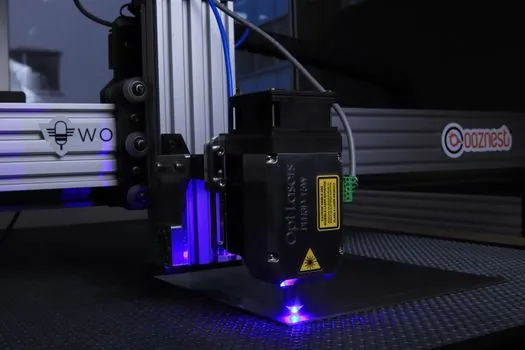
Dry cutting trades blade life for mobility, since no pump or reservoir is needed, and is reserved for short intermittent cuts where the blade is allowed to air-cool between passes [S2].
Cutting criteria differ sharply between the two modes: a plasma cutter or oxy-fuel cutter melts metal, but a marble cutter abrades stone, so heat management is fundamentally a blade-life problem, not a cut-quality problem. Hard materials such as granite and porcelain demand continuous wet feed, while soft marble can be scored dry provided feed pressure is kept low; pushing too hard in dry mode is the single most common cause of segment loss and bond glazing [S1][S3].
Selection criteria: power, speed, blade, weight
Four numbers drive the buying decision. Motor input power, normally 1,200-1,800 W for handheld units, sets the upper limit on feed rate. No-load speed should be at least 12,000 RPM because peripheral blade speed, not torque, is what actually cuts stone [S2]. Blade diameter (commonly 110, 125 or 150 mm) sets maximum depth of cut at roughly one-third of the diameter once the baseplate geometry is accounted for, and the bore must match the spindle exactly or the blade will not run true [S2][S4].
Weight is the ergonomic constraint: 2.5-3.5 kg is the industry-cited sweet spot for a handheld tool, since anything above 4 kg quickly produces operator fatigue on vertical cuts [S2]. A useful comparison snapshot for an engineer sizing a tool:
110 mm / 1350 W / 12500 RPM handheld: portable, shallow cut, best for tiles and trim. 125 mm / 1400-1600 W / 12000 RPM: balanced all-rounder for marble and porcelain. 150 mm / 1700-1800 W / 10000-11000 RPM: deeper cut for slabs, but heavier and harder to control overhead. 180 mm+ walk-behind or rail saw: workshop-only, used where handheld ergonomics no longer apply [S2][S4].
Who a handheld marble cutter is for, and who should spec something else
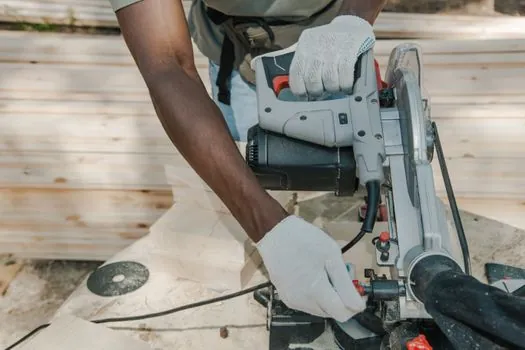
Handheld marble cutters fit tile setters, countertop fabricators doing on-site trim, masons cutting chases in brick or block, and DIY users scoring porcelain pavers [S4]. They do not fit high-volume slab production, where a bridge or gantry saw with CNC control holds tolerance a handheld cannot, nor do they fit reinforced concrete demolition, where a rebar cutter or concrete groove cutter is the correct tool class [S3].
For comparison with related cutting tools, a marble cutter sits at the abrasive-grinding end of the family, while a plasma cutter handles conductive metal via a constricted arc, and a concrete groove cutter shares the diamond-blade concept but adds a much larger frame for wall or floor chases. Picking the wrong family is the most expensive mistake a buyer can make, because the consumables, dust extraction, and operator PPE do not transfer between them [S2][S3].
Operating limits, failure modes, and safety practice
Three failure modes dominate in service. Glazing happens when the blade runs hot, the metal bond smears over the diamonds, and cutting rate collapses; the cure is a dress cut on an abrasive block, not more feed force [S2]. Segment loss happens when dry cutting is pushed too hard, when a hidden nail or aggregate strikes the rim, or when the blade is run below its rated speed; once a segment is lost the blade is scrap, because an unbalanced rim will shatter the steel core [S3].
Third, dust exposure: crystalline silica is a regulated respiratory hazard, so wet cutting is preferred indoors, and Class M dust extraction matched to the cutter's port is mandatory for dry cutting on most contractor sites [S2]. PPE baseline is a full-face shield, FFP2 or better respirator, hearing protection above 85 dB(A), and gloves that do not snag in the spinning guard, all of which are standard on professional models [S4].
Standards, sourcing, and trackable signals

Handheld marble cutters in the EU and UK carry a CE mark under the Machinery Directive, with a separate EMC and low-voltage declaration for the motor circuit; the diamond blade itself is normally EN 13236, which covers bonded abrasive products for machining stone and concrete. Sourcing teams should verify the blade certificate, not just the tool, because the blade determines both cut quality and operator safety [S2][S3].
Trackable signals to watch: rising input-power ratings in the 1,500-1,800 W band as brushless motors replace universal motors, broader availability of 125 mm blades with thin-kerf turbo rims for porcelain, and tighter integration of dust ports to the new Class M extraction standard [S2][S4]. A useful cross-reference for buyers comparing consumables across cutting families is this circular saw spare parts sourcing guide, which covers the same blade-diameter and bore logic that marble cutter procurement follows.