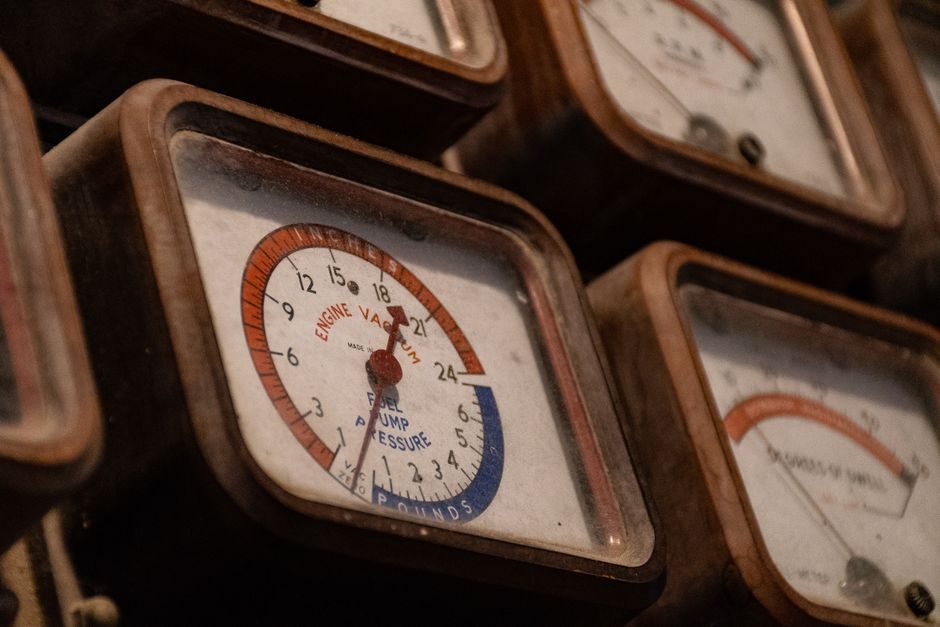
ABB/K-TEK's KM26 magnetic level gauge — flagship since 1975 — has logged over 350,000 installations globally in oil & gas, refinery, and chemical service [S1][S3].
Where the magnetic float cannot be read (vacuum, fully insulated vessels, low-DK hydrocarbons), guided-wave radar level meters such as the SUP-RD702 series step in with microwave time-domain reflectometry along a rod or cable probe [S4].
Two Different Physical Principles, Not Two Variants of the Same Sensor
An MLG is a mechanical coupled device: a float carrying permanent magnets rides on the process liquid outside a pressure boundary, and a visual indicator strip flips color as magnets pass — no electronics inside the wetted chamber in most designs [S1][S3]. A GWR launches a low-energy microwave pulse (typically 1 GHz or 6–26 GHz variants) down a coaxial rod or flexible cable; the pulse reflects at every dielectric discontinuity (air→liquid, liquid→liquid) and the run-time yields distance [S4][S6]. The float gives a flag-coupled, human-readable total level and clear liquid/liquid interface; the GWR resolves interface level only when the upper and lower fluids have a meaningful permittivity gap [S6].
Decision Criteria: Where MLG Wins, Where GWR Wins
MLG is specified when the operator needs a local, power-free, fail-safe visual readout that survives loss of loop power or DCS outage — typical fit is atmospheric refinery drums, boiler drums, and chemical storage tanks where the float and chamber are built to ASME B31.3 / PED pressure classes and the magnet track can carry a 4–20 mA or HART-output transmitter bolted to the side [S1][S3]. GWR is specified when the measurement point is inaccessible (inside a buried sphere, under foam, in a high-pressure separator) or when the fluid is a low-DK hydrocarbon, LPG, LNG, or a boiling hydrocarbon where a float would be gas-locked or vapor-locked [S4][S6]. For interface detection specifically, GWR reliably resolves an oil-on-water or solvent-on-aqueous split only when the upper fluid's dielectric constant is low and the lower fluid's is high (commonly εr > 10 differential) [S6].
Cost behavior differs sharply: a KM26-style chamber plus side-mounted transmitter lands in the mid-thousands of USD per measurement point, with a multi-week build cycle driven by the chamber length and flange class [S1]. A GWR probe with electronic head and standard flanged connection can be specified and shipped in days for an off-the-shelf run length up to 6 m on a cable probe, with the head electronics itself in the low four figures [S4].
Direct Comparison on Four Engineering Criteria

On the four criteria that drive specifier choice — local visual indication, interface resolution, vapor/foam tolerance, and installed cost — the two technologies split cleanly. MLG delivers permanent local indication and unlimited power-independent read-out, but it requires a welded chamber and cannot see through foam or past dense vapor [S1][S3]. GWR ignores foam, light vapor, and most turbulence, resolves interface under favorable dielectric conditions, and installs through a single 1–2" process connection on an existing vessel — but it has no primary local readout beyond the head display and is sensitive to heavy buildup on the probe [S4][S6]. When the spec mandates a powered interface signal plus a non-invasive installation, a radar level meter (free-space FMCW) is the third option, but it loses the GWR's ability to follow narrow stilling wells and bypass chambers [S6].
Who Should Specify MLG, Who Should Specify GWR
Specify MLG when the user is a process operator or panel-board watch engineer who needs the level to be readable with the power off, the controller dead, and the DCS rebooted — and when the vessel allows a side-mounted chamber [S1][S3]. Specify GWR when the user is a control engineer chasing a 4–20 mA + HART level signal into a DCS/PLC, the vessel cannot be tapped with a chamber, the fluid is low-DK or foaming, and the only available tap is on top of the vessel [S4][S6]. For interface service on a propane/butane sphere, GWR is essentially the only credible non-invasive option. For a refinery hot separator with a sight-glass port and a walk-by operator, MLG plus a side-mounted transmitter is still the cheapest and most reliable answer after 50 years of field history [S1][S3].
Failure Modes That End a Spec in Real Plants
MLG failure modes are mechanical: float collapse under high-pressure gas-locked service, magnet-track desensitization above roughly 400 °C chamber skin temperature, and chamber corrosion on sour-service units where NACE MR0175 material traceability is required [S1]. GWR failure modes are electrical and process-coupled: heavy hydrocarbon or calcium-coating buildup on the probe shifts the apparent dielectric, low-DK fluids below εr ≈ 1.4 return too little reflected energy for reliable end-of-probe detection, and bridging between the probe and a metal stilling well short-circuits the guided wave [S4][S6]. Operators have learned to specify a GWR probe with an integrated purge port and a stilling-well spacer on slurry duty to keep the probe mechanically centered [S6].
Standards, Sources, and Trackable Signals
Magnetic level gauges and guided-wave radar level meters sit under the same general instrumentation umbrella (IEC 60079-x for hazardous-area use, ATEX 2014/34/EU for European explosive-atmosphere equipment) but the two technologies are governed by different installation practices — MLG by pressure-vessel and welding codes that apply to the chamber, GWR by radar-installation guidelines from IEC 62758 and the OEM manuals [S1][S3][S4]. Cross-check the chamber rating and the probe's hazardous-area approval against the same hazardous-area classification document for the vessel; mixing the two approvals on one tap will fail the inspection.
Two signals to watch through the rest of 2026: ABB's continued multi-decadal KM26 installed-base growth (now over 350,000 units, with a new 4–20 mA + HART-compatible side-mount transmitter) [S1][S3], and the steady migration of GWR toward IIoT-native heads that publish process data over Ethernet-APL or wireless HART in greenfield units — a trend the OEM documentation flags explicitly as a 2026 design consideration [S4][S6]. When the next revision of GWR firmware hits, double-check the dielectric-table default for low-DK LPG service before re-commissioning.